Sunday, December 7, 2025

WEEKEND WRAP: Gold:Silver Ratio at 72, Lowest in Four Years; FOMC Rate Cut Expectations Skew Yields; Stocks Playing Waiting Game; Gas Prices Lowest in Five Years

The main focus of the past week, and something that has captured the attention of not a small slice of the investing world, continued to be the silver gambit, as the shiny precious metal continued to make new all-time highs the week following the still mysterious CME global shutdown. There continue to be reverberations from that seminal event, which may, over time, be looked upon as a epochal turning point in global economics. While there are plenty of people who may casually disregard the event and take without any grains of salt the official story of a cooling systems failure, the lack of any official government investigation leads on to conclude that there is actually something to see there, but the insiders don't want you to know what it is.

Stocks languished as bonds flourished, the rate cut odds providing ample rationale to flee from risk. Despite the usual suppression operations, gold and silver exhibited more than usual volatility. Pressure to the upside in prices is obvious and ominous at the same time.

The week ahead will be mostly about the Fed and the rate cut on Wednesday. In particular, it can be safely assumed that markets were playing the waiting game the past week, anticipating the all-powerful wizard of OZ FOMC emitting a bolt of lightning to shock and awe all participants.

Stocks

Stocks wasted everybody's time, with the operripe NASDAQ leading the way with a gain of 0.91%. The other indices were up much less than that, with the NYSE Composite actually registering a loss on the week. Equity investors are desperate for a Santa Claus rally, which could come in the form of a 0.25% rate cut at the FOMC meeting this coming week, on Tuesday and Wednesday, December 9 and 10, the latter date saved for the 2:00 pm ET official rate policy announcement.

While the expected drop in the federal funds rate from 4.00-4.25% to 3.75-4.00% may be good for stocks, it's probably going to be better for gold, silver, and possibly bitcoin, though the crypto king has been in a prolonged slump since early October and may be unable to convince enough suckers of its fabulous, long-term potential as a monetary replacement for the U.S. dollar (dreaming).

The stock market remains very close to all-time highs, and one wonders how long investors will hold onto the idea of seven stocks holding up the entire market structure on the promises of an AI revolution. The narrative has grown thin as the big players - Amazon, Google, Apple, Meta, Nvidia, etc. - are throwing hundreds of billions of dollars to build out data centers and power stations without much in the way of positive return being demonstrated.

AI, while it is useful in many functions, is not in itself a revolutionary development. It is something akin to a much faster search engine, a super-quick graphic card, and a relatively erudite wordsmith. It's main attraction is its ability to parse data at lightning speeds, which requires intense amounts of computing power. Applications for business and industry are paramount, but the promulgation of smaller, well-defined small language models (SMEs) may prove eventually to be cheaper and of more efficient use than the race toward large language models (LLMs) sought by the mega-tech companies.

As with every incident of technological advancement, there exists small start-ups and mid-cap companies whose use and advancement of the technology may produce returns that dwarf those of their gigantic rivals. Identifying those companies poised to benefit from further advancement in AI (which should be eventually deflationary when brought to scale) would be a worthwhile undertaking for the keenest of stock pickers.

Since Money Daily is not in the business of giving investment advice, we'll leave it at that, offering direction instead.

As the year of 2025 draws to a conclusion, stocks appear to have locked in rather solid gains. With just 17 trading days left, the Dow is up 12.73% year-to-date, the S&P up 16.81%, and the NASDAQ up 22.10%.

The NYSE Composite is up 14.21% on the year, and the Dow Jones Transportation Average lags, at +8.10%. Without sufficient catalysts to move stocks much higher, there's a good possibility for pullback on profit taking. There remains more than ample rationale to exit with profits before the calendar turns, with tax implications of this year and fourth quarter earnings results ahead in the new year.

While the top may already be in for this leg of the rally, nobody's yet to ring a bell, so, as anyone with two eyes is aware, this bubble may not be anywhere near bursting and a ride higher through the holiday season remains the general sentiment, and deservedly so, as the stock market usually performs rather well in December.

Individuals and institutions are likely to make their own choices based upon their investment regimens, which obviously have wide variety. Up, down, or mixed, seems to be the state of play.

Treasury Yield Curve Rates

Date 1 Mo 1.5 mo 2 Mo 3 Mo 4 Mo 6 Mo 1 Yr
10/31/2025 4.06 4.02 4.04 3.89 3.87 3.79 3.70
11/07/2025 4.01 3.96 3.98 3.92 3.83 3.76 3.63
11/14/2025 4.04 4.02 4.01 3.95 3.88 3.80 3.70
11/21/2025 4.03 4.01 4.00 3.90 3.84 3.75 3.62
11/28/2025 4.05 3.97 3.99 3.88 3.86 3.74 3.61
12/05/2025 3.82 3.78 3.77 3.71 3.73 3.68 3.61

Date 2 Yr 3 Yr 5 Yr 7 Yr 10 Yr 20 Yr 30 Yr
10/31/2025 3.60 3.60 3.71 3.89 4.11 4.65 4.67
11/07/2025 3.55 3.57 3.67 3.87 4.11 4.68 4.70
11/14/2025 3.62 3.61 3.74 3.92 4.14 4.73 4.74
11/21/2025 3.51 3.50 3.62 3.82 4.06 4.67 4.71
11/28/2025 3.47 3.49 3.59 3.78 4.02 4.62 4.67
12/05/2025 3.56 3.59 3.72 3.90 4.14 4.75 4.79

Fed speakers are in "quiet mode" prior to this week's FOMC meeting (Tuesday-Wednesday) as the 25 basis point cut seems virtually assured, especially given recent employment data. In the absence of the usual Non-farm Payroll data from the BLS, November's ADP report of a 45,000 jobs loss for the month sufficed to move the needle sufficiently in the direction of easier money.

Bond vigilantes weren't exactly sold on the idea, sending longer maturities higher over the week while the short end of the curve was brought lower. Yields on one-month bills declined a solid 23 basis points with the remainder giving up less until evening out at the one-year level, rising on maturities beyond that. The 30-year yield was the highest in three months (4.86% on September 4). While no cause for immediate alarm, the rise on longer-dated maturities signals that the general market still considers inflation an issue and the general tenor of U.S. fiscal policy for too loosey-goosey, for lack of a better term.

Spreads blew out, with the full spectrum (30 days - 30 years) reaching an unprecedented extreme of +97 as the polar fixtures moved in opposite directions. 2s-10s were better behaved, reaching 58, a three-month high, indicative of the many stresses in the funding mechanisms for U.S. fiscal profligacy.

From a near-term perspective, the sudden jerking of the entire curve, lower on one end, higher on the other, may seem troubling, but overall, a steepening should prove beneficial to the government as it attempts to reign in its extravagance, at least at the margins. Not to be concerned, congress will almost certainly find ways to overspend borrowed money until, well, something breaks, ostensibly, U.S. taxpayers.

Spreads:

2s-10s
2025
1/3: +32
1/10: +37
1/17: +34
1/24: +36
1/31: +36
2/7: +20
2/14: +21
2/21: +23
2/28: +25
3/7: +33
3/14: +29
3/21: +31
3/28: +38
4/4: +33
4/11: +52
4/17: +53
4/25: +55
5/2: +50
5/9: +49
5/16: +45
5/23: +51
5/30: +52
6/6: +48
6/13: +45
6/20: +48
6/27: +56
7/3: +47
7/11: +53
7/18: +56
7/25: +49
8/1: +54
8/8: +51
8/15: +58
8/22: +58
8/29: +64
9/5: +59
9/12: +50
9/19: +57
9/26: +57
10/3: +45
10/10: +53
10/17: +56
10/24: +54
10/31: +51
11/7: +56
11/14: +52
11/21: +55
11/28: +55
12/5: +58

Full Spectrum (30-days - 30-years)
2025
1/3: +38
1/10: +54
1/17: +41
1/24: +40
1/31: +36
2/7: +32
2/14: +32
2/21: +31
2/28: +13
3/7: +24
3/14: +25
3/21: +23
3/28: +26
4/4: +5
4/11: +38
4/17: +44
4/25: +40
5/2: +41
5/9: +46
5/16: +52
5/23: +68
5/30: +59
6/6: +69
6/13: +67
6/20: +69
6/27: +66
7/3: +51
7/11: +59
7/18: +65
7/25: +55
8/1: +32
8/8: +37
8/15: +44
8/22: +41
8/29: +51
9/5: +49
9/12: +40
9/19: +54
9/26: +55
10/3: +47
10/10: +43
10/17: +42
10/24: +48
10/31: +61
11/7: +69
11/14: +70
11/21: +68
11/28: +62
12/5: +97

Oil/Gas

WTI crude closed out the week at $60.14, departing from a two-week skid into the $50s, based primarily on what speculators must have considered to be oversold conditions, given that the latest round of sanctions propose to bring the evil Russian empire of crude oil to its knees and President Trump's 28, or 24, or 18-point peace plan were a sure step in the right direction towards an end of hostilities in Ukraine. What the half-hearted proposal did was provide cover for the failures of U.S. foreign policy, another short-term victory for the war promoters of Europe and the deep state in America, and more time for Russia's military to advance along the battle lines.

Such is the kind of lunacy effective in energy markets and the idle minds on Capitol Hill and in the White House. 18 rounds of sanctions designed to damage Russia haven't worked, but the 19th surely will. At this juncture, Senator Graham's proposal for even more extreme sanctions on Russia and its trading partners appear to have broad support, since everything up to this point hasn't worked. Indeed, THIS TIME will be different. Promise!

The U.S. national average for gas at the pump fell to $2.92, the lowest price in roughly five years and six cents lower than the prior week, according to Gasbuddy.com. Gas prices should continue to decline over the near term and through winter which is nothing but good news for stretched consumers and businesses.

California remains the highest in the lower 48 states, at $4.45 per gallon, down 10 cent on the week and 21 cents over the past three weeks, followed by Washington ($4.17), the two constituting the membership of the lonely $4+ club. Oregon ($3.69), was down six cents. The lowest prices remain in the Southeast, with Oklahoma checking in near the lowest price in over a year, $2.30, another radical drop of 15 cents just this week. Colorado ($2.39) and Texas ($2.42) were next. Arkansas ($2.46) and Mississippi ($2.48) and Louisiana ($2.49) follow. The remaining Southeast states are all below $2.76 with the exception of Florida ($3.91) down 20 cents in two weeks time.

In the Northeast, prices remain elevated, though at the early stages of what appears to be a general decline. Delaware ($2.89) was the lowest in the region, joined by New Hampshire, New Jersey, Rhode Island, and Maryland under $3.00, with Pennsylvania ($3.17) steady as the highest. Vermont ($3.12) and New York ($3.09) following lower.

In the midwest region, where the price relief has been significant, Illinois ($3.04) was the only state above $3.00. At the low end were Colorado ($2.39) and Iowa ($2.56).

Sub-$3.00 gas was reported in fully 34 states, a gain of three from last week and eight over the past two weeks.

Bitcoin

This week: $90,860.37
Last week: $91,709.19
2 weeks ago: $87,373.34
6 months ago: $105,525.30
One year ago: $99,819.01
Five years ago: $18,810.76

Bitcoin has recovered from a low of around $81,000 on November 22. It remains 27% or lower beneath its all-time high of October 7 ($124.310.60). A purchase of bitcoin five years ago still yields a five-bagger. It was nearly a seven-bagger two months ago. It doesn't take much in the way of fundamental analysis to conclude that bitcoin's current path is reminiscent of that of the period from mid-November, 2021 to the end of January, 2022, when it lost nearly $30,000, being cut almost in half, on its way from the high above $64,000 to a low in the $16,000 range, a roughly 75% decline.

The current trajectory puts bitcoin at $30,000 within a year's time, not the $200,000 or $1 million suggested by the likes of Anthony Scaramucci or Michael Saylor, whose business, Strategy (MSTR), will be pretty much bankrupted with such a decline. Charts are charts and cycles are cycles. Bitcoin cheerleaders haven't had much in the way of good things to say about crypto the past few months except that it's cheap, which is like saying the Colorado Rockies will probably win more games next season (maybe).

Precious Metals

Gold:Silver Ratio: 72.01; last week: 74.80

Futures, per COMEX continuous contracts:

Gold price 11/7: $4,007.80
Gold price 11/14: $4,084.40
Gold price 11/21: $4,099.20
Gold price 11/28: $4,256.40
Gold price 12/5: $4,227.70

Silver price 11/7: $48.22
Silver price 11/14: $50.40
Silver price 11/21: $50.33
Silver price 11/28: $57.08
Silver price 12/5: $58.80

SPOT:
(stockcharts.com)
Gold 11/7: $3999.89
Gold 11/14: $4,080.00
Gold 11/21: $4,063.98
Gold 11/28: $4216.71
Gold 12/5: $4,196.63

Silver 11/7: $48.33
Silver 11/14: $50.50
Silver 11/21: $49.97
Silver 11/28: $56.37
Silver 12/5: $58.28

Friday's closing futures price for gold on the COMEX is kind of a sick joke, considering that gold futures hit a high of $4,292.30 on Monday, December 1, and $4,279.50 on Friday, December 5. The gold price suppressors remain fully in control in terms of the gold market, with central banks worldwide more than willing to accede to their pricing scheme as they continue to accumulate the Tier 1 asset of choice.

What is not so funny is the loss of control of silver futures, that metric being led by physical spot pricing in the real world. With the March contract as the front end, silver futures are back in contango, though the highest price on the futures chain of $60.69 one year out (December 2026) does not reflect very much of the spot market supply side reality. Industrial demand, increasing investment interest, and a severe supply shortage continue to pressure prices higher and the gold:silver ratio lower, to a level not seen since July, 2021, as the world was emerging from the brief and painful COVID experience.

The covid slump, which sent the GSR down to a low of 65.41 in February, 2021, was neither very deep nor lasting. Gold and silver prices quickly recovered, with gold the leading edge. This was nothing compared to the post-GFC level of 31.60 posted in February 2011, as silver skyrocketed ahead of all other assets out of the slump, reaching its highest prices since 1980.

From an historical perspective, the lowest levels of the gold:silver ratio were in 1968 and 1980, when this metric was measured in the teens. In between, through the 1970s, the GSR gyrated around the low to mid-30s. This period, post-Vietnam and also post-Bretton Woods, was a time of relative peace and prosperity for much of the world. Once the mechanisms were fully in place for price suppression of precious metals, the proponents of such found it easier to control the price of silver that that of gold, the former being a much smaller market. Of course, this period was subsequent to silver being demonetized in the United States (In 1965 silver coins were removed from circulation and in 1968 silver certificates were no longer redeemable for physical metal.) and antecedent to the infamous Hunt Brothers' escapades in the silver market in 1979 and 1980.

Conditions have changed dramatically since then. In the 50+ years since the 70s, the United States became the world's greatest debtor nation, arguably the world's foremost military aggressor and global hegemon, and today is experiencing a decline in financial and political dominance as the world becomes increasingly fractured and polarized. The main industrial use of silver was in film processing in the 70s and 80s. Today, it's solar energy, EV technology, and military manufacturing, much greater use.

What is also propelling the price of silver higher and the gold:silver ratio lower is the increased interest in silver as a monetary metal. It was 60 years ago that silver was used as a common currency, a medium of exchange, as money in not just the United States, but in many countries around the world. While silver is no longer accepted as currency or legal tender in most of the world, that is changing rapidly in major economies such as China, India, and even the United States.

The Sound Money Defense League and Money Metals produce the Sound Money Index which rates the individual states on various criteria in terms of the free use of gold and silver as money. On April 1, 2026, Indian citizens will have the ability to use silver coins and jewelry as collateral for loans, and China, which maintained a silver standard until 1935, has a long history with silver as money.

While silver minted as currency ended abruptly in the mid-20th century, the minting of silver coins for investment purposes has continued uninterrupted. From Canadian Maple Leafs, U.S. Silver Eagles, Australian Kangaroos, Cinese Pandas, and Mexican Libertads, the minting of silver coins of high (.999) purity has proceeded uninterrupted.

Those who believe that a return to a 10:1, 15:1 or 20:1 gold:silver ratio simply don't know their history. It has only been in the past 150 years (essentially since the "Crime of 1873") that silver has not held a tight peg to gold. Recent developments, such as India maximizing silver loans at a 10:1 ratio to gold (1 kilogram gold to 10 kilograms silver) and the Dubai Bank of Bullion specifying minimum purchases of 1 Oz of Gold, Platinum or Palladium and 10 Oz of Silver as minimum purchases, suggest a stealth reordering of the gold:silver ratio.

While the gold:silver ratio appears to be beginning a trend lower, getting back to historical standards of 10:1 ro 20:1 would likely take decades, or, it could happen in the blink of an eye, taking just one populous country, such as India or China, to formally declare a gold:silver ratio for a global reset to occur. The arbitrage possibilities would be so enormous that most, if not all, other countries would soon fall in line with the new standard. It is something that all siver and gold investors should carefully consider.

In the meantime, silver continues its recent acceleration over gold. Year-to-date, silver is up 101.95% to gold's rise of 60.66%. In just the past six months, silver is up a whopping 60% compared to gold's rather "pedestrian" 26%, and the meteoric rise of silver may be just beginning. The gold:silver ratio can drop rapidly. As it is, it has fallen from over 100 in May to its current level of 72. That's 30 points in just eight months. If the trend continues, imagine where it might be in five years and what the price of both gold and silver might be. Estimates range from the reasonable to the absurd, but the numbers bandied about recently focus around $10,000 for gold and $700 for silver, a GSR around 14. Over the near term, $5000 gold and $100 silver (50:1) does not seem far-fetched, even as early as the coming new year.

Here are the most recent prices for common one ounce gold and silver items sold on eBay (free shipping included, numismatics excluded):

Item/Price Low High Average Median
1 oz silver coin: 59.50 69.95 66.23 67.48
1 oz silver bar: 62.00 73.95 66.62 66.43
1 oz gold coin: 4,221.99 4,518.12 4,400.19 4,389.92
1 oz gold bar: 4,338.76 4,477.78 4,400.74 4,386.88

The Single Ounce Silver Market Price Benchmark (SOSMPB) delivered, for the second straight week, an impressive gain, to $66.69, up $3.75 cents from the November 30 price of $62.94 per troy ounce. The small-denomination, physical market continues to add high premia over spot and derivative market pricing.

WEEKEND WRAP

As legend goes, the eminent J.P. Morgan, when queried on whether he thought markets will go up or down, paused a moment and said, as sagaciously as possible, "markets will fluctuate." That, friends, is a truism that should always be top of mind when making any kind of investment decision.

At the Close, Friday, December 5, 2025:
Dow: 47,954.99, +104.05 (+0.22%)
NASDAQ: 23,578.13, +72.99 (+0.31%)
S&P 500: 6,870.40, +13.28 (+0.19%)
NYSE Composite: 21,810.07, -25.72 (-0.12%)

For the Week:
Dow: +238.57 (+0.50%)
NASDAQ: +212.44 (+0.91%)
S&P 500: +21.31 (+0.31%)
NYSE Composite: -14.60 (-0.07%)
Dow Transports: +597.31 (+3.60%)


Disclaimer: Information disseminated on this site should not be construed as investment advice. Downtown Magazine Inc., Money Daily and it's owners, affiliates and/or employees are not investment advisors and do not offer specific investment advice. All investments have risk. You should consult a professional investment advisor or stock broker or use your individual judgement when making investment decisions. By viewing this site, you hold harmless Downtown Magazine Inc., Money Daily, its owners, affiliates and employees against any and all liability. Copyright 2025, Downtown Magazine Inc., all rights reserved.

Saturday, December 6, 2025

Unraveling the $1.972 Billion Silver Trade That May or May Not Have Happened Amid the CME Shutdown; The Possibility of a Gold:Silver Ratio at 10:1

Editor's Note: While trying to reclaim a little bit of sanity as my post, "It's my Birthday, So you Better Read This" was maliciously shadow-banned by the usual platforms (probably just a little too honest), some details concerning the mysterious 10-hour CME shutdown Thanksgiving evening into Black Friday were emerging from a variety of sources. Nothing you read below has been verified, since the principal parties aren't about to spill the beans on what actually happened, but, speculation points toward a major event that has been tucked away for safe keeping by the financial deep state. - Fearless Rick

The 10-hour shutdown of the CME, the world's major derivatives platform, late on the night of Thanksgiving and extending into Black Friday morning in the U.S., continues to raise eyebrows, though it is almost universally accepted that the cause was not "cooling issues" as the official story wants the world to believe.

The most likely cause was a large purchase of physical silver, the buyer (or buyers) standing for delivery and the contract seller (ostensibly a short seller) failing to deliver

At about the 5:15 mark of the video below, Mario Innecco begins to talk about 34 million ounces of silver (6,800 contracts) being bought by supposed Mideast Sovereign Wealth Funds or cental banks. That's about $1,972 billion worth of silver that the customer was standing for delivery on and maybe did or did not receive, but that's just the tip of the silver iceberg that is threatening the Western economies and confidence in the institutions of the CME, COMEX, Globex, the LBMA, indeed, the pillars of derivative trading, the the main suppressors of gold and silver prices for the past 50 years.

Vince Lanci's analysis via the Wednesday, Decemebr 3, Arcadia Economics' Money Morning Report "SHOCKING SILVER NEWS: JP Morgan Transfers 13.4 Million Ounces To Eligible During CME Shutdown" provides further analysis and speculation to what happened on Thanksgiving evening and Black Friday morning at the CME. Lanci's reporting also verifies JP Morgan moving 13.4 million ounces from registered (available for delivery) to eligible (customer owned, not available for delivery).

Taking the gist of the two video postings together, a story begins to emerge. Of course, nothing is verified. It is still speculation, but, perhaps, just prior to the shutdown, the buyer of 6,800 silver contracts (5,000 ounces each) stood for delivery. Frantic, panicked, whoever wrote the contracts (could be one entity, or many) informed the CME that they didn't have the silver to satisfy delivery or didn't want to part with the metal.

It would appear that the writer of the contracts in question was most likely one bullion bank, possible the COMEX London vaults, a large broker-dealer or a combination of such. In an event that would shatter confidence - failing to deliver on nearly $2 billion in silver - CME officials decided to shut down the entire exchange, effectively covering the tracks of the silver trade (or non-trade).

During the shutdown, as Lanci assiduously points out, negotiations likely took place, an agreement was reached, and that would partially explain JP Morgan's action, essentially, covering part of the purchase by reclassifying 13.4 million ounces. For illustration purposes, suppose JP Morgan was made part of the deal, instructed to cover part of the purchase via accounting. In essence, the 13.4 million ounces that were available prior to the shutdown became the property of the buyer, for delivery at some agreed-upon date. (BOLO for planes laden with 1,000-ounce silver bars leaving New York and headed for Dubai)

Digging a little deeper, the lie of the "cooling issue" story and the truth about what really happened begins to crystallize. About a week before Thanksgiving, President Trump welcomed Saudi Prince, Mohammed bin Salman, to the White House for extensive meetings attempting to repair the badly frayed U.S.-Saudi relationship. Desperate to make amends, Trump, who, as everybody knows, is the most fabulous, greatest-ever deal-maker in the history of the known universe, gave bin Salman just about anything and everything he wanted, including the purchase of F-35 fighter jets wihtout the caveat of normalization of relations between the Kingdom of Saud and Israel.

Just before the Saudi visit, on or about November 11, the United States declared silver a critical mineral.

The Saudis, being not the least misinformed concerning geopolitics and money, might have decided that silver at $57 to $58 per ounce might offer an opportunity to trip up the United States and cripple the corrupt Western derivative markets, while at the same time grabbing hold of a valuable asset that is likely going to triple in value over the next 12-18 months.

After all, at the Bank of Bullion in Dubai, on their FAQs page, the answer to the question:

What is the minimum Quantity of gold and other precious metals I can buy from Bank of Bullion?
is
1 Oz of Gold, Platinum or Palladium. 10 Oz of Silver

For reference, one ounce of gold is roughly $4,250. 10 ounces of silver is only about $570.00. Why not 75, 80, or 100 ounces of silver, which would be roughly equivalent to the minimum capital limit on gold?

This aligns with India's recent directive to allow citizens and businesses to borrow against their gold and silver, their minimums being 1 Kilogram of gold or 10 Kilograms of silver.

The world order is being turned upside-down and it may take just one big trade to completely flip the scales.

Markets are open for Friday's trading.

Good luck.

At the Close, Thursday, November 4, 2025:
Dow: 47,850.94, -31.96 (-0.07%)
NASDAQ: 23,505.14, +51.04 (+0.22%)
S&P 500: 6,857.12, +7.40 (+0.11%)
NYSE Composite: 21,835.79, +30.39 (+0.14%)


Thursday, December 4, 2025

It's My Birthday, So You Better Read This

Hey, today's my birthday, so I might go off the rails a bit here.

One of the biggest problems in the world today is that of political and economic leadership failing to acknowledge their own failures.

Manifested in various schemes and sub-routines, like sending a real estate developer and your son-in-law to negotiate peace with Russia over Ukraine, or claiming covid vaccines are safe and effective while people collapse right after receiving the "jab", the willful blindness of people in leadership positions is stunning.

One activity that constantly comes into perspective is the decades-long suppression of gold and silver by minions in the COMEX-LBMA-ESF cartel. These delusional folks actually believe they are doing some good with their naked shorts, spoofing, and assorted market manipulations by sending the price of silver a buck or two lower, or holding the price of gold right at some pre-determined level, satisfying their need for control and influence.

All they're actually doing is delaying the inevitable collapse of fiat currencies and the return of honest money devoid of counter-party risk.

Europeans are particularly adept at self-deception and delusion. Many heads of state within the EU - at least the important ones, France and Germany - must have to wake up every morning and convince themselves that Russia is about to invade Europe and that Ukraine is effectively holding them back. Macron in France and Merz in Germany are primary exemplars of delusional behavior. The U.S. has developed its own brand of pseudo-realism, thanks in part to the fall of journalistic standards, large swaths of heavily-controlled and coerced populations, and just plain stupidity.

It began with Joe Biden and Nancy Pelosi, in a manner that was equally hilarious and disturbing at the same time. Biden's famous wide-eyes whispered threats and Pelosi's aimless ranting became standard fare to feed to the masses. Mostly, their incoherent ramblings were shucked off as just drivel, but they kept at it until it worked on the whole psyche of America. Russia was evil. Trump was a criminal. Climate change. The green new deal. Open borders. All good on the suface while America was rotting at its core.

Then along came Trump 2.0 who promised to release the Epstein files and bring the pedophiles and human traffickers to justice, to end the Ukraine conflict in 24 hours, to deport 20, no 40 million illegals, to bring down grocery prices, to stop the endless wars and declare peace, and, boldly Make America Great Again (MAGA). Now, after being duly elected and in office for almost a year, Mr. Trump, presumably the most braggadocios president ever to grace the Oval Office with his magnificent presence, has, in his mind, ended 8, 9, or 12 wars, raised "trillions" in tariffs, and made deals with every country on the planet, each one favorable to U.S. interests.

Meanwhile, right before the president's eyes, we're bombing fishing boats in the Caribbean, running what looks like a $2 trillion deficit for fiscal 2026, sending more money and arms to Ukraine, and the American dream has become unattainable to all but maybe the top 10% of earners in the United States, and even some of them are struggling to make ends meet.

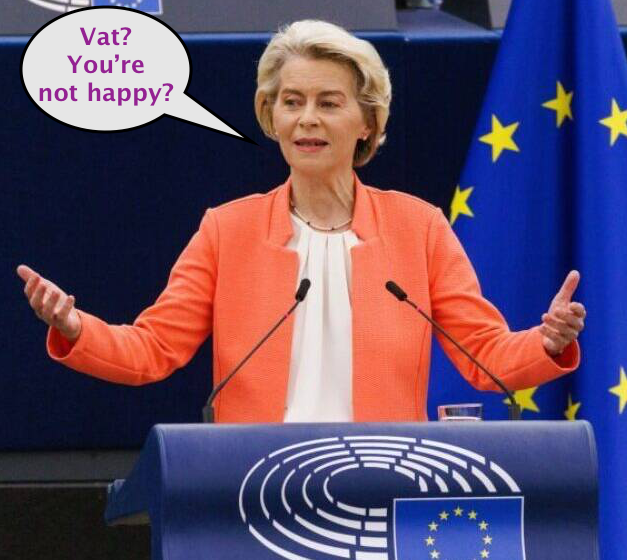
Trump has redefined the limits of self-delusion. He may be outdone only by the EU's Ursula von der Leyen, but probably not. Credit is due for the president shutting down the border crossings, fighting against all the LGBTQ+ ideology, and a good number of other efforts, but, walking back from DOGE was an epic fail. Ukraine is also a loser. The economy stinks for most people, but the president keeps telling us the stock market is at all-time highs, as if that makes the people who own stocks marginally or not at all happy.

Trump's tariffs are bringing in extra revenue, setting a record for October, at $31.4 billion. But, thanks to Trump and the congress, the Big Beautiful Bill passed back in July has so far produced a $284 billion deficit and that's when the government was supposedly shut down. And, that's just the first month of the fiscal year. Can't wait to see how this all goes once Trump has his own guy or gal in at the Fed and pushes him or her to cut the federal funds rate to two percent, or one, or lower. $7 bananas and $85,000 cars aren't exactly what one might classify as "great."

Tariff revenue barely makes a dent in the $7 trillion the government plans to spend. It might come close to paying some of the interest on the ever-expanding debt, but at what cost? A middle class that can't afford a mortgage, a new car or dinner at a restaurant? Foreign nations aren't buying U.S. debt anymore, or, at least not as much as they used to. Seriously, the U.S. government issues far too much debt and then they overspend anyway, so what's the point? Maybe Trump can boast about how much money the U.S. tariffs are brining in, but how does that help regular folks? More SNAP, Section 8 housing, and $2,000 stimulus checks? No thank you.

Just about everybody in Washington is either delusional, crooked, or both.

Trump's Wall Street buddies are happy.

I suppose stockholders are happy.

But, those people at the supermarkets, they don't look very happy.

So, we're still awaiting Trump's promised "golden age" while many of the MAGA supporters have left the club, this writer included. It appears that in Trump's America, Wall Street does fine, billionaires buy more yatchs and condos, but for the regular Joes and Janes, meh. Just, meh. We just don't get it.

I may have strayed a bit from what I originally intended to say, but my bottom line is this: when you get upset that the crooks in the COMEX sent the price of silver down another buck-and-a-half overnight (when you know it should be going up), or when you gasp at two strip steaks for $34, or experience some other lunacy that is the product of the age of delusion, it's OK to blurt out, "God, I really hate these people!”

Really, it is. God may or may not be listening, but somebody within earshot might be, and you might hear, "Yeah, me too."

Happy Birthday to ME.

-- Fearless Rick

At The Close, Wednesday, December 3, 2025:
Dow: 47,882.90, +408.44 (+0.86%)
NASDAQ: 23,454.09, +40.42 (+0.17%)
S&P 500: 6,849.72, +20.35 (+0.30%)
NYSE Composite: 21,805.41, +154.92 (+0.72%)


Wednesday, December 3, 2025

U.S. - Russia Peace Talks Stalled; ADP Reports November Payrolls -45,000; Bitcoin Remains in Bear Market; Are Trump Accounts Any Good?

With the holiday season in full swing, Wall Street made up for lost ground on Tuesday, sending all the indices higher on promises for no peace and ill will toward other countries, which kind of goes against the biblical rendering, "peace on earth, good will toward men."

Most of the world is at Defcon 1 or 2 by now, getting ready for World War III, which Europe, the UK, and the United States appear to be intent on starting.

Meanwhile, Steve Witcoff and President Trump's son in-law, Jared Kushner, have traveled to Moscow, negotiating terms of their 18-28 point peace plan with Russian president Putin. Word has it that negotiations went deep into the evening, past midnight, and that the talks were "constructive", which is a media dog whistle for "we got nothing." This is the same messaging that was issued over the weekend from the meetings in Miami with officials from Ukraine. The whole "peace deal" is just plain bunk, made for media spin. The war in Ukraine will end when Russia completely wipes out the Ukraine's armed forces, which is happening on a continuous basis. Figure by June or sooner, Russia will own all of Ukraine east of the Dnieper River.

In the meantime, NATO and friends have been targeting oil tankers which are supposedly carrying Russian oil, a big no-no from an American perspective but also not something of which Mr. Putin is very fond. Russian pipelines and energy facilities have been under heavy assault the past few months. This is apparently how the West negotiates. With explosions and targeting Russia's energy infrastructure. That should work out just fine for the comedy team of Witkoff and Kushner.

Also, sooner or later, the U.S. is going to invade Venezuela, for their oil, not because they traffic drugs, as we've been told. These people are insane.

So, stocks should go up because, um, America, yeah!

Elsewhere, whether you believe last Friday's CME outage was real or a devious ploy to hide severe stress in the silver market, the usual suspects were back at work, sending the price of silver on the globex down from $59 to $57.53 in a matter of an hour right around midnight ET. Silver is gaining as the sun rises over Wall Street, trading just above $58.

Around the same time, gold received similar treatment. At around 7:30 am ET, gold was trading just above $4,200 per ounce.

The continuing suppression effort by the LBMA, CME, COMEX underlings, Exchange Stabilization Fund (ESF), and/or anybody else, has become something of a running joke to serious investors. Everybody knows what they're doing, and everybody also knows that the jig is just about up. The rising price of gold and silver at various rates of change in different countries is not that gold and silver are becoming more valuable, it's that the currencies used to purchase them are losing value. Yen, yuan, euros, dollars, pounds are basically becoming toilet paper.

Gold and silver endure. Get some soon, because today's prices - even at or near all-time highs - are going to look ridiculously cheap in the not-so-distant future as the entire facade of Western prosperity and productivity meets the reality of the emerging BRICS nations. Western economies are deeply in debt and unable to escape the clutches of inflation and boom-bust cycles. The stock market cannot go up indefinitely, though it appears that the money behind the gains of the last five years, at least, aren't yet satisfied.

There's money to be made in stocks. That's for certain. How much is a matter of investing acumen, timing, and capital willing to be employed. With the Fed all but certain to cut the federal funds target rate by 0.25% next Wednesday, stocks should see solid gains between now and then and probably beyond. There just isn't any kind of anchor in the system. Nothing seems to shake the confidence level of the confidence men or the back room antics of the string-pullers.

Nobody with a functioning brain dares short this market, so the upward slope is practically guaranteed. What might it take for the markets to correct? Who knows? Wall Street manages to spin every bit of news - good or bad - into a positive for stock ownership.

So, why worry?

Maybe because the narrative doesn't quite match reality. AI hasn't produced any significant scientific breakthroughs, any significant increase in knowledge or productivity, or any other tangible result beyond writing pretty good high school and college term papers and enhanced porn. Big tech companies are investing hundreds of billions of dollars on a technology that is unlikely to ever produce positive ROI.

Then, there's bitcoin and the crypto con. Since November 22, bitcoin has gained from a low of $84,000 to over $93,000 this morning. That's all well and good and the crypto bros are once again touting "new highs, soon, real soon," and other rubbish. Bitcoin and most of the other popular copies are still 25-30% down from recent all-time highs. For all intents and purposes, crypto remains in a bear market.

What's even more concerning about bitcoin and crypto in general is that it serves no useful purpose other than providing a means to soak up excess liquidity and fund illegal activities. It's not a store of value or a viable means of exchange. Bitcoin and all the other "coins" are just speculations. Eventually, like fiat currencies, they will be worth little if anything.

Not that it matters much, but, this morning, the November ADP employment report registered a loss of 32,000 jobs in the month, missing expectations of +40,000 by a mile and well below the +47,000 upwardly-revised from October.

According to Dr. Nela Richardson, Chief Economist, ADP:

Hiring has been choppy of late as employers weather cautious consumers and an uncertain macroeconomic environment. And while November's slowdown was broad-based, it was led by a pullback among small businesses.

Thank you, Captain Obvious.

Normally, the ADP report presages the BLS Non-farm Payroll report issued the first Friday of each month, but, according to the ever-efficient federal government bureaucrats, the November report has been delayed until December 16 and will include partial data from October. Well, isn't that special? After the FOMC meeting (December 9-10).

Moving on, Money Daily did a little investigating on Trump Accounts after Michael Dell and his wife pledged to put $250 into 25 million Trump Accounts, for a total contribution of $6.25 billion. Americans have about 3.6 million births a year, so over four years time, that amounts to 14.4 million. In order for the Dells to reach the $6.25 billion target, the US birth rate would have to pretty much double, and nearly every parent of a child born during the eligibility period would have to open a Trump Account.

As usual, the hype overshadows the reality.

Q: Should you open a Trump Account if you have a baby born on or after Jan. 1, 2025, through Dec. 31, 2028?

A: Not until you read the 44-page notice the IRS has prepared. Nobody can open a Trump account until sometime next year. Contributions to Trump Accounts cannot be made before July 4, 2026. The IRS is still in the process of creating Form 4547, which has to be filed when opening a Trump Account.

The federal government will supposedly make a contribution to eligible Trump Accounts in the amount of $1000. It's free money, but the beneficiary of the account - your kid - can't touch it until they're 18. The money has to go into a bank or other non-bank custodian trustee acount and be invested in either mutual funds or ETFs. The contribution limits are $5,000 a year. After the beneficiary turns 18, any distributions are taxed as ordinary income.

Here's a thought: How about, instead of dealing with the government, banks, taxes, and the stock market, you buy $1000 worth of gold, silver, baseball cards, and comic books, store them in a safe place (like an actual "safe") and don't tell anybody? Then, you can add to it whenever you please, spend it whenever you like, do whatever you want with it. If that sounds easier and more desirable, it's because it is.

Some people may have a problem with this latest vote-buying-stock-market-pumping scheme. The $1,000 that will be donated by the government to each account is taxpayer money, or, rather, about 60% taxpayer money and about 40% borrowed from the Federal Reserve. Did anybody ask American taxpayers if they wanted their money spent this way? No.

Beyond that, the money, including any contributions made by parents, grandparents, or anybody else, goes into the system, is tracked, then eventually taxed. As usual, the government has plenty of hooks into the whole thing and is tied to Wall Street investment banks who will be getting a nice boost from these accounts which can't be touched for 18 years. Talk about building a floor under the stock market!

Here's a prediction. No more than 5 million Trump Accounts will be created, and the money invested in them will vanish, just like in the famous South Park episode.

Stock futures are pointing to a positive open. Go get 'em.

At the Close, Tuesday, December 2, 2025:
Dow: 47,474.46, +185.13 (+0.39%)
NASDAQ: 23,413.67, +137.75 (+0.59%)
S&P 500: 6,829.37, +16.74 (+0.25%)
NYSE Composite: 21,650.48, -15.98 (-0.07%)


Tuesday, December 2, 2025

Stocks Look to Rebound After Poor Start to December; Silver Continues Gains on Pathway to Triple Digits

As stocks entered the home stretch, they began to fade with the finish line in sight... story to be continued.

There are just 20 trading days left in 2025, and all indications suggest that it will go down as a solid, though unspectacular, year for equities. The Dow is up 11%; S&P up 16% and the NASDAQ ahead by 20% as of Monday's close. Those are pretty good returns, if they hold, which is why many fund managers have already closed their books and will resume buying or switching out in January. Life is good spending December in the Bahamas or Caymans.

The Dow took the worst of Monday's selloff, losing nearly one percent. As usual, it could have been worse... or better. The major indices erased most of the steep, early losses by midday, but all faded into the close. This is the kind of volatility that can be expected in an uncertain environment. Thank the government for that, at least partially, by delaying the usual economic reports - NFP and GDP in particular - and blaming their own shutdown for the lack of data.

Silver, after Friday's big run, cooled off a bit on Monday, especially after Arcadia Economics' Chris Marcus posted a note about it hitting 59 (and keeping going) in the futures market. Silver lost a bit of its mojo, but that's probably to be expected from an asset that's up 99% year-to-date. Silver won't stop rising, though there may be a few pullbacks, stutters, and surprises on its way to triple digits, where it belongs. Considering that the price of an ounce of silver would be $128 if the gold:silver ratio were a realistic 25:1 and even higher by historical standards of anywhere from 8:1 to 16:1.

Silver will be triple digits within 24 months, possibly within six.

Meanwhile, be on the lookout for the Santa Claus Rally, which usually occurs in the week between Christmas and New Year. Considering current valuations and the levels of naked greed and avarice on Wall Street, it may kick off sooner. Then again, December remains a great time to lock in gains and impress your friends.

Keep your stop losses close.

At the Close, Monday, December 1, 2025:
Dow: 47,289.33, -427.09 (-0.90%)
NASDAQ: 23,275.92, -89.76 (-0.38%)
S&P 500: 6,812.63, -36.46 (-0.53%)
NYSE Composite: 21,666.47, -158.21 (-0.72%)