Sunday, June 29, 2025

WEEKEND WRAP: High on Hopium, Low on Intelligence; U.S. Stocks Rip to All-Time Highs on Iran Bombing; Oil Lower; Silver Finds Relief

The Shiller PE, the price earnings ratio based on average inflation-adjusted earnings from the previous 10 years, known as the Cyclically Adjusted PE Ratio (CAPE Ratio), Shiller PE Ratio, or PE 10, stands at 37.65 as of Friday's close, the third-highest reading ever for this gauge.

Questioning why stocks are so richly valued would go a long way toward rationalizing what is essentially an irrational market, based largely on fraud, government handouts, allowance of tech monopolies, hedge fund oligarchies, insider trading, complete lack of oversight, questionable statistics, corrupted data, unreliable media, and the idea that if something or somebody doesn't comply with the wishes of the hegemonic, fractional reserve, fiat currency counterfeiting regime, the U.S. military will simply blow them up.

The merry-go-round that is the U.S. economy is a marvel of ingenuity and process. Create money out of thin air, make congress borrow it, hand it off to banks, consumers, retirees, welfare recipients, and have them spend it on things produced by Fortune 500 companies, make fat profits, send stocks higher, line the pockets of politicians and billionaires and just keep it going. It's a nice gig.

The S&P, NASDAQ and NYSE Composite made all-time highs this week. The U.S. dollar was weaker. Get used to it.


Stocks

Bombing Iran was good for business. The major indices had one of their best weeks of the year. The S&P, NASDAQ and NYSE Composite all made new al-time highs, with everyone from the Wall Street Journal to CNBC proclaiming the rebound from Trump's "liberation day" tariffs to be extraordinary and magnificent.

That's all well and good, but the tariffs aren't even in place yet. Recall, if you will, that on April 9, Trump offered a 90-day limited hang-out on tariffs. That 90 days expires in two weeks. Prior to that, on Tuesday, July 1, all U.S. banks will treat gold as a Tier 1 asset on par with U.S. treasuries. There's been plenty of resistance to the change, but here it comes, right before the June non-farm payrolls on Thursday, just prior to the Independence Day three-day weekend, so, it better be a good one, or America's 249th birthday might not be such a grand old time.

From a Wall Street perspective, nothing could be better than a very weak jobs number, like 35,000 or less, because that would put pressure on the Fed to lower interest rates, which is what Wall Street wants most of all, and especially before Christmas. If there is anything even close to Christmas in July, a bad jobs report would fit the bill rather perfectly for Wall Street honchos. The ever-reliably-incorrect BLS is on it. Plenty to look forward to in the week ahead, and then, the first full week of July, come second quarter earnings, likely to be a mixed bag like the first quarter, full of beating expectations but falling short of prior year revenue and EPS. The combination of a possible rate cut and stocks beating lowered expectations is the perfect setup for a big, fat summer rally. Hot dogs and mustard all around!

Fed Chairman Powell addressed both houses of congress this past week. For all the words and questions and answers, he didn't say anything. It was another example of congress wasting tax dollars, and not in a good way.

May Existing Home Sales were pretty much a disaster, with prices hovering near record highs while sales were up 0.8% on a month-to-month basis, but that was an increase from the slowest April for existing home sales in 16 years. Last month was the slowest May for existing home sales since 2009. Existing home sales in May fell 0.7% compared to the same month last year. Median home prices are up 52% compared to May 2019, which has raised the cost of a typical mortgage from around $1,000 a month to beyond $2,000. No wonder home sales are below pre-covid levels.

The third (and final) estimate of first quarter GDP was released by the BEA on Thursday, showing the economy slowed by not 0.2% (first est.) or 0.3% (second est.), but 0.5%. Hmmm. Maybe by next year, they'll have figured out that the economy slowed by 1.0% or maybe 1.5%. Rinse, revise, repeat.

Nobody wanted to talk about the Fed's favorite inflation gauge deeking back up to 3.7%. We need rate cuts, dammit!


Treasury Yield Curve Rates

Date 1 Mo 1.5 mo 2 Mo 3 Mo 4 Mo 6 Mo 1 Yr
05/23/2025 4.36 4.34 4.35 4.36 4.43 4.35 4.15
05/30/2025 4.33 4.35 4.35 4.36 4.39 4.36 4.11
06/06/2025 4.28 4.31 4.35 4.43 4.38 4.31 4.14
06/13/2025 4.23 4.32 4.48 4.45 4.40 4.30 4.09
06/20/2025 4.20 4.38 4.55 4.39 4.40 4.29 4.07
06/27/2025 4.19 4.43 4.49 4.39 4.36 4.26 3.97

Date 2 Yr 3 Yr 5 Yr 7 Yr 10 Yr 20 Yr 30 Yr
05/23/2025 4.00 3.96 4.08 4.29 4.51 5.03 5.04
05/30/2025 3.89 3.87 3.96 4.18 4.41 4.93 4.92
06/06/2025 4.04 4.02 4.13 4.31 4.51 4.99 4.97
06/13/2025 3.96 3.90 4.02 4.20 4.41 4.93 4.90
06/20/2025 3.90 3.86 3.96 4.16 4.38 4.90 4.89
06/27/2025 3.73 3.72 3.83 4.03 4.29 4.85 4.85

What's good for stocks (sanctions, bombs) is also good for bonds, with yields lower across the treasury curve this week. The 2-year note saw a significant decline of 17 basis points, while the 10-year dropped nine, from 4.38% to 4.29%, leaving the 2s-10s spread at +56, a hearty steepening in yield curve dynamics, the highest in a period of high spreads, dating back to right after Trump reversed course on tariffs in early April.

The long end of the curve is steepening rapidly, which is a positive for debt buyers and sellers alike. With full spectrum (30 day - 30 years) at +66, all the treasury market now needs is for Chairman Powell and his henchmen and wench-women to lower the federal funds target rate down a few notches, to, let's say, 3.75-4.00%, to eliminate the slouch in the belly between 6-month bills and 10 year notes. Even better would be a full one percent cut to 3.25-3.50%, which would unleash incredible liquidity, not unlike what we've just witnessed, with lag effect, from the Fed one percent rate cut from September (-0.50%), November (-0.25%), and December (-0.25%).

The Fed cut rates when stocks were at all-time highs back then, which was unprecedented. Now that they've set a new precedent, they're about to do it again, though probably not right away. There's a chance that they'll find a rationale for cutting 25 basis points in July, since economic data is pointing towards slowing and the June non-farm payroll report out Thursday may influence that further. The result will be similar to the six-to-eight months following their first round of cuts: higher stock prices, followed by smart money cashing out, then re-entering and driving stocks up to even higher highs. By the end of 2025, U.S. markets should be floating on clouds and Treasuries will be yielding reasonably good rates from 3.50 to 5.00% from 2s out to 30s.

What's not to like?

Bubbles. Investors should beware of bubbles, because they eventually burst. But, not right away. We're going to have prosperity, like it or not, even if candy bars are $3 and chicken is $9 a pound.

Overall, from a consumer perspective, interest rates are irrelevant until they become the only factor, overriding common sense and fiscal order. Since the U.S. is devoid of both of those commodities, expect everything to price higher - well, except maybe gold and silver - because the Fed and the current crooks in congress can't see anything past the midterms. They might be overcooking this particular goose, however, because Wall Street is so flush with money, congress is becoming envious.

More for them, less for you.

Spreads:

2s-10s
9/15/2023: -69
9/22/2023: -66
9/29/2023: -44
10/06/2023: -30
10/13/2023: -41
10/20/2023: -14
10/27/2023: -15
11/03/2023: -26
11/10/2023: -43
11/17/2023: -44
11/24/2023: -45
12/01/2023: -34
12/08/2023: -48
12/15/2023: -53
12/22/2023: -41
12/29/2023: -35
1/5/2024: -35
1/12/2024: -18
1/19/2024: -24
1/26/2024: -19
2/2/2024: -33
2/9: -31
2/16: -34
2/23: -41
3/1: -35
3/8: -39
3/15: -41
3/22: -37
3/28: -39
4/5: -34
4/12: -38
4/19: -35
4/26: -29
5/3: -31
5/10: -37
5/17: -39
5/24: -47
5/31: -38
6/7: -44
6/14: -47
6/21: -45
6/28: -35
7/5: -32
7/12: -27
7/19: -24
7/26: -16
8/2: -08
8/9: -11
8/16: -17
8/23: -09
8/30: 00
9/6: +06
9/13: +09
9/20: +18
9/27: +20
10/4: +5
10/11: +13
10/18: +13
10/25: +14
11/1: +16
11/8: +5
11/15: +12
11/22: +4
11/29: +5
12/6: +5
12/13: +15
12/20: +22
12/27: +31
1/3: +32
1/10: +37
1/17: +34
1/24: +36
1/31: +36
2/7: +20
2/14: +21
2/21: +23
2/28: +25
3/7: +33
3/14: +29
3/21: +31
3/28: +38
4/4: +33
4/11: +52
4/17: +53
4/25: +55
5/2: +50
5/9: +49
5/16: +45
5/23: +51
5/30: +52
6/6: +48
6/13: +45
6/20: +48
6/27: +56

Full Spectrum (30-days - 30-years)
9/15/2023: -109
9/22/2023: -99
9/29/2023: -82
10/06/2023: -64
10/13/2023: -82
10/20/2023: -47
10/27/2023: -54
11/03/2023: -76
11/10/2023: -80
11/17/2023: -93
11/24/2023: -95
12/01/2023: -105
12/08/2023: -123
12/15/2023: -154
12/22/2023: -149
12/29/2023: -157
1/5/2024: -133
1/12/2024: -135
1/19/2024: -118
1/26/2024: -116
2/2/2024: -127
2/9: -117
2/16: -103
2/23: -112
3/1: -121
3/8: -125
3/15: -109
3/22: -112
3/28: -115
4/5: -93
4/12: -87
4/19: -77
4/26: -70
5/3: -85
5/10: -87
5/17: -94
5/24: -99
5/31: -83
6/7: -92
6/14: -113
6/21: -103
6/28: -96
7/5: -101
7/12: -108
7/19: -103
7/26: -104
8/2: -143
8/9: -131
8/16: -138
8/23: -141
8/30: -121
9/6: -125
9/13: -117
9/20: -80
9/27: -80
10/4: -75
10/11: -58
10/18: -54
10/25: -38
11/1: -18
11/8: -23
11/15: -10
11/22: -12
11/29: -40
12/6: -23
12/13: +18
12/20: +29
12/27: +38
1/3: +38
1/10: +54
1/17: +41
1/24: +40
1/31: +36
2/7: +32
2/14: +32
2/21: +31
2/28: +13
3/7: +24
3/14: +25
3/21: +23
3/28: +26
4/4: +5
4/11: +38
4/17: +44
4/25: +40
5/2: +41
5/9: +46
5/16: +52
5/23: +68
5/30: +59
6/6: +69
6/13: +67
6/20: +69
6/27: +66

Oil/Gas

$65.07 was the closing price of WTI crude oil in New York on Friday, after closing at $74.04 last week (6/20). The price erosion occurred as soon as markets opened Monday after the U.S. bombed three nuclear facilities in Iran. Who knew bombing a country that's been under U.S. sanctions for 30 years could be so beneficial to the price of gas at the pump in America.

It didn't take long for gas prices to reflect higher oil prices, largely the result of the Israel-Iran tiff, and, just like that, they're down four cents nationally.

Gasbuddy.com is reporting the national average for a gallon of unleaded regular gas at the pump at $3.17. With a three-day weekend upcoming on July 4, 5, and 6, prices aren't probably going to come down right away, but once all the holiday travel is over and done with, expect $3.10 or lower on the national level in a few weeks unless there's another outbreak of hostilities in the Middle East.

The highest prices in the country remained California's, at $4.57, down seven cents on the week. Mississippi was edged out by Oklahoma ($2.69) for the low spot at $2.70, just a penny lower than a week ago and up 11 cents over the past three weeks. Other states in the Southeast were also down over the course of the week. Texas is at $2.74, followed by Tennessee ($2.77), Louisiana ($2.78), and Alabama and Arkansas ($2.79). South Carolina is at $2.84, Georgia, $2.91, and Florida and North Carolina both $2.92. Florida fell 16 cents, from 3.08 last week.

The Northeast continues to be led by Pennsylvania ($3.38), up eighteen cents from three weeks ago. All other New England and East coast states are all back above $3,00, ranging from $3.03 (New Hampshire) to $3.25 (Maryland). Prices were stable to slightly higher across the region.

Midwest states are led by Illinois ($3.48), up five cents from last week. Missouri is the lowest in the region, at $2.87, followed by Kansas ($2.90) and Kentucky ($2.91). The remainder of the Midwest ranges from $2.92 (Nebraska) to $3.27 in Michigan, with Ohio, North and South Dakota, Iowa, and Wisconsin all falling back below $3.00.

Along with California, Washington ($4.44) and Oregon, at $4.02, are the only states above $4.00 in the country. Nevada ($3.75) dropped two cents. Arizona ($3.24) is still priced at a premium to neighboring New Mexico, a relative bargain, at $2.92. Idaho ($3.41), and Utah ($3.33) each saw prices rise.

Sub-$3.00 gas can be found in three more states this week than last, with now 20 under the line. If the Middle East situation remains in a relatively peaceful state, prices should continue to come down.


Bitcoin

This week: $108,168.60
Last week: $102,703.00
2 weeks ago: $105,037.50
6 months ago: $93,169.94
One year ago: $60,860.10
Five years ago: $9,134.03

Bitcoin had a nice week to the upside. Doesn't mean that it's still not a complete scam.

In 2023, there were $5.3 billion in losses due to crypto scams.

Cryptocurrencies are useless. There's No Good Reason to Trust Blockchain Technology (Wired, February 6, 2019).

Over 1,600 of the Brightest Scientific Minds in Technology Have Signed a Letter Calling Both Crypto and Blockchain a Sham - Wall Street on Parade, July 13, 2022.

The Senate passed the GENIUS Act on June 17, and the bill is currently under review in the House, where it is largely expected to pass. It should be on the president's desk sometime in July and will become law.

David Sacks, a member of the Council on Foreign Relations and President Trump's "Crypto Czar" is a big proponent of the GENIUS act and crypto in general. Sacks was born to a Jewish family in Cape Town, South Africa, and emigrated to Tennessee, United States, with his family when he was five. He has multiple ties to Elon Musk and Peter Thiel of Palantir. Once the GENIUS Act becomes law, the United States will be one step closer to the realization of central bankers' wet dreams of permanently eliminating cash and replacing it with programmable, trackable crypto in the form of stablecoins. Sacks will be leading the crypto effort to completely devalue the U.S. Dollar mich in the manner the German mark was hyper-inflated during the days of the Weimar Republic.

People invested in crypto are likely going to get what they're after, good and hard.


Precious Metals

Gold:Silver Ratio: 90.85; last week: 94.14

Per COMEX continuous contracts:

Gold price 5/30: $3,313.10
Gold price 6/6: $3,331.00
Gold price 6/13: $3,452.60
Gold price 6/20: $3,384.40
Gold price 6/27: $3,286.10

Silver price 5/30: $33.08
Silver price 6/6: $36.13
Silver price 6/13: $36.37
Silver price 6/20: $35.95
Silver price 6/27: $36.17

Gold got a little less expensive, which is great for big-time stackers at central banks and sovereign wealth funds. Buyers of individual coins and bars at retail got some relief. Where the price of gold goes from here - in the near term - is not significant. There's considerable effort bing made to suppress it further in Western markets and the usual suspects were busy doing just that this week.

The effort to downgrade gold can only be beneficial to silver, which has held up quite well over the past month since breaking through the $35 barrier. If gold goes lower, don't expect silver to follow point-for-point. The gold:silver ratio is still over-extended and will continue to revert towards the mean. Any gains in gold could send silver right through $40 in a short span. As it stands, only the biggest stackers, buying in quantity, can get silver for under $40, given the premiums at retail.

Not much should be taken from gold's slippage this week or even if it continues lower in weeks ahead. It's still out-performing stocks by distance on a year-to-date basis, and the pullback is simply in keeping with the stocks at record highs narrative. If anything, gold is presenting a buying opportunity to those late to the game.

Here are the most recent prices for common one ounce gold and silver items sold on eBay (numismatics excluded, free shipping):

Item/Price Low High Average Median
1 oz silver coin: 39.00 49.99 43.39 42.50
1 oz silver bar: 38.00 49.00 44.28 44.62
1 oz gold coin: 3,382.10 3,538.06 3,451.75 3,435.11
1 oz gold bar: 3,350.00 3,474.70 3,432.33 3,430.98

The Single Ounce Silver Market Price Benchmark (SOSMPB) bounced higher this week, to $43.70, a gain of $1.20 from the June 22 price of $42.50 per troy ounce.

Prices in the Sunday eBay survey indicate that buying is still very brisk with premia remaining enhanced. Despite gold being downgraded at the COMEX this week (silver, less so), prices for finished silver one ounce pieces were higher, while gold was generally knocked down by roughly $100 across both coins and bars. Like everything else touched by corrupted Western markets, the influence of the COMEX is being gradually eroded. While it's not likely to happen overnight, there's no doubt that the future for precious metal pricing will become the province of Eastern nations with currency and metals markets hubs in Shanghai, Hong Kong, Singapore, Moscow, Dubai, Jakarta and elsewhere.

WEEKEND WRAP

Well, that's it for another Weekend Wrap, the production of which was severely impacted by yet another internet failure in deep woods, Tennessee. If the rural flavor wasn't so delightful, Money Daily might someday consider relocating to a big city where internet service isn't interrupted on a semi-regular basis (any time the wind blows, pretty much).

Could happen, but probably not. Peace and quiet - even at the sacrifice of browsing and researching on the web - trumps hustle, bustle, and noise every time. A Starlink connection looms.

At the Close, Friday, June 27, 2025:
Dow: 43,819.27, +432.43 (+1.00%)
NASDAQ: 20,273.46, +105.54 (+0.52%)
S&P 500: 6,173.07, +32.05 (+0.52%)
NYSE Composite: 20,338.41, +82.21 (+0.41%)

For the Week:
Dow: +1,612.45 (+3.82%)
NASDAQ: +826.05 (+4.25%)
S&P 500: +205.23 (+3.44%)
NYSE Composite: +470.05 (+2.37%)
Dow Transports: +729.74 (+4.94%)

Friday, June 27, 2025

Stocks Up Big Since Bombing Iran; Fake and GDP -0.5%, PCE +3.7%; Positive Inflation Precedes Likely Fed Rate Cut in July; S&P New All-Time High

Continuing to look at just how fake the U.S. economy is today, one need go no further than the GDP numbers released on Thursday to understand what comprises the so-called U.S. $30 Trillion economic juggernaut.

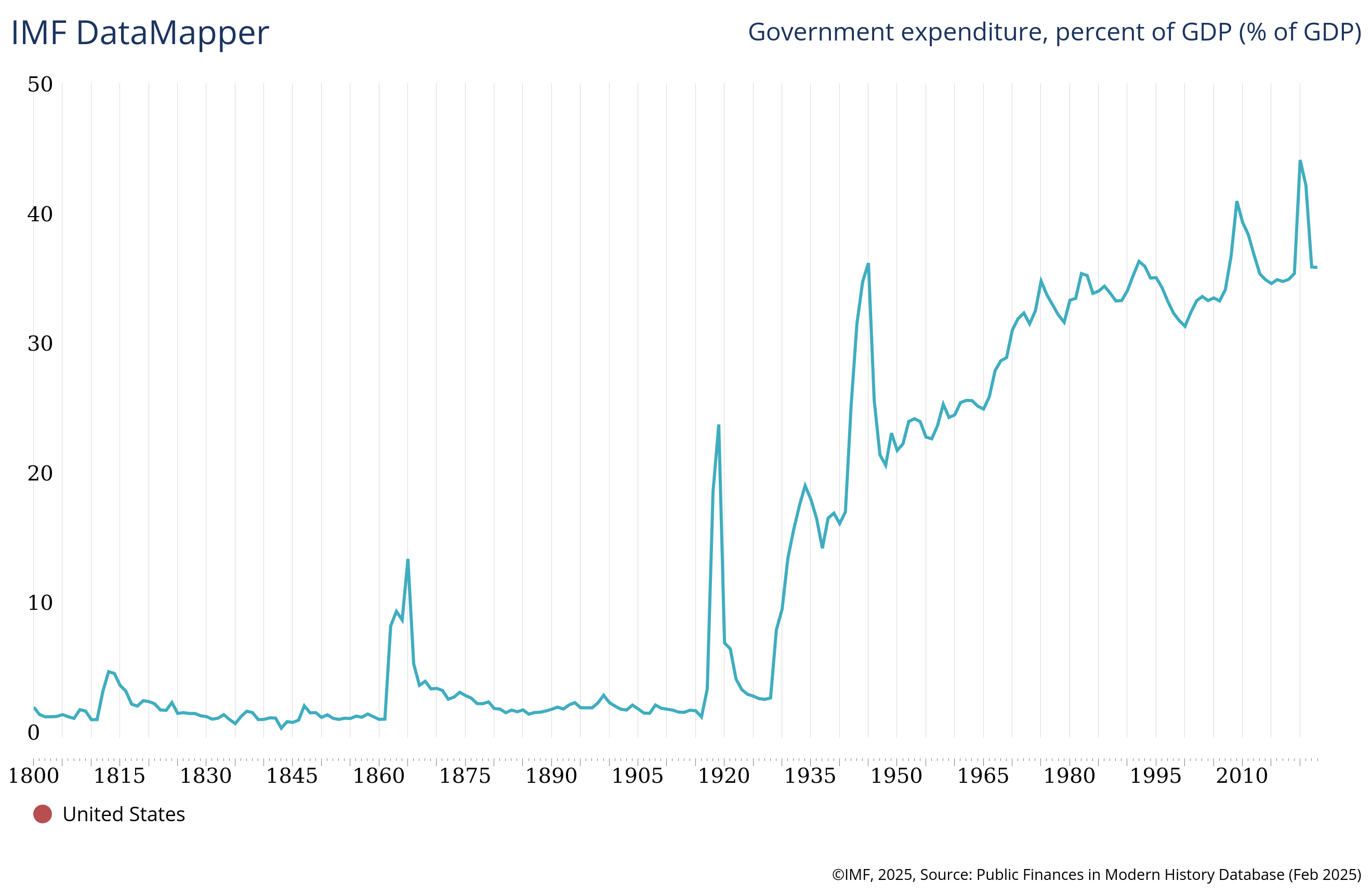
Right off the bat, one needs to deduct at least 30% of total GDP from whatever figure one is using because that is the percentage of GDP that is government spending, which produces nothing and accounts for $200 toilet seats, $57 screwdrivers and other absurd excesses.

The chart below, from the IMF, shows how government's contribution to GDP has grown over the years, from about two percent before the 1930s Great Depression to well above 30% since around 1970. So, GDP, being vastly overstated, is a complete canard, and a horrible measure of a nation's productivity.

One would have to reach back and re-jigger all the data, stripping out government expenditures, from the 1920s forward, to even get anything that somewhat resembles a true picture of the U.S. economy. With the government's greedy hands in everything from lemonade stands to B-2 bombers, it's hard to imagine any economy - much less that of the bloated U.S. - that doesn't include purchases by the government to boost its attractiveness to worldly-wise investors.

Beyond the obvious overhyped nature of the U.S. GDP, what's interesting about this latest estimate (3rd revision), is that it shows the PCE Index - which is, as has been mentioned ad nauseum over the past few years - the Fed's favorite inflation reading, ramping up to 3.7%. If the Fed's target for inflation is two percent and their BFF indicator is at 3.7% it doesn't take a genius to figure out that they haven't beaten inflation, as they claim they have. It also explains why stocks have been soaring. Precisely because inflation continues to ravage consumers, Wall Street sees this trend as extremely positive toward the Fed cutting interest rates, possibly as soon as their July FOMC meeting in another five weeks (July 29-30). By then, the S&P might be approaching 7,000 and the Dow over 45,000.

But, that's not all. The BEA also reported that consumer spending fell 0.1% in May, which stands to reason. People tend to spend less when prices are too high.

But, that's enough about the fake U.S. economy. Taking a look at the recent stock market upswing, it's clear that Wall Street has joined hands with Washington and the mainstream media in claiming victory over Iran with the bombing runs this past Saturday. Stocks have roared over the following days, with the S&P making a new all-time high on Thursday, which is not only fake, but also something else, that we're not allowed to speak of in the politically correct matrix in which we reside.

So far this week, stocks are banging up hard. The Dow is up 1180 points through Thursday's close. NASDAQ has tacked on some 720 points and appears to be not done yet. The S&P is up 173 points the past four sessions, so, apparently, the world is safe for democracy once again and Trump's tariffs don't matter now that our spectacular military has utterly demolished Iran's ability to enrich uranium to weapons-grade levels, which is all well and good, except that it's not true.

As the world lurches into the last weekend before the fourth of July, stock futures are once again registering to the upside, while gold is down another $64 this morning, to $3,283. Silver is also lower, at $36.15, which is, relatively speaking, not all that underpriced.

Gold peaked at $3,407 on Monday, so it's down just $124, which, after the gains made the past two years, isn't really much.

But, who needs pet rocks when you've got the Fed, the media, the military, the President, and congress all singing from the same hymn book?

At the Close, Thursday, June 26, 2025:
Dow: 43,386.84, +404.41 (+0.94%)
NASDAQ: 20,167.91, +194.36, (+0.97%)
S&P 500: 6,141.02, +48.86 (+0.80%)
NYSE Composite: 20,256.20, +168.75 (+0.84%)


Thursday, June 26, 2025

Federal Reserve Counterfeiting; Goverment Over-Spending is Crushing the U.S. Economy Leaving Citizens Broke and Desperate

One item that was left out of Wednesday's screed about the near-complete falsity of American politics and media was the mighty U.S. dollar, that, since 1944, has been regarded as the world's reserve currency.

Sadly, even the U.S. substitute for money is as fake as the proverbial three-dollar bill. Whereas a single greenback might have bought an entire breakfast back in the 1960s and early 1970s, today's dollar will barely cover the retail cost of two raw eggs. The Federal Reserve Notes that circulate across the country and around the world have been issued is such magnificent volume that the value of the "buck" or "Fedbuck" has fallen precipitously, especially since President Richard M. Nixon ended the convertibility of dollars into gold back in August of 1971.

Consider, for a moment, that a single slim dime, made of 90% silver, could have purchased an entire candy bar, possibly two, prior to 1965, but today will only cover the cost of one fifth or less of a Fifth Avenue or Mars or Baby Ruth bar. Of course, today's dime is 91.67% copper, 8.33% nickel, according to coinflation.com. It has no - as in zero - silver content.

An ounce of silver prior to it being demonetized and all U.S. silver coins taken out of circulation as of 1965, was about $1.35, or five silver quarters and a silver dime. The idea that an ounce of silver on spot markets is over $35 today illustrates the absolute decimation of the U.S. currency.

It's that way because the cost of printing up a $100 bill is about three cents, and it gets even worse as the Federal Reserve doesn't even both printing new bills these days, they just type in digits on one of their computers and send the fake dough out to one of their primary dealers (mostly big banks, like JP Morgan, Bank of America, etc.). The money supply has increased astronomically over time. In 1960, the U.S. money supply was about $400 billion. Today it's $21,942 billion, or, nearly $22 TRILLION.

Now certainly, the population of the United States has increased substantially over that 60-year period, but the roughly doubling of the population comes nowhere close to the 5,485% increase in the supply of fake, counterfeit Federal Reserve Notes or their equivalents.

The United States' exceptional privilege of having the most-valued, highly-respected reserve currency is coming to a hasty conclusion and American citizens are paying an enormous price for the hubris of government and the profligate spending of congress, enabled by the Federal Reserve, which issues debt to the government in the form of treasury bills, notes, and bonds, which the same government is likely never going to be able to repay.

While its easy to blame the Federal Reserve for the massive inflation and loss of purchasing power of the currency, it's the government that should shoulder most of the blame. They are the ones that have run up debt of over $37 trillion, effectively increasing the money supply to unforgivable levels. People elected by U.S. citizens themselves have betrayed the trust of the populace for far too many years and there appears to be no inclination that they intend to stop.

The current "big, beautiful bill" before the Senate virtually guarantees a deficit of more than $1.5 trillion in fiscal 2026. Voting for Donald J. Trump las November was supposed to at least slow the roll of the spendthrifts in congress, but, apparently, not even the Orange Don can be trusted to do the right thing.

At this point in time, most Americans cannot afford to buy a home. The median existing home price rose 1.3% from a year earlier to $422,800 in May, the National Association of Realtors (NAR) reported Monday. That puts the monthly mortgage payment in excess of $2,000, a number that a two-earner family making $100,000 pre-tax total, would be stretching to make, and that's before PMI, taxes, and insurance. It's just beyond ridiculous.

Rents are even more extreme. Food prices aren't coming down any time soon, so the numbers on welfare continue to grow. Americans have been sold out and are facing very tough choices in the coming months and years.

An hour before the opening bell, the BEA announced its third estimate of first quarter GDP, figuring a contraction of 0.5% for the three months ended March 31. The previous estimate was 0.2%, though most of the decline is being blamed on imports, as businesses rushed to purchase inventory from foreigners prior to President Trump's proposed tariffs. That's a flat-out lie. The U.S. economy is toast and the government will do anything and everything in its power - including sending the stock market to all-time highs - to keep that information hidden from the American people, and, maybe more importantly, from foreign investors.

Stock futures are up, but off their morning highs. Go figure.

At the Close, Wednesday, June 25, 2025:
Dow: 42,982.43, -106.59 (-0.25%)
NASDAQ: 19,973.55, +61.02 (+0.31%)
S&P 500: 6,092.16, -0.02 (-0.00%)
NYSE Composite: 20,087.45, -129.89 (-0.64%)


Wednesday, June 25, 2025

Fake News, Fake Wars, Fake Markets, Fake Rules-Based Order All The Time

Just about everything that comes out of Washington, D.C. or Wall Street is complete and utter nonsense. All fake, all lies, all the time. Nothing they do benefits the citizens of the United States and hasn't for years, probably decades.

Everything is done to protect the status quo, which consists of - in no particular order - grifting by congress off the bloated federal "budget" (What a joke. The U.S. government hasn't had a proper budget since the 1980s), paying interest to the Federal Reserve, protecting and supporting Israel and Ukraine, lining their pockets with contributions (Washington) and retail investor funds (Wall Street).

In the matter of President Trump's gloating over the recent strikes on Iran, it was all for show, designed to get Israel out of a bad situation. Don't believe me. Do some research. Start with the substack by Simplicious and this ZeroHedge article authored by Pepe Escobar.

As far as Wall Street is concerned, it's all run on algorithms that operate off of mainstream media news headlines with little to no human input. Eventually, Bloomberg, CNBC, and Fox Business will just write headlines that please the algorithms, whether they are true or not. If New York got nuked, Bloomberg might pen a headline like, "Massive redevelopment underway in Manhattan with Russian assistance." That's just how the little midget who thought he might be president some day rolls. Mike Bloomberg is a rich guy who could care less about the country in which he lives and made his fortune.

Anyhow, stocks just keep going up. What's not to like? Maybe the purchasing power of the dollar? Same buck, buys less every day. Those of us in our senior years probably remember our parents or grandparents complaining about the price of a candy bar or some other item. They'd say, "it used to be a penny when I was a kid." We laughed, and thought, oh, these old folks. Now, we're the ones looking at a Fifth Avenue or Baby Ruth at the candy counter, remarking that the 50-cent candy bar used to be a nickel or a dime when we were kids (1950s and 1960s) and, they were BIGGER. We're not delusional, nor senile, yet. Everything was much, much less expensive 50, 60, 70 years ago.

But, that's progress! Yes, if one defines progress as obliterating the middle class through inflation while putting everybody into debt slavery and the U.S. government $37 trillion in debt and paying over A TRILLION DOLLARS A YEAR in interest on that ungodly amount of debt.

A new car in the early 1970s cost somewhere between $1500 and $3000. Teenagers were able to buy their first used car for a couple hundred bucks. The median price of an existing home was, well, orders of magnitude cheaper than today, and, back then, homes were built with good lumber, concrete, bricks, etc.

Trump's Big Beuatiful Bill is going to be a train wreck after the Senate gets through with it and sends it back to the Hosue. It's loaded with pork and earmarks and loads of helping hands to big corporations with nothing for small business. Nothing outside the extension of the 2017 tax breaks and maybe the funding for more border control are any good. As it was originally written, it would produce a $2 trillion deficit, so why bother promoting it as some kind of magic pill for Americans?

Trump and others in the MAGA crusade use the term, "America First" to describe their basic intent. What Americans need is a government that supports "Americans First." There's a big difference.

And, what ever happened to the hundreds of billions in waste, fraud, and abuse that Elon Musk and his DOGE team unearthed? Congress has managed to cut that down to about $9.2 billion in savings. Originally, Musk and Vivek Ramaswamy were supposed to have been working at the Department of Government Efficiency (DOGE) until July 4, 2026.

Well, Ramaswamy left early on to run for governor of Ohio, but Musk carried on and did exceptional work, but it's not even July 4, 2025, and he's already gone (and disgusted with government). So much for fixing the broken federal government. The powers that be, the status quo, aren't interested in fixing anything, besides, well, elections.

If there's any hope at all, maybe the BBB will blow up in congress and the government will shut down on October 1. Don't count on it, though. What's more likely to happen is what always happens, they (the Uniparty) will reach a compromise on another three or six-month continuing resolution and move on to the next crisis.

Under the current leadership, despite Trump's best efforts, thwarted at every turn, America is burnt toast, with Wall Street and Washington requesting theirs be buttered on both sides.

Meanwhile, Fed Chairman Jerome Powell gave his semi-annual testimony on monetary policy to the Committee on Financial Services in the House on Tuesday. Did anybody even notice? He's scheduled to spew before the Committee on Banking, Housing, and Urban Affairs in the U.S. Senate, Wednesday. Nobody gives a damn what he has to say, mostly because it's all fake or gibberish, or both.

Prepare for more fakery, because, at this point, it's all they've got.

At the Close, Tuesday, June 24, 2025:
Dow: 43,089.02, +507.24 (+1.19%)
NASDAQ: 19,912.53, +281.56 +(1.43%)
S&P 500: 6,092.18, +67.01 (+1.11%)
NYSE Composite: 20,217.34, +209.17 (+1.05%)


Tuesday, June 24, 2025

B-2 Diplomacy Works Wonders for Stocks; Oil Prices Lower on Iran-Israel Cease Fire; Gold, Silver Under Pressure

“Political power grows out of the barrel of a gun." - Mao Tse Tung

U.S. foreign policy used to be described as "gunboat diplomacy," wherein the U.S. Navy would sit off the coastline of the opposition and shell them into agreement on any demands the U.S. might be seeking. It wasn't new. Other countries such as France and Great Britain, used the tactic to great success in the 19th century. The U.S. experience was made by presidents Teddy Roosevelt and Woodrow Wilson.

Nowadays, the U.S. doesn't just use the threat of violence to get what it wants, it actually uses violence - as demonstrated over the weekend by the bombing of Iranian nuclear facilities - to achieve its ends. While some tomahawk missile strikes were made from submarines in the Persian Gulf, the bulk of the action was carried out by B-2 Stealth bombers with bunker-busters and other ordnance.

The strike on Iran and Monday's "cease fire" initiated by President Trump to end the conflict between Israel and Iran are being hailed as a big success in the military and political community. Wall Street loves it as well, sending stocks higher Monday with futures soaring Tuesday morning.

With the ability to strike virtually anywhere on the planet, Trump's "B-2 Diplomacy" resonates with Roosevelt's, "walk softly and carry a big stick," foreign policy. As far as the effectiveness of the policy is concerned, that remains to be seen. While the initial objective of crippling Iran's nuclear ambitions seems to have been achieved, the "cease fire" is nothing other than a pause in the Middle East miasma that's been going on for centuries.

Iran isn't going away, nor is Israel. For now, there's a break in the military action. There's no peace agreement, so the conflict will alsmost certainly go hot at some time in the future. Until then, Wall Street can focus on the President's "Big Beautiful Bill" and reaching for all-time highs on the various U.S. indices.

It won't take much to push stocks up, up, and away. Here are the all-tim high targets with their respective dates:
Dow: 45,014.04, 12/4/2024
NASDAQ: 20,173.89, 12/16/2024
S&P 500: 6,114.15, 2/19.2025

Given the MAGA theme and economic data suggesting a muddled business environment, a couple percentage points on the majors shouldn't be a problem. After all, stocks remain in one of the biggest bubbles in the history of the world.

The Shiller PE, closed yesterday at 36.72, short of the recent high from October, 2021, 38.58.

Meanwhile, just because Israel and Iran stopped shelling each other and the "threat" of a nuclear-armed Iran has been softened, gold is no longer as valuable as some might have hoped, at $3,329.00, down $66 this morning. Silver is back below $36.

Money Daily was dead on in the Weekend Wrap this past Sunday, saying:

Iran has threatened to close the Strait of Hormuz, which is laughable, since all Iranian oil flows through there with China as the destination 90% of the time. Because Iran presumably would not cut off its own revenue stream, oil remains only slightly elevated instead of stupidly high. Fact of the matter is that there's still a global glut and will be until either Russia, Saudi Arabia, or the U.S. is shut off, shut down, or the regular flow somehow curtailed, which is, naturally, very, very unlikely to occur.

Oil got crushed Monday, with WTI crude dropping more than $10, from a high of $75.29 to a low of $64.83.

Buy stocks. Be happy.

At the Close, Monday, June 23, 2025:
Dow: 42,581.78, +374.96 (+0.89%)
NASDAQ: 19,630.97, +183.56 (+0.94%)
S&P 500: 6,025.17, +57.33 (+0.96%)
NYSE Composite: 20,008.18, +139.82 (+0.70%)