Tuesday, July 15, 2025

China Infrastructure Puts America's to Shame; CPI at 2.9% is Not Close to Fed Target of 2.0%. Inflation Is Returning, Not Defeated

Why do American politicians want to go to war with China?

Possibly, part of the answer lays in just how badly Chinese technology is beating U.S. technology, especially when it comes to infrastructure. Bear in mind that in November, 2021, Joe Biden signed into law a $1.2 trillion infrastructure bill, the Infrastructure Investment and Jobs Act. Faster trains? Better roads? High speed rural broadband access? Rebuilt bridges? Mostly no.

Excessive graft, kickbacks, and congress lining their own pockets? Yep.

In China, travelers can ride a the world's fastest train from Beijing to Shanghai (or vice versa) at speeds of up to and beyond 350 km/h (217 mph), making the 1,302 km (809 mi) trip in roughly four-and-a-half hours, at a cost of $135 - $150.

Comparably, a train trip of nearly 800 miles - New York City to Chicago, Illinois - takes about 20 hours by train (usually more) and costs over $300.

So, should we bomb China just for being so much more technologically advanced and cheaper? Not really. If anything, the U.S. should copy their successes, but that would run counter to the usual political argument that they're evil commies. Seriously, U.S. politicians have sold out their constituents to special interests with bribes, kickbacks, and worse, otherwise known as campaign contributions.

This kind of comparison is something that should trouble all Americans, and there are certainly many more, and not just with China. Many other countries - mostly in Asia or the Pacific Rim - have better infrastructure than the United States, by far. From cheap, fast broadband in Malaysia to bullet trains in Japan, the U.S. fails on many levels, yet Americans are told by politicians and the mainstream media that they live in the best, most-advanced, most free country in the world. The level of hubris and propaganda is disturbing, to say the least.

Tuesday morning in America brings second quarter earnings reports from some of the nation's biggest banks including JP Morgan Chase (JPM), Citigroup (C), Wells Fargo (WFC), BlackRock (BLK), State Street (STT), and Bank of New York Mellon (BK).

Also reporting Tuesday morning are chain grocer, Albertsons (ACI), and electronics firm, Ericsson (ERIC).

Analysts are mixed on JP Morgan's results. Excluding one-off costs, JP Morgan earned $4.96 per share, compared with the $4.48 per share that analysts were expecting, according to estimates compiled by LSEG. Provision for credit losses was $2.85 billion, compared with $3.05 billion a year earlier.

There should be little argument about the direction of this company. Year-ago EPS was $6.12. First quarter EPS was $5.07. FAIL.

Citigroup (C) reported 2Q earnings of $1.96, against last quarter's $1.99 and year-ago, $1.57. Shares are marginally higher, up less than one percent.

Wells Fargo reported earnings, excluding one-time costs, of $1.54 per share on revenue of $20.8 billion for the second quarter, beating Wall Street estimates for profit of $1.41 and revenue of $20.7 billion. Comparisons to year-ago ($1.34) and prior quarter ($1.28) were positive, but the stock is lower by more than two percent before the bell due to reducing its provision for credit losses to $1.01 billion in the quarter from $1.24 billion a year ago, which aided the earnings number.

BlackRock (BLK) reported record AUM of $12.53 trillion, but missed on the top line (revenue). Despite glowing media reports, shares are lower heading toward the open.

State Street (STT) showed non-GAAP 2Q EPS of $2.53, topping estimates of $2.36. Year-ago was $2.15. Prior quarter EPS was $2.04. Shares are flat.

Bank of New York Mellon (BK) non-GAAP EPS was $1.94. EPS from 2024 2Q was $1.51. First quarter EPS, $1.58, but those figures, like State Street's were GAAP-compliant. Why are two of the largest funding banks in the country using non-GAAP accounting, usually reserved for startups and penny stocks? Obviously, there's something wrong there. BK is down three percent in pre-market trading.

Albertson's and Ericsson are both lower in pre-market trading.

All of these earnings reports preceded the release of June CPI from the BLS. Their press release was sobering:

The Consumer Price Index for All Urban Consumers (CPI-U) increased 0.3 percent on a seasonally adjusted basis in June, after rising 0.1 percent in May, the U.S. Bureau of Labor Statistics reported today. Over the last 12 months, the all items index increased 2.7 percent before seasonal adjustment.

The index for shelter rose 0.2 percent in June and was the primary factor in the all items monthly increase. The energy index rose 0.9 percent in June as the gasoline index increased 1.0 percent over the month. The index for food increased 0.3 percent as the index for food at home rose 0.3 percent and the index for food away from home rose 0.4 percent in June.

The index for all items less food and energy rose 0.2 percent in June, following a 0.1-percent increase in May. Indexes that increased over the month include household furnishings and operations, medical care, recreation, apparel, and personal care. The indexes for used cars and trucks, new vehicles, and airline fares were among the major indexes that decreased in June.

The all items index rose 2.7 percent for the 12 months ending June, after rising 2.4 percent over the 12 months ending May. The all items less food and energy index rose 2.9 percent over the last 12 months. The energy index
decreased 0.8 percent for the 12 months ending June. The food index increased 3.0 percent over the last year.

As Money Daily anticipated, June CPI showed inflation re-emerging. Anybody who shops for food or dines out knows that prices have been increasing again, which is on top of the high price hikes from 2023 and 2024. With this information in hand, there's little chance of the Federal Reserve cutting interest rates at their next meeting, July 29-30. Will President Trump still be haranguing Chairman Powell to cut rates? He may, because, for all his education and training in economics (Wharton), he's committed to Keynesian policies and getting bad advice from his economic team.

Despite headline CPI year-over-year the hottest since February, stock futures shot higher on the release. Apparently, monthly core CPI printing below expectations (+0.1% vs. +0.2% MoM expected) is a win, as opposed to the year-over-year rise of +2.9%. Once the initial knee-jerk higher response on stock futures was in the books, they began to come down, though the S&P and NASDAQ were still positive at 9:00 am ET.

As some are asking, Is it just me or does 2.9% sound a whole lot more like 3 than 2?

While the Fed might want everybody to believe they've completely wiped out inflation, there's absolutely no truth to that statement. Inflation is nowhere near their target of two percent annually. It has remained closer to three percent since they stopped raising rates in July 2023 at 5.25-5.50%, then lowered them a full percent in September, November, and December 2024 with cuts of 0.50%, 0.25%. and 0.25%, respectively.

In case anybody hasn't noticed. Prices most most things - and especially food and energy - have not come down much in the past year. Defeating inflation should be represented by CPI in the red on a monthly basis, not these piddling +0.1, +0.2, +0.3 percent gains that have become common. At two percent inflation, the purchasing power is halved in 30 years. At three percent, it's cut in half in just 20.

Anybody who has the capability should be looking to move to other countries, preferably ones that aren't run by central bank and political sociopaths.

America is doomed and its failings have become obvious to the rest of the world. Prepare for hyper-inflation within two years. Weimar America is within reach!

At the Close, Monday, July 14, 2025:
Dow: 44,459.65, +88.14 (+0.20%)
NASDAQ: 20,640.33, +54.80 (+0.27%)
S&P 500: 6,268.56, +8.81 (+0.14%)
NYSE Composite: 20,581.45, +33.78 (+0.16%)

Sunday, July 13, 2025

WEEKEND WRAP: BRICS and Tariffs; Epstein Files, Silver Gains Dominated the Week; June CPI, PPI, Retail Sales, 2Q Bank Earnings on Deck

Three things happened over the past week that are likely to have ongoing impacts to finances.

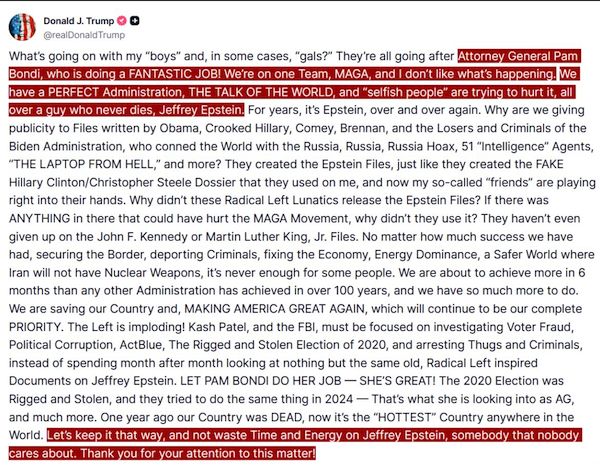
The first was the Trump administration abruptly ending the investigation of Jeffrey Epstein. Above is a post by President Trump from Saturday, urging his MAGA followers to just forget about the whole, sordid, mess of pedophilia and human trafficking and move on. Ain't gonna happen. Shutting down the investigation with no findings of blackmail, no lists of clients, and the absurd contention that Epstein committed suicide in prison is going to stick with this administration - and Mr. Trump in particular - for the rest of his term. Support for the America First agenda, MAGA, and all th patriotic bullshit is fading rapidly. If the administration doesn't come clean on this, nobody will ever trust them again.

After four years of Biden idiocy, the American public is in no mood to bear more lies and deflections from the federal government. People are fed up with government in general and many - in and out of the MAGA movement, on the right and the left - are quietly disengaging. The government is too deeply intertwined into people's lives and there are actions being taken by individuals at various levels of engagement to free themselves from what they consider to be a rogue, criminal operation, run by a uniparty with hidden agendas.

Stonewalling the Epstein affair pushes the truly patriotic followers further away from Trump, who has broken promises made during the campaign, and the government in general. People on the left and the right are now in agreement on many issues. The potential for widespread civil disobedience, civil war, or outright revolution is growing. It's possible that the government would like nothing more than civil war or rebellion, which would give them all the more rationale to impose martial law and stomp the population into jackboot submission. Smart Americans are unlikely to give them that opportunity, preferring quiet actions over violence.

Number two on the week's big events is actually a combination of two disparate occurrences: the BRICS Summit in Brazil and Trump tariffs, round two. They dovetail because Trump threatened BRICS countries with addition 10% tariffs, and also socked Brazil with a destructive, mendacious 50% tariff. Tariffs will prove to be the ruin of the U.S. economy. The government will prosper at the expense of consumers, who will see either higher prices (already happening), lower quality products from exporters to the U.S., or empty shelves if enough countries disengage from U.S. trade.

Meanwhile, BRICS are moving on, promoting international trade using their own currencies, bypassing the U.S. dollar completely. BRICS countries and those aligned with them will eventually isolate the United States as the bi-polar East-West split accelerates.

Third, and maybe the most important development, was the rapid price advance of silver, which over the course of just two days - Thursday and Friday - posted a gain of 6.5%, from $36.69 to $39.08 on the COMEX.

Gains like that don't happen in a vacuum. They are part and parcel of bigger agendas, larger trends and developments. Silver is a key industrial element and has thousands of years of history as money. Recent gains - outpacing every asset except the phony blockchain Ponzi scheme of bitcoin and other crypto frauds - are part of a larger movement, freeing silver and gold from the fiat currency monopoly.

Notice that none of these events have anything to do with stocks or bonds, the paper promises promoted by Western governments that are not only wildly overvalued, but ultimately subject to extreme volatility and manipulation. Every market is manipulated, but none as severely as stocks and fixed income (bonds).

The world is moving away from U.S. dominance toward a more free, equitable, honest future. The time is short.


Stocks

All of the majors ended the week on the downside, with the exception of the 20 stocks comprising the Dow Jones Transportation Average, which was up 1.01% for the week.

As the week just past offered little in the way of economic data or earnings, the upcoming week will be loaded, and especially front-loaded with bank and financial stocks, with a liberal dose of Dow components added in for flavor.

Stocks reporting second quarter earnings this week:

Monday (before open) Fastenal (FAST); (after close) FirstBank (FBK)

Tuesday (before open) JP Morgan Chase (JPM), Citigroup (C), Wells Fargo (WFC), BlackRock (BLK), State Street (STT), Bank of New York Mellon (BK) Albertsons (ACI), Ericsson (ERIC); (after close) J.B. Hunt (JBHT), Pinnacle Financial (PNFP)

Wednesday (before open) Bank of America (BAC), Goldman Sachs (GS), Morgan Stanley (MS), Johnson & Johnson (JNJ), PNC Bank (PNC, ASML (ASML); (after close) Synovus (SNV), Alcoa (AA), Kinder Morgan (KMI), United Airlines (UAL)

Thursday (before open) Taiwan Semi (TSMC), Cintas (CTAS), US Bancorp (USB), Fifth Third Bank (FITB), Travelers (TRV), Abbot Labs (ABT), Pepsico (PEP); (after close) Simmons Bank (SFNC), Bank of the Ozarks (OZK), Netflix (NFLX), Interactive Brokers (IBKR)

Friday (before open) Huntington Bank (HBAN), Truist Financial (TFC), American Express (AXP), Ally Bank (ALLY), 3M (MMM), Regions Bank (RF), Charles Schwab (SCHW), Comerica (CMA).

Highlighting the data front will be June CPI and PPI, Tuesday and Wednesday, respectively. Capacity Utilization and Industrial Production for June is also out on Wednesday. June Retail Sales appear Thursday morning, along with the Philly Fed and the NAHB Housing Market Index.

If you think June's CPI data being released on the same morning as second quarter earnings from JP Morgan Chase, Citigroup, Wells Fargo, BlackRock, State Street, and Bank of New York Mellon, is just a coincidence, you just don't get it. Look for the banks to report massive profits and the CPI to edge up slightly, so "investors" will focus on bank stocks and ignore the re-ignition of inflation.


Treasury Yield Curve Rates

Date 1 Mo 1.5 mo 2 Mo 3 Mo 4 Mo 6 Mo 1 Yr
06/06/2025 4.28 4.31 4.35 4.43 4.38 4.31 4.14
06/13/2025 4.23 4.32 4.48 4.45 4.40 4.30 4.09
06/20/2025 4.20 4.38 4.55 4.39 4.40 4.29 4.07
06/27/2025 4.19 4.43 4.49 4.39 4.36 4.26 3.97
07/03/2025 4.35 4.43 4.50 4.42 4.41 4.34 4.07
07/11/2025 4.37 4.39 4.47 4.41 4.42 4.31 4.09

Date 2 Yr 3 Yr 5 Yr 7 Yr 10 Yr 20 Yr 30 Yr
06/06/2025 4.04 4.02 4.13 4.31 4.51 4.99 4.97
06/13/2025 3.96 3.90 4.02 4.20 4.41 4.93 4.90
06/20/2025 3.90 3.86 3.96 4.16 4.38 4.90 4.89
06/27/2025 3.73 3.72 3.83 4.03 4.29 4.85 4.85
07/03/2025 3.88 3.84 3.94 4.12 4.35 4.87 4.86
07/11/2025 3.90 3.86 3.99 4.19 4.43 4.96 4.96

Notice how interest rates crept up on the week, with the bulk of yield gain coming on Friday, the same day stocks were down. In other words, instead of rushing into the safety of fixed income as stocks were being somewhat clobbered (especially the DOW), bonds were being sold off as well. Where did the money go? Cash, gold, silver.

The 10-year note was up eight basis points and the 30-year bond up 10 on Friday. This is no coincidence. This is an early warning sign of an upcoming financial crisis. Everybody knows that a financial crisis will occur - it's only a matter of time - the question is when and what will be the cause. Speculation is that the repo market will explode again or that some banks might be found to be undercapitalized and overly aggressive in their treasury distribution.

The current narrative that inflation is under control, approaching two percent (meaning your money devalues by half in 30 years, instead of 20 years at three percent) annually, is about to change. Inflation has never been under control. Prices have been rising, especially lately, as in the past few months. Those who do grocery shopping understand this all too well.

Instead of cutting rates, the Fed should be raising them. Will they? Probably not. They are more likely to cut rates to stave off a recession (can't have those!) than raise them to shut down inflation.

Full spectrum spread fom 30 days out to 30 years remains elevated at +59. 2s-10s are back to April highs, at +53.

Be on guard for the 30-year bond to hit five percent and higher, and the 10-year note to exceed a yield of 4.5%. The Treasury market is under severe stress, from lack of foreign buying to unease over economic conditions caused by continuing deficits and lack of capital formation.

Spreads:

2s-10s
9/15/2023: -69
9/22/2023: -66
9/29/2023: -44
10/06/2023: -30
10/13/2023: -41
10/20/2023: -14
10/27/2023: -15
11/03/2023: -26
11/10/2023: -43
11/17/2023: -44
11/24/2023: -45
12/01/2023: -34
12/08/2023: -48
12/15/2023: -53
12/22/2023: -41
12/29/2023: -35
1/5/2024: -35
1/12/2024: -18
1/19/2024: -24
1/26/2024: -19
2/2/2024: -33
2/9: -31
2/16: -34
2/23: -41
3/1: -35
3/8: -39
3/15: -41
3/22: -37
3/28: -39
4/5: -34
4/12: -38
4/19: -35
4/26: -29
5/3: -31
5/10: -37
5/17: -39
5/24: -47
5/31: -38
6/7: -44
6/14: -47
6/21: -45
6/28: -35
7/5: -32
7/12: -27
7/19: -24
7/26: -16
8/2: -08
8/9: -11
8/16: -17
8/23: -09
8/30: 00
9/6: +06
9/13: +09
9/20: +18
9/27: +20
10/4: +5
10/11: +13
10/18: +13
10/25: +14
11/1: +16
11/8: +5
11/15: +12
11/22: +4
11/29: +5
12/6: +5
12/13: +15
12/20: +22
12/27: +31
1/3: +32
1/10: +37
1/17: +34
1/24: +36
1/31: +36
2/7: +20
2/14: +21
2/21: +23
2/28: +25
3/7: +33
3/14: +29
3/21: +31
3/28: +38
4/4: +33
4/11: +52
4/17: +53
4/25: +55
5/2: +50
5/9: +49
5/16: +45
5/23: +51
5/30: +52
6/6: +48
6/13: +45
6/20: +48
6/27: +56
7/3: +47
7/11: +53

Full Spectrum (30-days - 30-years)
9/15/2023: -109
9/22/2023: -99
9/29/2023: -82
10/06/2023: -64
10/13/2023: -82
10/20/2023: -47
10/27/2023: -54
11/03/2023: -76
11/10/2023: -80
11/17/2023: -93
11/24/2023: -95
12/01/2023: -105
12/08/2023: -123
12/15/2023: -154
12/22/2023: -149
12/29/2023: -157
1/5/2024: -133
1/12/2024: -135
1/19/2024: -118
1/26/2024: -116
2/2/2024: -127
2/9: -117
2/16: -103
2/23: -112
3/1: -121
3/8: -125
3/15: -109
3/22: -112
3/28: -115
4/5: -93
4/12: -87
4/19: -77
4/26: -70
5/3: -85
5/10: -87
5/17: -94
5/24: -99
5/31: -83
6/7: -92
6/14: -113
6/21: -103
6/28: -96
7/5: -101
7/12: -108
7/19: -103
7/26: -104
8/2: -143
8/9: -131
8/16: -138
8/23: -141
8/30: -121
9/6: -125
9/13: -117
9/20: -80
9/27: -80
10/4: -75
10/11: -58
10/18: -54
10/25: -38
11/1: -18
11/8: -23
11/15: -10
11/22: -12
11/29: -40
12/6: -23
12/13: +18
12/20: +29
12/27: +38
1/3: +38
1/10: +54
1/17: +41
1/24: +40
1/31: +36
2/7: +32
2/14: +32
2/21: +31
2/28: +13
3/7: +24
3/14: +25
3/21: +23
3/28: +26
4/4: +5
4/11: +38
4/17: +44
4/25: +40
5/2: +41
5/9: +46
5/16: +52
5/23: +68
5/30: +59
6/6: +69
6/13: +67
6/20: +69
6/27: +66
7/3: +51
7/11: +59

Oil/Gas

WTI crude oil closed out the week at $67.35, a $2.20 increase from last Friday's $65.15. The gain was largely synthetic, with traders adjusting after the major downdraft at the end of June. Call it a knee-jerk reaction to much lower pricing which will probably prove to be both short-lived and wrong-footed.

Gas prices have followed oil's path lower in general.

Gasbuddy.com is reporting the national average for a gallon of unleaded regular gas at the pump at $3.13, a two-cent gain from last week, mostly insignificant.

The highest prices in the country were in California, as usual, at $4.50, down four cents on the week.

Prices at the traditional low end have settled, but were mostly higher, led by Mississippi ($2.68), Oklahoma ($2.71), Alabama and Louisiana ($2.75). Other states in the Southeast are all between $2.76 (South Carolina, Texas) and $2.79 (Arkansas), with the notable exceptions of Georgia ($2.87), North Carolina ($2.88), and Florida ($2.91). 12 states under the 42nd parallel are below $3.00, including New Mexico.

The Northeast continues to be led on the high side by Pennsylvania ($3.25), down six cents. All other New England and East coast states remained above $3.00, ranging from Massachusetts at $3.02 to New York at $3.15, except for New Hampshire ($2.98).

Midwest states are topped by Illinois ($3.47), the price up six cents on the week. Nebraska ($2.82)is lowest in the region, followed by Kansas ($2.87), North Dakota ($2.88), and Missouri ($2.89). Along with Illinois, Wisconsin ($3.01), Ohio ($3.05), Indiana and Minnesota ($3.06), and Michigan ($3.27) are all back above $3.00.

Along with California, Washington ($4.40) is the only other one above $4, as Oregon checks in at $3.98. Nevada ($3.70) dropped two cents. Arizona ($3.17) is still priced at a premium to neighboring New Mexico, a relative bargain, at $2.84. Idaho ($3.44) was up a nickel, and Utah ($3.27) was unchanged.

Sub-$3.00 gas can be found in one fewer state this week than last, with now 21 making the grade. Prices could go either way. It's political.


Bitcoin

This week: $119,022.00
Last week: $108,808.00
2 weeks ago: $108,168.60
6 months ago: $95,099.77
One year ago: $59,477.68
Five years ago: $9,177.39

New highs. Bitcoin is the gateway drug to controllable, programmable, government digital currency, CBDC, so good luck with your crypto fantasy.


Precious Metals

Gold:Silver Ratio: 86.24; last week: 90.13

Per COMEX continuous contracts:

Gold price 6/13: $3,452.60
Gold price 6/20: $3,384.40
Gold price 6/27: $3,286.10
Gold price 7/3: $3,346.50
Gold price 7/11: $3,370.30

Silver price 6/13: $36.37
Silver price 6/20: $35.95
Silver price 6/27: $36.17
Silver price 7/3: $37.13
Silver price 7/11: $39.08

Both gold and silver were bid on the week, but the big story was silver, closing above $39.00 an ounce on the COMEX, with spot at $38.34. What triggered silver's rise was likely related to U.S. President Trump calling for a 50% tariff on copper. A good portion of silver mined around the world is as a by-product of other mining, copper being prominent.

The gains on silver, which many believe to be long overdue come at a time when there are more than ample numbers of catalysts, main among them being the silver shortfall in production, mining not keeping pace with demand for what appears to be a fifth straight year, according to the Silver Institute.

On a more technical level, the recent gold:silver ratio bounding over 100 was a certain buy signal for metals dealers, stackers, and investors. It was so far out of whack that it prompted silver sales to outpace supplies and now, the restocking of inventory is pushing the price even higher, so much so that the GSR checks in this week at a more rational 86.24.

As always, when gold rises, silver usually catches up and then exceeds in percentage terms, which is now the case. Gold is up 27.38% year-to-date, while silver has passed it by, up 33.24%. On a five-year scale, silver is up 97.17%, gold, 85.86%, These are the kinds of numbers that should put some of the whining about silver's poor performance to rest. It's even outpacing the S&P 500 over the past five years (94.12%). Not bad for an assets without counter-party risk that has been accepted as MONEY for millennia.

The narrative promoted by central banks since the so-called "Crime of '73" when the U.S. demonetized the metal, disallowing the U.S. Mint from turning citizen silver into silver coinage.

In 1965, silver was taken further out of circulation with the Coinage Act of 1965, eliminating silver dimes and quarters and reducing the content of silver in the half dollar from 90% to 40% (Kennedy halves).

Readers of Money Daily are likely to be acutely aware of silver's constitutional status as money in the United States. Sooner or later, there's going to be a crisis that will force the hand of government to default on the Federal Reserve's fiat currency. Whether it restores the U.S. to honest money remains a mystery, but, rest assured, the rest of the world is not going to wait around for the United States. Central banks around the world have been buying up gold hand over fist, and now some are going to be looking seriously at silver as a strategic asset and possibly a basis for currency. Peru and Mexico would be prime candidates for a re-monetizing of silver as both countries mine massive amounts of it a year.

In 2024, again, using Silver Institute figures, four of the top five silver-producing countries are in South America and five of the top 10. Here's the breakdown for 2024 production in millions of ounces:

Mexico: 185.7
China: 110.1
Peru: 108.0
Bolivia: 47.8
Chile: 43.2
Poland: 42.5
Russia: 41.0
Australia: 38.8
United States: 36.2
Argntina: 24.9

Also of note, Russia formally announced adding silver to its central bank holdings more than a year ago, and China's position at #2 in terms of production adds more speculation towards silver's role in the BRICS and the emerging global, multi-polar financial framework. Simply put, gold could be the vehicle for trade settlement between nations; silver the choice for individuals and small businesses. Could happen, but probably not overnight.

In the meantime, keep stacking.

Here are the most recent prices for common one ounce gold and silver items sold on eBay (numismatics excluded, free shipping):

Item/Price Low High Average Median
1 oz silver coin: 39.00 52.50 45.34 44.98
1 oz silver bar: 41.01 49.95 45.35 45.00
1 oz gold coin: 3,451.10 3,633.43 3,517.89 3,517.23
1 oz gold bar: 3,500.92 3,533.53 3,515.58 3,513.72

The Single Ounce Silver Market Price Benchmark (SOSMPB) rose dramatically this week, to $45.17, an improvement of $1.61 from the June 29 price of $43.56 per troy ounce.

WEEKEND WRAP

Money Daily is gradually moving toward a non-U.S.-centric approach to coverage of the global economy. While it's clear that enormous changes are underway, they are generally very slow to develop. The U.S. and the West are not becoming irrelevant, it's just that the systems they employ have broken down and their governments and central bankers execute a daily ongoing scramble to keep those systems operational.

On the other side of the ledger, so to speak, are BRICS and countries aligned to them, which are in the process of building what they propose as a better system. Ultimately, the use of gold as backing for currencies will be essential, but not without a lot of pain and suffering - mostly by innocent people - first.

Sound financial management is moving West to East. South America and Africa are likely to be key battlegrounds in economics over the coming years.

At the Close, Friday, July 11, 2025:
Dow: 44,371.51, -279.13 (-0.63%)
NASDAQ: 20,585.53, -45.17 (-0.22%)
S&P 500: 6,259.75, -20.71 (-0.33%)
NYSE Composite: 20,547.67, -130.43 (-0.63%)

For the Week:
Dow: -457.02 (-1.02%)
NASDAQ: -15.57 (-0.08%)
S&P 500: -19.60 (-0.31%)
NYSE Composite: -178.12 (-0.86%)
Dow Transports: +162.03 (+1.01%)


Disclaimer: Information disseminated on this site should not be construed as investment advice. Downtown Magazine Inc., Money Daily and it's owners, affiliates and/or employees are not investment advisors and do not offer specific investment advice. All investments have risk. You should consult a professional investment advisor or stock broker or use your individual judgement when making investment decisions. By viewing this site, you hold harmless Downtown Magazine Inc., Money Daily, its owners, affiliates and employees against any and all liability. Copyright 2025, Downtown Magazine Inc., all rights reserved.

Friday, July 11, 2025

Weaponized Tariffs More Resemble Sanctions Than Trade Equalizers; Government Actions Seem Unsuitable for "America First" Agenda

President Trump's announcement Wednesday of 50% tariffs on Brazil, ostensibly in protest over the South American country's criminal trial against its former president, Jair Bolsonaro, has been met with skepticism in the U.S. and revulsion in Brazil.

Current president Lula da Silva said Thursday that he would impose retaliatory tariffs on the United States if President Trump follows through on a pledge to boost import taxes by 50% on August 1st. Bolsonaro's trial is based on charges he attempted to interfere with the 2022 election, won by da Silva, though, just as in the U.S. during the 2020 elections, many observers considered the result rigged, as Bolsonaro had been leading da Silva in most polls.

Whatever the truth behind election irregularities over the past decade happens to be, Trump's use of tariffs to "punish" Brazil make little sense from an economic perspective.

First, the United States actually runs a trade surplus with Brazil, so tacking on tariffs would amount to undermining one of the few trade relationships that favors America. Second, 50% tariffs are prima facia unreasonable, amounting to sanction-level punishment, a favorite tactic of the U.S. geared more towards political aims than evening the trade playing field.

Trump's recent flurry of tariff threats make him - and, by extension, the United States - look like a bully, using hard-line tactics to put trading partners at significant disadvantages. Between broken promises on Ukraine, the Epstein matter, balancing the budget, and other matters, Trump's base support is being severely eroded, endangering the Republican party in next year's midterm elections. Beyond the political implications, the economic realities appear to be headed very much in the wrong direction.

Whichever way economists want to twist the math on tariffs, goods coming into the United States become either more expensive, of inferior quality, or the profit margins of exporting companies get squeezed if they decide to "eat" the import duties. The effects are overall inflationary, coming at a time in which the average consumer is being stretched by higher prices on just about everything. The Fed and government number crunchers continue to insist that inflation is coming down, but regular people just aren't buying their narrative.

The other alternative is empty shelves, if enough countries determine that doing business with the United States isn’t worth the effort.

Beef prices, in particular, are through the roof and largely unaffordable for most families. Tacking on extra charges to Brazilian imports - a good portion of it food, and, especially, beef - makes little sense from an "America First" perspective. It has a better chance of being more destructive than productive.

Standing back for a "big picture" perspective, everything Trump has proposed or accomplished over the past few months seems designed to harm America rather than help it. There aren't many people worldwide that he hasn't pissed off of late. The forever wars appear to be back on the table. Government spending will continue to overrun revenue via his big, beautiful bill. The Middle East is far from being settled. Trump continues to attack Fed Chairman Jerome Powell, calling for lower interest rates, a purely inflationary suggestion. The dollar is weaker, and, while it does make American exports more competitive, it makes imports more expensive. By shutting down the Epstein investigation without anyone being charged with anything, Trump's message to his base was clear. He doesn't care to keep campaign promises. After all, he can't run for president again. He's a lame duck already. MAGA loyalists can GF themselves.

It's almost as if the government, now firmly back in the grip of the neocon deep state, wants the American people angry, tired, hungry, drugged, broke, and on the verge of rebellion. Those in charge - now including Trump - seem to want either runaway inflation, a depression, a civil war, or revolution, or a combination of all in order to impose martial law and put everybody under the jackboot of corporatism.

Just a thought.

In any case, the U.S. stock market seems to like most of what's being fed them, at least until today. The NASDAQ and S&P made new highs on Thursday, and the Dow continues to hover near record territory.

Stocks weren't the only things being bought on Thursday. Bitcoin traded at a record-high price and this morning surpassed $118,000. Gold was only marginally higher, but is up nearly $40 Friday morning, at $3,365. Silver has screamed higher, breaking through $37 on Thursday and trading as high as $38.60 Friday morning, prices not seen since 2011.

Stock futures are lower across the board. Whether that plays out in the cash market to close out the week remains to be seen, but there certainly is more than ample stress in financial markets for something not to break soon.

At the Close, Thursday, July 10, 2025:
Dow: 44,650.64, +192.34 (+0.43%)
NASDAQ: 20,630.66, +19.33 (+0.09%)
S&P 500: 6,280.46, +17.20 (+0.27%)
NYSE Composite: 20,678.11, +69.88 (+0.34%)


Thursday, July 10, 2025

U.S. Failure in Ukraine is Certain; BlackRock shuts down "Recovery" fund as Russia Steamrolls and Outpaces NATO in Armaments

As Money Daily transitions to a greater level of coverage of markets outside the Western sphere of influence, it's still a good idea to keep tabs on the floundering, mismanaged economies in the U.S. and Europe.

One area in which the West is stumbling and fumbling is in military readiness, as evidenced by their abject failure in Ukraine. Coverage begins with the story from Bloomberg over the weekend on BlackRock's cancellation of their highly-touted Ukraine Recovery Fund. Make note of the time and date of the article, posted innocuously at 3:00 am on Saturday, in the middle of a three-day U.S. holiday weekend. Obviously, Bloomberg didn't want to embarrass its sponsor, BlackRock or its meritorious leader, the obnoxious - and aptly named - Larry Fink.

This is done ZeroHedge, style, i.e., cribbing the entire article.

BlackRock Halted Ukraine Fund Talks After Trump’s Election Win

By Jenny Leonard, Donato Paolo Mancini, and Leonard Kehnscherper
July 5, 2025 at 3:00 AM EDT

BlackRock Inc. halted its search for investors to back a multibillion-dollar Ukraine recovery fund earlier this year after Donald Trump’s election victory saw the US sour on the eastern European country, people familiar with the discussions said.

The fund, meant to be unveiled at next week’s Ukraine Recovery Conference in Rome, was close to securing initial support from entities backed by the governments of Germany, Italy and Poland, the people said, declining to be identified discussing private information.

However, in January, BlackRock decided to pause talks with institutional investors due to a lack of interest amid increased uncertainty over Ukraine’s future.

Donald Trump ran his reelection campaign on a promise to immediately end the war in Ukraine and bring the country’s president, Volodymyr Zelenskiy, and Russian counterpart Vladimir Putin together for peace talks.

Since his inauguration at the start of the year, the US president has clashed with both men and issued inconsistent proposals for a path forward, while indicating an end to US military support for Ukraine.

The US government was a notable absence from the fund’s backers in December.
Reconstruction Funding

The Ukraine Development Fund was on track to secure at least $500 million from countries, development banks and other grant providers, along with $2 billion from private investors, Philipp Hildebrand, vice chairman of BlackRock who was among the financiers leading the discussions, said last year.

At the time, Hildebrand said that could bring together a consortium of equity and debt investors who could finance at least $15 billion of reconstruction work in Ukraine. The total bill to rebuild Ukraine following Russia’s invasion was estimated at more than $500 billion by the World Bank and others in February.

A BlackRock spokesperson said the firm completed its pro-bono advisory work on the Ukraine Development Fund in 2024 and is currently not engaged in “any active mandate” with the Ukrainian government. “The only conversations that drive our decision-making are those with our clients,” the spokesperson added.

BlackRock was set to unveil the fund in Italy, some of the people said, during the Ukraine Recovery Conference on July 10-11 that Italy’s Giorgia Meloni and Ukraine’s Zelenskiy are set to attend, though the timeline was never made public.

Spokespeople for Prime Minister Meloni and the foreign ministry didn’t respond to a request for comment.

France has been working on a fund proposal to replace the canceled BlackRock initiative but it’s not clear how effective the new plan will be without US backing, the people said.

— With assistance from Daryna Krasnolutska, Harry Wilson, Joe Deaux, Silla Brush, and Katherine Griffiths

What a joke. It took eight people to put together this 200-word story. Overpaid.

Next up, a snippet from Simplicius over at Substack.

SITREP 7/8/25: Trump Flips on Ammo (Again?), as Russian Steamroller Bursts into Zaporozhye

Simplicius / Jul 08, 2025

This week brings us news that Trump has reversed on his weapons aid suspension to Ukraine—but is there more to this than meet’s the eye?

I believe so: everyone has jumped to conclusions assuming it means full resumption, when in reality Trump never specified what weapons—he merely said we’ll have to send them ‘some’ weapons, and defensive ones at that. It’s likely this could include just a few more Patriots and little else, more as performative gesture to once again appease neocons and relieve pressure from himself. That’s not to mention it’s not any new congressionally-approved weapons packages, but rather trickling resumption of the already dwindling Biden-inked deal.

Finally, here's Alex Cristoforou and Alexander Mercouris discussing - and laughing at - the disastrous policies of the U.S., UK, and EU, as their leaders "fail forward."

Good luck, Western dogs.


Wednesday, July 9, 2025

Face It, America, It's Over. Trump Has Broken Too Many Campaign Promises; Congress is a Laughing Stock; Wall Street Thoroughly Corrupt

Following four years of absolute chaos and disgrace on the world stage, a large segment of the American public thought they were voting for change and salvation in electing Donald J. Trump as the 47th president of the country, and, in the beginning of his term, starting with DOGE and expulsion of illegal immigrants, it appeared that possibly, America could get back on a positive track.

Since the fateful "liberation day" fiasco upon which President Trump announced punishing tariffs on countries around the world, sending the stock market reeling into bear market territory, many Americans who supported and voted for the president have been abandoning him in large numbers, but Monday's announcement by the Department of Justice, in collaboration with the FBI, that the Jeffrey Epstein investigation was closed with no evidence of a large-scale blackmailing operation or a client list, and, concluding that Epstein committed suicide, appears to have been the last straw.

Because of the unsigned statement issued by the DoJ, and the embarrassing follow-up denial by Trump and Attorney General Pam Bondi featured in the clip below, supporters of the president and the MAGA movement are abandoning this administration in droves.

Notably, the question, Trump's quizzical response, and, especially, Pam Bondi's detailed, unprompted response concerning her prior statements, the missing minute from the prison tapes, and the allegation of "child porn downloaded by that disgusting Jeffrey Epstein" appear to have been completely pre-rehearsed and scripted.

Furor over the failed - and likely covered-up - investigation into Epstein's affairs is growing and likely to tear the country further apart, though further downside for the government comes in the form of former MAGA loyalists now siding with far-left Trump-haters who have derided the administration's policies from day one.

Tech billionaire Elon Musk, the former Trump adviser, posted Tuesday on his X platform, “How can people be expected to have faith in Trump if he won’t release the Epstein files?”

Burying of the Epstein files and video tapes, which likely implicate many members of congress, former president Bill Clinton and possibly President Trump himself, along with other high-ranking politicians, judges, Hollywood movie stars, producers, and tech billionaires (Bill Gates), are almost certain to prove the undoing of Trump, his administration, the whole of government, and the social contract with the American people.

It is the touchstone - the black swan - which could trigger mayhem and violence, some almost certain to be the product of deep state operatives and false flags. Shading of the truth, denial to come clean with the American public on matters of extreme importance - many of which the president campaigned on - will prove to be the undoing of the American experience, sadly, on the cusp of the country's 250th anniversary. America will be lucky to avoid civil war.

The Epstein matter isn't the only fumble by the administration. After month's of tireless work by Elon Musk and his DOGE team to uncover waste, fraud, and abuse in government, nearly none of it was codified by congress in their "big, beautiful bill", the continuing resolution passed recently and signed by Trump on July 4. The bill itself is chock full of pork, over-spending, higher deficits, and perks for billionaires and congress, when the president and members of congress - mostly Republicans - had promised to reduce government and begin a process to balance the budget. Really can’t blame all Democrats for voting against it, albeit for all the wrong reasons. Both parties - now essentially a uniparty - are equally corrupt and complicit in crimes against the American people and humanity in general.

While Trump has effectively closed the U.S. southern border, deportations have been slow to materialize. It's largely being suggested by political junkies on the left and the right, that most of the estimated 30-40 million illegals still residing in the United States will be offered amnesty and a path to citizenship rather than rightfully being sent back to their countries of origin.

Other failures by President Trump include not halting arms and financial aid to Ukraine, which would have ended the war immediately as he promised during the campaign. Further support for Israel in its genocide in Gaza and endless warring against Iran and most of the Arab world is a sore point for almost everybody, from leftists to pacifists, to former right-wing supporters.

Trump's tariff back-and-forth posturing is cause for alarm. His recent post on Truth Social of imposing an additional 10 percent tariff on BRICS nations or those aligned with their (in Trump's words) "anti-American" policies, was a backhand to countries representing more than 60% of world commerce. Rather than any attempt at conciliation with the rest of the world, Trump, congress, and their supporters are continuing with sanctions, tariffs, and other forms of punishment that will only serve to alienate the United States further.

President Trump has made no mention of giving back the money stolen from Russia at the onset of the Ukraine conflict in 2022. There is still roughly $300 to $400 billion in Russian assets frozen by the U.S., UK, and EU, that should rightfully be returned.

There's no investigation into the affairs of the Bidens, nor into any of the countless numbers of congresspeople and senators who made trips to Ukraine and received $$$ millions in kickbacks and bribes. There's been no audit of how the money and arms sent to Ukraine were dispersed. The list of failures, mostly of doing nothing in the face of obvious corruption at the highest levels of government and business, grows longer and longer with each passing day.

As far as Wall Street is concerned, the party rages on no matter the circumstance. When Wall Street bankers plead for a poor employment report so that the Federal Reserve will have reason to cut interest rates and the BLS non-farm payroll is revealed as positive, that serves as cause for celebration and a continuance of the rally.

It doesn't take a stock market genius to observe patterns of fraud in stocks and manipulation of the bond markets. How many times do the S&P and NASDAQ have to finish close to unchanged before people realize the depth of corruption and rigging in U.S. markets by the rich and powerful? Vanguard and BlackRock own most of the shares of stock in the most important companies. They can move markets in whichever way they please.

The rest of the world looks upon the United States with a growing sense of tragedy. Europe, for what it's worth, is already finished, their formerly homogenous populations now polluted with migrants from the Middle East, Africa, Asia, and other foreign locales, the immigrants given free reign over the native populations in countries ranging from Sweden, to France, to Germany, Spain, and beyond. Great Britain is no longer great, or even British. They're completely finished as a country and a government.

When people lose faith in institutions of the government, the ability to govern is severely impaired, eventually to a point at which the general population becomes ungovernable. Given rates of inflation, the continued debasement of the nearly-worthless U.S. dollar, now amplified by backward-thinking trade policies that will only exacerbate the situation, the average consumer is squeezed, not only by higher prices, but higher taxes at the state and local levels, more extreme government regulations and denial of basic rights of free speech, assembly, and importantly, a free, critical press. America is very far a breaking point.

From all indications, America is circling the drain of failed empires like many before it. The country is no longer capable of projecting military power. China and Russia have exceeded the U.S. capacity both in terms of quantity and quality. U.S. posturing as a military force with which to be reckoned is at best a bluffing tactic. Rather than seek peace - as Trump promised - the decades old practice of bombing opponents into submission is now the preferred tactic.

Standards of living in the United States continue to decline. The wealth gap continues to grow. Arrogance and hubris by the federal government is unceasing. All of these things, and more, point in only one direction.

249 years. It was a good run, America. But now, it's over.

Henceforth, Money Daily will strive to focus on the economies of the rest of the world, especially BRICS and the Global South, where cooperation and inclusion are fostered and economies are growing as they move away from dollar hegemony. The U.S. and its Western allies are failed states, grasping at economic and political straws like drowning people. Asia, Africa, South America and the Middle East are bustling with activity, growth, cooperation, and prosperity.

Regards,

Fearless Rick

At the Close, Tuesday, July 8, 2025:
Dow: 44,240.76, -165.60 (-0.37%)
NASDAQ: 20,418.46, +5.9 (+0.03%)
S&P 500: 6,225.52, -4.46 (-0.07%)
NYSE Composite: 20,541.96, -3.64 (-0.02%)