Sunday, March 21, 2021

WEEKEND WRAP: Inflation Pressures Continue Mounting In Bonds, Base Metals, Despite Official Fed Muttering

Despite an overall down week, stocks remained buoyant as declines across major indices were uniformly less than one percent, with the Dow the best, losing just under 0.50% and the NYSE dropping by just under one percent.

Stocks started the week upbeat, but ended with two straight sessions on the downside, save for the NASDAQ, which was the only major to manage a gain on Friday. This lackluster performance was likely the result of competing factions of rising long-term interest rates, the ongoing tech wreck, and anticipation of millions of $1400 checks being slowly doled out to Americans earning less than $75k per year, some of which (10-15% overall, or roughly $50 billion) is expected to be invested in equities.

While the bump from retail investors has yet to materialize, Mr. Market seems to be indicating that this could be a near-term top, as retail always comes in late, often too late, after stocks had legged up. If stocks sink a bit through April, it would be a normal happening for consume bag-holders.

Rising yields on 10-year notes and 30-year bonds are a screaming signal for at least a slowdown if not an outright correction. By almost any calculation, stocks are overvalued, though that sentiment is partially obscured by ongoing Federal Reserve QE and those juicy stimulus checks and added unemployment benefits being rolled out.

While the higher yields might not exactly be in competition with dividend yields on stocks, they're close enough to have people paying attention, plus, if they're treasuries, they're considered almost risk-free, and, smart bond buyers can have them at a discount, making them quite attractive to high-income individuals and funds. The flow hasn't reversed just yet, but the effect of high yields at the long end of the curve is beginning to become a worry for markets.

Yield on the 10-year note rose 10 basis points, from 1.64% to 1.74% over the week, while the 30-year rose five basis points, from 2.40% to 2.45%, both of which are the highest in more than a year. The last time rates were at these levels was roughly from June of 2019 through mid-January 2020, during which stocks gained, though we all know what happened in February 2020, when the pandemic struck and stocks sank.

It appears that current interest rates won't likely be enough to cause a stampede out of equities, though levels with the 10-year over 2.5 percent and the 30 above 3.0% might. With Fed talking down inflation every chance they get, it's almost a certainty that interest rates will continue rising and stocks will flounder over the medium term. Spring and Summer may turn out to fall into the "sell in May and stay away" category and by fall, the inflationary overhang of relentless QE and government overreach in terms of largesse, deficit, and stimulus (congress is already discussing the next round) will be unmistakable.

A shift from risk assets to fixed income to cash and then to parts unknown is an emerging pattern, though, like all things financial, is not yet obvious to most and won't occur in a straight line pattern. There will be bumps, grinds, euphoria and despair aplenty along the way. From a purely irrational, unattached perspective, stocks would seem to be unable to reproduce this year the outsized gains from March 2020 through the present. Using year-end figures, there doesn't seem to be a discernible pattern for gains or losses in stocks overall. WIth the NASDAQ an outlier, the main indices are up five to six percent overall year-to-date. Even the NASDAQ is holding onto a slim gain just over two percent, having closed out 2020 at 12,888.

If indicators are a friend of the investor, perhaps the price of oil was showing the way this week as WTI crude took a nosedive this week. After reaching what appears to be a double top ($66.09 on 3/5; $66.02 on 3/11), the price of a barrel fell below $60 briefly on Thursday before rallying Friday to close out the week at $61.42. While the United States seems hell-bent on reopening schools, businesses and the economy, Europe is struggling with a third wave of COVID, and that seems to be putting some pressure on demand, along with warming Northern Hemisphere temperatures following what was, in total, a relatively ordinary winter, outside of Texas, of course.

Slack demand and oversupply usually equates to lower prices, so, at a time in which oil was rocketing higher (up from the high $30s to low $40s in November and December to over $60 in just four months), some pullback was to be expected. The price ran ahead of projections for both economic recovery and return to normal patterns, which is happening at a snail's pace.

Cryptocurrencies spent the week hitting the pause button after Bitcoin nearly topped $62,000 last Saturday. It spent the week grinding lower, currently pricing at $56,000-$58,000. While this price level may be disappointing to some true believers, it's still good for an 800% gain from a year ago, so nobody is as yet pulling their hair out.

For the Week:
Dow: -150.67 (-0.46%)
NASDAQ: -104.63 (-0.79%)
S&P 500: -30.24 (-0.77%)
NYSE: -152.95 (-0.97%)

Precious metals had a productive, if uninspiring, week, with gold rising from $1726.85 to $1,749.60, while silver took it on the chin, dropping from $26.60 per ounce to $26.39. Silver seems to be stuck in a range between $25 and $27, with seemingly no escape from the clutches of the LBMA and futures trading, which has managed to meep a lid on prices despite widespread reporting of shortages and shipping delays from online dealers.

An interesting story is still developing out of Perth Mint, which recently ran out of finished silver products for sale at retail. The reddit crowd over at r/wallstreetsilver wants to believe that its efforts are having some effect on global inventories, and, undeniably, to an extent, they are, but Perth Mint answered its critics in a blog post on Wednesday, March 17.

While claiming there was in fact no physical shortage of the metal, and that Perth Mint was focusing on producing one ounce Aussie Kangaroos, there are, in fact, no 2020 or 2021 Kangaroos available for sale. The seemingly conflicting information has prompted a lively debate. In the grand scheme of things, silver is still significantly undervalued and finished products continue to fly off shelves at super premium prices, when even available.

Here are the most recent sale prices for common one ounce gold and silver items for immediate delivery on eBay (numismatics excluded, shipping - often free - included.

Item: Low / High / Average / Median
1 oz silver coin: 35.50 / 44.00 / 40.92 / 41.25
1 oz silver bar: 36.78 / 49.99 / 42.38 / 42.86
1 oz gold coin: 1,881.52 / 2,021.63 / 1,951.39 / 1,949.14
1 oz gold bar: 1,829.95 / 2,050.73 / 1,873.96 / 1,854.20

What's demonstrated by the gold and silver prices for immediate delivery is that extraordinarily-high premiums still command the market, though silver slipped somewhat over the course of the week, with the Single Ounce Silver Market Price Benchmark (SOSMPB) falling to $41.85. The auction and individual ounce market remains red-hot, however, with silver premiums upwards of 60% over spot. Gold, due to its higher average and median values, still carries premiums over 13% for common coins, and about 10% over spot for bars and rounds.

While the precious metals wholesale market remains moribund and the retail market in tight supply, there's no mistaking the real rally in base commodities. Zinc, Tin, Nickel, Copper, Lumber, and Aluminum have all risen steadily - if not spectacularly - over the pst year, yet another indication that inflation is well entrenched, despite what government and Federal Reserve mouthpieces have to say.

When Money Daily recommended canned goods on Friday, not only will the contents of such purchasing now act as a future inflation hedge, the packaging may turn out to be one of the best investments of the decade.

That's a WRAP for this 3000th posting of Money Daily.

At the Close, Friday, March 19, 2021:
Dow: 32,627.97, -234.33 (-0.71%)
NASDAQ: 13,215.24, +99.07 (+0.76%)
S&P 500: 3,913.10, -2.36 (-0.06%)
NYSE: 15,562.26, -26.81 (-0.17%)

Friday, March 19, 2021

NASDAQ Tumbles Again, Pulling Dow, S&P Off Record Highs; Long Bonds Issue Warnings

Just a day after making new all-time highs, the S&P 500 and Dow Jones Industrials tumbled in sympathy with the NASDAQ, where tech stocks dragged the index lower, ending a string of three straight positive sessions.

It was the worst loss of the year for the NASDAQ, and its worst one-day performance since falling 427 points this past October 28. The NASDAQ closed at an all-time high of 14,095.47 on February 12. Since then it's down nearly seven percent, hitting a closing low of 12,609.16 on March 8 which put it into correction territory with a 10% loss from the prior high.

While the NASDAQ continues to lag the other indices, it's worth noting that the gap continues to be substantial. The Dow and NYSE Composite are less than one percent off record highs, while the S&P is less than two percent below its record close on Wednesday. While the NASDAQ has been the leading index on the way up through the post-sub-prime-crisis years, it makes sense that it would be the leader on the way back down.

So, if the NAZ is falling faster than the other indices, it would serve as an indicator of what's to come in a simplistic sort of way. Also, if investing, making money, and keeping money safe was that easy, wed all already be rich and there would be no reason to invest in anything. We could just hand down our wealth to the kids and they could ride off into the future with saddlebags full of dough.

In the real world in which we're forced to engage more often than we'd like, there are such things as taxes, expenses, health issues, car accidents, natural disasters, and untold numbers of human errors which make life a little less bearable than a stock market and cryptocurrency utopia. It's against this real world backdrop to which we have to gauge our appetite for risk, ability to earn, saving discipline, health, and future expectations. The calculations and extrapolations often collide with unknowns, making precise future predictions all but impossible. The best one can hope for is to hold reasonably correct assumptions about the various elements in finances, keep to some sane degree of caution versus risk and have a strategy designed to reach expected outcomes.

In markets such as exist today, where passive investments have outperformed active trading regimens, one big, bad downturn or mistake can take everything away in a rush. Investments are crowded. Certain market segments are overcrowded and overvalued, ripe for profit-taking. Therein lies the risk to markets, investments, whole economies. Nobody can reasonably assume that stocks will continue to rise, virtually unimpeded, forever, though that's been the case for more than 12 years, since stocks bottomed out in March of 2009. Eventually, the party ends, everybody staggers home at some degree of happiness or depression. The smartest will have left early. The happiest will have left early, returned, had more fun and gone home long before the last stragglers find the door.

It could be reasonably discerned that we're getting close to that last straggler condition in markets. On the contrary, the party seems to be at its peak or just past it, roaring along, which is usually when the police arrive, alerted by some neighbor who isn't exactly appreciative of loud noises late at night. When that happens, either everybody quiets down or some people get pulled off in a squad car. Shortly thereafter, a bunch of people leave, but the celebration continues, albeit at a less-enthusiastic pace. That's probably where we are today. People are still throwing money at stocks, cryptos, commodities, but they're a little more wary of the outcomes. They've made some money and don't like losing (nobody does). Money is still loose, but the rapidity of the rise in yields on long-dated treasuries augurs ill for the future. Yield on the 10-year note (1.71%) reached its highest since January 2020. For the 30-year bond (2.45%), we have to go all the way back to November, 2019, for an equivalent.

These higher bond yields are broadcasting a message that business conditions are tightening. The "recovery" meme is for rubes. If the economy is supposed to be recovering from the corona crisis, why then are stocks at all-time highs, bitcoin close to record highs, and incomes higher in 2020 than in prior years. The twisted logic of the pandemic benefited a few large companies (Wal-Mart, Facebook, Google, Amazon, et. al.), but people still went about their routines, despite having to take different routes to get there. The drop-off in economic activity was contained largely to entertainment, travel, and leisure. Most other businesses of size carried along as usual and most of the effect was in the summer and fall of 2020. Most people have resumed somewhat normal routines. Any recovery that's going to happen isn't going to produce much of a bang.

There are still gains to be made, but maybe not in the usual places. Even though there will be millions of $1400 checks being issued over the next few weeks, not everybody is buying stocks with all of it or even some of it. Only about 15-20% of that money is going into stocks or cryptos. The rest is going into paying bills, shoring up households, savings. When that money hits the markets - by April 15, more or less - one might as well ring a bell, roust up the sleepers and send them on their way. The party is going to wind down. The NASDAQ and the 10-year note yield popping upwards of 1.70% are providing clues that it's time to take a step back, watch, learn, listen, and look for opportunities.

Friday is known as a quad witching day, on which stock index futures, stock index options, stock options, and single stock futures expire simultaneously. These occur on the third Friday nearing the end of each quarter, March, June, September, and December. There's usually a bit of volatility as fund managers square up positions and money is reallocated, though there's often less drama than the pundits would have us believe. Friday may be a good day to take some profits, pare down losses (who has those, and what are they?) or at least take account of balances and devise a workable exit strategy.

At the Close, Thursday, March 18, 2021:
Dow: 32,862.30, -153.07 (-0.46%)
NASDAQ: 13,116.17, -409.03 (-3.02%)
S&P 500: 3,915.46, -58.66 (-1.48%)
NYSE: 15,589.07, -142.07 (-0.90%)

Thursday, March 18, 2021

Jerome Powell and the FOMC Flying Usury Circus

On Wednesday, Federal Reserve Chairman, Jerome Powell, and his colleagues at the FOMC issued a statement regarding current interest rate policy and then held a press conference to discuss aspects of their ongoing operations.

According to people in the financial media, it was a big deal. This, despite the press release being almost a carbon copy of their last press release, and no change in the federal funds interest rate (0.0-0.25%), had lots of people on edge until the 2:00 pm ET announcement and somehow ended up being net positive for stocks. All of the major indices finished the session with gains, most of them made after the FOMC announcement and Powell's press conference.

It's interesting that so many people, with so much money, pay so much attention to a bunch of egghead economists who have basically wrecked the economy and debased the US$ currency by 98% over the past 107 years. Why would people commit time and effort to figure out what this group of people is doing when, on the surface, they don't really do much at all?

Well, for really, really rich people and people who manage money and assets for those people, little changes can add up to lots of money gained or lost. Big, multi-national corporations like to know that they can continue borrowing at close to zero percent interest and for how long. For those people, the Fed has maintained a constant green light pretty much since March of 2009.

People who have mortgages on their homes, vacation homes, second homes, or commercial property want to know that mortgage rates are going to stay low, being that the federal funds rate has implications for all other interest rates.

For people without much “skin in the game,” i.e., people without stocks or mortgages, the Fed’s actions mean little. Many people out in the real world pay rent instead of owning a home, and, if they’re fortunate enough to have a job, get paid in Federal Reserve Notes (AKA US$), pay their bills with cash or checks, and don’t really pay much attention to Powell and his fellow eggheads. These people are commonly referred to as “consumers,” because they consume things in the economy, like food, clothing, cars, kitchen sinks, toys, computers, and assorted goods and services that keep the economy and businesses humming along.

If, however, these consumers have a personal loan, student loan, car payment, credit card, or any other kind of debt, they are confused by all the interest in the Fed and why their interest rates are so high if big institutions can borrow money for almost nothing.

For instance, depending on one’s credit score, a new car loan can carry an interest rate as low as 4% and as high as 14%. Used car loan rates range between 6% and 21%.

Credit card rates are even worse, ranging from 14% to 25%, with penalty rates at high as 29.99%. If a consumer misses a payment or go over your credit limit they get hit with the higher rate. Credit card issuers can increase the interest rate on credit cards for any reason if the account is more than one year old and there’s no limit to how high that rate can go. They also can assess various penalties which cost the consumer even more.

So, if a person is late or misses a payment, the credit card company or bank usually increases the interest rate and likely to limit the line of credit. If a big company has trouble paying off a loan - at a very low interest rate - the bank will likely call and make arrangements, loan them more money, and, if they get into serious trouble, the Fed - yes, Jerome Powell and his egghead buddies - will bail them out.

It’s a very unlevel and unfair playing (and paying) field. It's very troubling because consumers purchase goods and services produced by the big corporations. They get low interest rates, mark up their products and charge well beyond their costs to produce, and the consumer pays, often not just the higher price (inflation), but a premium if purchased with a credit card.

Personal credit cards have been a staple of American business since the 1960s. Prior to that, interest rates were reasonable and many states had what were then known as usury laws. Banks and credit companies could not charge above a certain percentage rate. Usury laws had their origins in the Roman Empire. Beginning somewhere around 443 BC, interest rates on all loans were capped at 8 1/3%. This rate persisted almost worldwide until until 1543 AD, nearly 2000 years.

As populations grew and time marched forward to the industrial revolution, various countries and states within the United States began to write their own usury laws. Many states capped interest rates at 12 to 18%, but in 1979, the landmark Supreme Court decision in Marquette National Bank v. First of Omaha Service Corporation changed everything, allowing nationally-chartered banks to "export" their interest rate from the state in which they were incorporated, doing an end run around state usury laws.

Since then, usury laws have been nullified by federal laws superseding them. Effectively, there are no usury laws in the United States. Banks and oher financial firms can charge whatever interest rate they see fit, often referred to as predatory lending which encompasses almost of the financial industry that has been making enormous profits from consumers for decades. So-called payday loans charge interest as high as 350%, making a $1000 loan cost $4500 over the course of a year. It's actually not criminal, though it should be.

The US congress (oh, boy, them again) has allowed interest rates on credit cards and consumer loans to rise unregulated since the 1980s. A few attempts to establish a national usury rate have failed, primarily because people in congress are lobbied extensively by banks and financial firms are among the top donors to political campaigns. Thus, people in congress have juxtaposed their constituencies from the district or state they represent to the people who finance their campaign. Congress - in terms of banking and consumer protection, as well as in many other areas - doesn't represent people; it represents business, at the expense of people.

To eliminate confusion about why corporations get the best deals on interest rates and consumers get the shaft, one need look no further than congress and the Federal Reserve, which, in addition to openly promoting inflation, could reinstate usury laws, since they exert so much control over banks and credit institutions, but they don't and they won't.

That's why people pay so much attention to Jerome Powell and his FOMC Flying Usury Circus. It affects everybody in some way, from low, low interest rates for business, to high, high interest rates and inflation for consumers.

Just since 2000, total US consumer credit has increased from $1.7 trillion to over $4.5 trillion. The country is having its currency strip-mined by banks and financial firms. The Fed and congress enable it and actively promote it.

Announced Thursday morning, 770,000 people filed for unemployment benefits last week.

At the Close, Wednesday, March 17, 2021:
Dow: 33,015.37, +189.42 (+0.58%)
NASDAQ: 13,525.20, +53.63 (+0.40%)
S&P 500: 3,974.12, +11.41 (+0.29%)
NYSE: 15,731.15, +61.85 (+0.39%)

Wednesday, March 17, 2021

Stupid People Are Running (and Ruining) Everything

Time magazine used to be the standard for excellence in magazine journalism. Over the past number of years, the once-proud bastion of liberal news-making has slipped into irrelevance due to the evolution of the internet, sagging sales and advertising revenue, sketchy (at best) reportage, but mostly, bad leadership characterized most prominently by stupidity.

Take, for instance, their choices for "Person of the Year" over the past 10 years shown below. Four of them weren't even individual people (2011, '14, '17, '18). Making the case for extended stupidity, in 2006, the Person of the Year was awarded to "You" (kidding you not).

The other six included a three US presidents (and one VP, Harris), one for a second time (Obama), a foreign leader ((Merkel), a Pope and a nagging, teenaged environmentalist, proving just how short-sighted the editors at Time are, that they can't see beyond the people most prominent in the media, and those just seeking attention.

  • 2011: The Protester
  • 2012: Barack Obama
  • 2013: Pope Francis
  • 2014: Ebola Fighters
  • 2015: Angela Merkel
  • 2016: Donald Trump
  • 2017: The Silence Breakers
  • 2018: The Guardians and the War on Truth
  • 2019: Greta Thunberg
  • 2020: Joe Biden, Kamala Harris
  • Looking back over the past decade, this list is pretty disappointing, not so much that the individual people are largely politicians, but that the magazine and its editors think they are the most influential, or powerful, or had contributed the most to the human experience over the course of a year. Where the heck are soccer moms, grocery store clerks, gardeners, carpenters, engineers, scientists, wedding planners, babies, and the vast array of people who make life worth living just by doing their jobs. Heck, there isn't even a movie star or pop singer among them.

    For better or for worse, the world lives with the likes of the auteurs formerly known as Time magazine and other formerly-magnificent publications and media outlets like the Washington Post and NY Times, which still have reporters and opinion-makers who fall over each other trying to get the inside scoop from politicians who are shadows of the great leaders who came before them.

    The same can be said of business and culture. The people at the top just aren't making it for the most part. Allowing for maybe a 10% drop-off, politicians are all dirty, journalists are all vapid, business leaders are all corrupt and greedy, and movie stars and pop culturalists are snobs. The world is falling to pieces because 99% of the population has some fascination or adoration (ughh!) with the one percenters who got to where they are either through inheritance, corruption, lying, cheating, or stealing.

    Sure, some survived on talent, but has anyone taken a really close look at the people who are occupying the White House lately? These folks are devoid of common sense, driven by lust for power, have accomplished little, and care more about their personal appearance and mask etiquite than they do the American people.

    The one prominent leader that had a backbone, accomplishments, savvy and fearlessness - Donald J. Trump - was pilloried and cancelled by the culturalists and a broken political, judicial, and journalistic system.

    Americans are like sheep being led to slaughter, the vast majority of them going willingly to slaughter. After being told to stay home, lose your job, wear a mask, stay six feet apart, and don't sneeze for a year, lots of really, really stupid people have decided to get stuck in the arm with a needle containing a mystery vaccine concoction of chemicals and fluids that haven't been adequately tested just so they can get on with whatever small part of their lives are left to them.

    No wonder stupid people are leading the way down the paths of destruction. The people following are even dumber.

    Perhaps we're being a little to harsh in evaluating the power people of our time. Perhaps it's always been this way, but we've failed to notice until now, now that it's probably too late to matter, but, the people who make the rules and then don't follow them, just are not very impressive.

    Joe Biden, Dr. Anthony Fauci, Kamala Harris, Nancy Pelosi, the cast of SNL, Grammy winners, just seem so... disingenuous, aloof, and lacking. America, and the world, deserves better.


    Heads up on Wednesday's trading includes a 2:00 pm ET announcement by the FOMC of the Fed that interest rates are not changing. It's not a big deal unless the Fed’s move some of their dot plots around or Jerome Powell makes some noises about inflation or velocity or money supply, all of which seems unlikely.

    Looking ahead, Friday is a quad-witching day for options and futures, which may be cause for volatility.

    At the Close, Tuesday, March 16, 2021:
    Dow: 32,825.95, -127.51 (-0.39%)
    NASDAQ: 13,471.57, +11.86 (+0.09%)
    S&P 500: 3,962.71, -6.23 (-0.16%)
    NYSE: 15,669.30, -106.21 (-0.67%)

    Tuesday, March 16, 2021

    Gold, Silver, Stocks, Bitcoin, Canned Goods, Water, Guns, Ammo... What Do You Really Need?

    It wouldn't be a stretch of the imagination to suggest that the current occupants of elected offices in Washington, DC (your executive, senators, representatives) would dearly love to have your guns.

    After all, they've had the Capitol grounds surrounded by the National Guard for two months now. Nobody goes in or out of congress, the White House, or the Supreme Court without dealing with a phalanx of GWG (Guys With Guns) supposedly there to protect the precious few from the unruly many (US citizens). It's an odd thing, this occupation of the nation's capitol. Nobody living can remember anything quite like it. Many questions about why troops are stationed in and around the US Capitol remain unanswered, but one thing is certain: the National Guard isn't there just for show. Somebody's afraid of something, and it's probably the people on the inside, afraid of the people on the outside.

    Having the ability to pass laws that would give the elected people access to all the guns in the country, or, at least a record of who has guns, might, in their squeamish little brains, give them some comfort and maybe even prompt the removal of the barricades and armed guards surrounding and supposedly protecting them.

    House Democrats (and a few Republicans) recently passed a couple of acts designed to exert more control over gun ownership in the United States. The proposed legislation has to clear the senate, but will need 60 votes to pass procedural hurdles, so it's unlikely that their dreams of nearly complete gun control will come to fruition. A few more Democrats in congress and some arm-twisting of Republicans, however, could result in bans on popular sporting rifles, registration of all guns bought or sold in the country (even gun sales between relatives, neighbors, or friends, and no time limit on how long the FBI could take to complete a background check (it's currently three days, but their legislation would allow the FBI to hold up gun sales and purchases indefinitely).

    These measures certainly seem to be on the extreme end of the spectrum and some say even violate the second amendment, which, if anybody wishes to recall, reads as follows:

    A well regulated Militia, being necessary to the security of a free State, the right of the people to keep and bear Arms shall not be infringed.

    That seems pretty straightforward to anybody at a fifth-grade reading level or better. Apparently, the current occupiers of the Capitol don't appear to have much of a sense for following the US Constitution, nor do they seem to have a working understanding of the words, "shall not be infringed," with emphasis on the word "infringed."

    For their edification, and yours, here's a commonly-used definition of "infringe" from which "infringed" is derived in the past tense or as a past participle (thanks to both Mrs. Meyers for grammar school education):

    infringe
    [in?frinj]
    VERB
    infringed (past tense) · infringed (past participle)
    actively break the terms of (a law, agreement, etc.).
    "making an unauthorized copy would infringe copyright"
    synonyms:
    contravene · violate · transgress · break · breach · commit a breach of · disobey · defy · flout · fly in the face of · ride roughshod over · kick against · fail to comply with · [more]
    act so as to limit or undermine (something); encroach on.
    "his legal rights were being infringed" · [more]
    synonyms:
    undermine · erode · diminish · weaken · impair · damage · compromise · limit · curb · check · place a limit on · encroach on · interfere with · disturb · disrupt · trespass on · impinge on · intrude on · enter · invade · barge in on · burst in on · entrench on

    Gee, golly, those synonyms... erode, diminish, weaken, impair, damage, compromise, limit, curb... sure make it sound like our Founding Fathers wanted everybody to at least have unfettered access to guns, i.e., having the right to bear Arms. All the laws, regulations, and limitations on gun ownership and possession seem to fly in the face of the founding document of the United States of America. According to some sources, there are more than 55,000 laws regarding gun possession scattered through federal, state, and local statutes. That sure seems like a lot of infringing by people who are elected by "we, the people" to uphold the constitution.

    No wonder they're scared. They don't seem to be doing a very good job at following the law.

    Leaving the constitutional argument hanging out there like a sore thumb, more immediate concerns for ordinary people - and even oddballs and extraordinary folks - involve money, finance, and choosing on what to spend those juicy stimulus checks.

    Some banks and other financial outfits have done some studies on the topic and they've discovered that people used previous stimulus checks on food, rent, and paying down debt, but also on electronics, clothes, video games, bikes, and toys at major retailers like Wal-Mart, Target, Best Buy, and others.

    Bank of America concludes that the "stimmie" will largely go toward saving rather than spending, while coindesk.com sees a suspiciously high percentage of people planning on buying some bitcoin.

    Other anecdotal evidence points out that much of the $1400 doled out to everybody earning less than $75,000 is going into stocks, and smaller amounts into other assets like gold or silver. Some people have already committed to buying guns and/or ammo, so the wants and needs of Americans really run the gamut of preferences, assumedly determined by how concerned about the future one may be.

    People who are readying for Armageddon, full scale rioting, gun-grabbing, government overreach and so on are the ones shoring up their food and water supplies. These types used to be laughed at and called "preppers," but, since the run on toilet paper last Spring and the threat of more lockdowns and travel restrictions still loons, nobody's laughing at them any more. Today, they're being hailed as realists with good doses of common sense. Over the past year, it's a good bat that a large number of people have joined their ranks or at least began thinking seriously about what they need to have on hand for emergencies.

    The gold bugs and silver stackers continue to believe there's upside in those "ancient relics" and they're right. Both of the precious metals have been employed as money for centuries. If the economy goes into the tank or things continue to spiral out of control. having some hard assets like bars or coins might be a handy trading tool. At the very least, they'll retain their value if everything else is going to heck.

    As for guns and ammo, that would likely depend upon where you live and how secure you are in your possessions. Folks in the cities might think conditions have become more dangerous of late and they'd be right. Crime in large urban centers has risen dramatically over the past 12 months. Personal protection is high on the list when it comes to survival. People out in more rural areas are likely to be already well-armed, have solid supplies of food and water (many have their own wells or access to water in the wild), and may just sock that dough away in their IRA or savings account. Some will surely buy stocks or bitcoin or gold or silver or all of them.

    Bottom line, one cannot go wrong with some canned goods, and, while $1400 worth of beans, peas, carrots, olives, pickles, and assorted culinary treats might be a bit on the extreme side, putting up $100 to $200 worth of extra food and bottled water seems like a no-brainer. It's all about perspective.

    Here's looking at you, Green Giant.

    At the Close, Monday, March 15, 2021:
    Dow: 32,953.46, +174.82 (+0.53%)
    NASDAQ: 13,459.71, +139.84 (+1.05%)
    S&P 500: 3,968.94, +25.60 (+0.65%)
    NYSE: 15,775.50, +60.30 (+0.38%)

    Sunday, March 14, 2021

    WEEKEND WRAP: Stimulus Bill Sends Stocks Soaring; Bitcoin Over $60,000; Long Bonds Battered

    Other than the relentless gains that have persisted for the better part of the past 12 years, a very discernible pattern has emerged recently in equity markets.

    It's quite simple, and sensible, in respect to the working parts of the macro-economy of financial markets. When the dollar is weak, longer-duration bonds are as well (higher yields), and equities generally perform positively. The troika of moving parts was evident this week and has been a prime indicator since the beginning of the COVID panic.

    Thus, for the past year, investors have had a reliable set of markers by which to set their targets. For any trader worth his or her salt, the gains off the March 2020 lows have been easily taken with generous infusions and injections of spendable currency from the Federal Reserve and the government.

    The week just past was exceptionally kind.

    The Dow was higher every day last week amd enters next week riding a six-day winning streak along with the NYSE Composite. Following a Monday blood-letting, the NASDAQ, despite being down three of the five days, ended the week with a three percent gain. The S&P was the laggard of the bunch but still put up 101 fresh points, making all-time highs in the process, joined by the Dow Industrials and NYSE.

    It was the best week for stocks since the beginning of November, 2020.

    There really isn't much more to be said about the remarkable week for stocks other than to point out that the passage of massive stimulus bills usually produce positive results on Wall Street and this big one, signed into law by Joe Biden on Thursday, was no exception.

    Also of interest was the renewed battle over GameStop (GME), or, rather, the battle upon GameStop stock, wherein all measurement of fundamental price and value has been discarded by bulls and bears alike, the platform upon which the stocks and options trade turned into an arcade game replete with villians and heroes, anti-heroes, antagonists and saviors.

    The merry fellows from reddit.com group, r/wallstreetbets continue to buy into the stock to the utter dismay of the short-sided hedge funds which have renewed their efforts to wring out a profit from the beleaguered company's shares. Playing both sides of the trade are Wall Street sharpies, always ready to pounce upon an amoral or immoral situation with vigor.

    Shares of the stock embarked upon another wild ride this week, opening Monday at 153, soaring to an apex at 344 on Wednesday, then abruptly dropping like a rock to 198 before recovering to close the day at 263. Thursday and Friday were mildly amusing, as shares changed hands on lower volume, but finished the week at 264. Chalk up a winning week for the whiz kids at wallstreetbets. The wizened hands at the hedge funds vow revenge as the battle for absurdly-valued trades rages.

    Making life for stock jocks just a little more complex was the unusual action in the treasury complex, which was somehow managed into containment for the first four days of the week. Closing out at 1.56% and 2.28% on Friday, March 5, by Thursday, the 10-year and 30-year bond yields stood at 1.54% and 2.29%, respectively, still elevated, but seemingly within some controlled range.

    Friday's abrupt sell-off changed the dynamic, as yields jumped to 1.64% on the 10-year note and 2.40% on the 30-year bond. Moves of 10 basis points over the course of one day on long-dated bonds are not normal occurrance, but stock traders barely noticed. All the indices but the NASDAQ were higher on Friday, though gains were pared down during the session.

    This massive repricing in what is normally one of the more stable markets in the world is likely the result of two forces operating under similar principles. First, loss of faith in the Fed's ability to control the entire curve - from near-zero at the short end all the way out to 30-years - and, secondly, rising prospects in equity markets are producing monstrous imbalances and outflows. With the Fed sopping up most of the issuance, they're basically unwilling to pay a premium for securities yielding much less than the rate of inflation, which, according to the laughable CPI figures released Wednesday, was only higher by 0.4% in February and up 1.7% from a year ago.

    The Producer Price Index (PPI) for final demand (Thursday, March 11 release) increased 0.5 percent in February, as prices for final demand goods rose 1.4 percent, and the index for final demand services advanced 0.1 percent. The final demand index increased 2.8 percent for the 12 months ended in February.

    Realists assume the government numbers to be off by orders of magnitude, with true inflation closer to eight to 10 percent year-over-year. Studies like the Chapwood index and John Williams' Shadow Stats offer a more honest appraisal of consumer prices, rendering bond investments among the worst in terms of preservation of capital.

    Speaking of preserving capital, bitcoin and other cryptocurrencies continue to rise as individuals and corporations seek safer harbors for their money. Bitcoin, quickly becoming the de facto reserve cryptocurrency, was bid higher through the week, eventually reaching a record high Saturday, vaulting over $60,000 to an all-time high of $61,788.45.

    That bitcoin continues to rise at a nearly hyperbolic rate comes as no surprise to the serious adherents who have done their due diligence on he crypto universe and bitcoin in particular. As adoption becomes more widespread, since there are a finite amount of bitcoins available (21 million), price will reflect the desirability of ownership. This should be the same for precious metals, but, as has been proven without doubt, the central banking system's reliance upon suppression of currencies competing (gold, silver) with all forms of fiat (yen, euro, dollars, pounds, loonies, etc.) is a feature of debt-based economies, whereas bitcoin - via blockchain - has proven to be impenetrable, unmaleable, and reliable.

    There is mathematical certainty in the price of bitcoin. It will rise until all participants are satisfied with the level of their individual holding, the cumulative effect being upwards in relation to depreciating currencies.

    Looking at bitcoin's price from another perspective, it reflects the devaluation of fiat, allowing for some variance due to the level of satisfaction (or dissatisfaction) in respective currencies.

    When all participants are secure in their holdings and satisfied with the price/value constituent, bitcoin will become less a tradable asset and more a medium of exchange. With more than 100 million bitcoin wallets worldwide and an estimated 11% of Americans owning some bitcoin, penetration into the mainstream is likely still in its infancy. As fiat currencies continue to devalue and self-destruct, alternatives such as bitcoin and etherium will be sought, bought, and held.

    In addition to openly and aggressively devaluing their currencies by massive issuance, central banks and their respective governments will continue to try to infiltrate, control, or otherwise degrade, dismiss, or regulate cryptos. This creates a virtuous cycle (for bitcoin), as the more governments and central banks attempt control, the faster adoption will occur.

    Considering that the market capitalization of gold in existence at current prices is just north of $10 trillion ad bitcoin is just over $1 trillion, it's obvious why masses and corporates alike are flocking to the crypto universe.

    Precious metals continue to be under pressure and may be shunned even more as interest rates in long-dated US treasuries rise, though that particular gauge of value may itself be tested as underlying currencies are continually debased. It is only because of the LBMA's daily price fixing mechanism and outrageous shorting in the futures market that gold and silver haven't skyrocketed.

    On the week, gold was up, from $1700.80 to $1,726.85, while silver advanced from $25.24 to $26.60 on the COMEX.

    Here are the most recent sale prices on eBay for common gold and silver items (numismatics excluded, shipping - often free - included):

    Item: Low / High / Average / Median
    1 oz silver coin: 35.50 / 54.00 / 43.94 / 41.90
    1 oz silver bar: 35.00 / 60.00 / 45.80 / 44.95
    1 oz gold coin: 1,833.77 / 1,994.01 / 1,926.17 / 1,931.24
    1 oz gold bar: 1,800.00 / 1,879.20 / 1,842.98 / 1,835.41

    It remains apparent that individuals are still willing to pay premiums for small amounts of gold or silver, but especially silver, which, to many, remains the most undervalued asset on the planet. Judging by shipping delays, minimum purchase requirements, and stock shortages in silver at almost every online dealer and the premium prices on eBay, gold and silver are still being bought aggressively, despite the efforts of the manipulators.

    This week's Single Ounce Silver Market Price Benchmark (SOSMPB) rebounded from $42.62 per ounce to $44.15, a 66% premium over the COMEX price. The wide gap indicates that individual buyers of finished pieces of silver coins and bars for immediate delivery are not cowed by paper prices. Dealers, being in competitive conditions, may be reluctant to raise prices to dizzying levels, but even their premia over spot have been high for many months and even higher recently.

    The price of a barrel of oil seems to have stabilized, at least so during the past week, as a barrel of WTI crude fell from $66.09 (March 5) to $65.56 (March 12). Today's price is more than double what is was a year ago, when a barrel was under $30 and collapsing, he glut eventually producing a crater at -$37.63, when sellers could literally not even give the stuff away in mid-April, 2020.

    While the current number may be deceivingly high, there is the potential for a quick reversal, though the voices of industry will insist that the economy is on the mend and there is increased demand. Neither of those statements can be backed up with much in the way of fact. There are still more than 20 million Americans on unemployment, many businesses have closed up for good, and the only thing keeping the US economy afloat are timely checks to consumers, increased unemployment benefits and massive infusions of capital to states and municipalities.

    Prices for gas at the pump have risen from around $2.00 a gallon a year ago to a national average of $2.86 in the United States. When oil prices bottomed in April of last year, the national average sank to decades-low $1.74. Nothing will put the brakes on economic recovery with as much force as high gas prices. With many states already over $3.00 a gallon, either the government will have to step in at some point and put on controls (a distinct possibility considering the current makeup of socialist Democrats in Washington, DC), or the natural supply-demand apparatus be allowed to prevail over speculation.

    In summation, thanks to the passage of the $1.9 trillion stimulus package, the week was a grand one for equities, horrid for bonds, solid for precious metals and commodities overall, and especially robust for bitcoin - which is the leading asset of 2021 with an impressive gain of over 100% thus far - and other cryptos.

    Signs of runaway inflation are beginning to emerge in places like gas stations, grocery stores, home improvement centers, used car lots, and the PPI. There is simply no way the government can dole out free currency every few months without prices being affected. Even though the government wishes to reassure everybody that inflation is under control via the CPI, the PPI year-over-year increase of 2.8 percent is notable as underlying commodity prices have been on the move.

    Protecting oneself from rampant government overreach and spiraling inflation is quickly becoming an international frenzy.

    That's the WEEKEND WRAP.

    At the Close, Friday, March 12, 2021:
    Dow: 32,778.64, +293.05 (+0.90%)
    NASDAQ: 13,319.86, -78.81 (-0.59%)
    S&P 500: 3,943.34, +4.00 (+0.10%)
    NYSE: 15,715.21, +67.20 (+0.43%)

    For the Week:
    Dow: +1282.34 (+4.07%)
    NASDAQ: +399.72 (+3.09%)
    S&P 500: +101.40 (+2.64%)
    NYSE: +463.37 (+3.04%)

    Friday, March 12, 2021

    Record Highs on Dow Industrials, S&P 500, NYSE Composite; How Far Can They Go?

    Three of the four major US indices closed at record highs on Thursday, as the Dow Jones Industrial Average, S&P 500, and NYSE Composite Index each set new high closing marks.

    Only the tech-laden NASDAQ is lagging, though its 329-point gain on the day put it within five percent of the record close of 14,095.47 achieved just one month ago.

    The high stock prices are largely the result of significant efforts by the Federal Reserve and the US government to shore up citizens, businesses, and state and local governments. Thursday afternoon, Joe Biden signed into law the $1.9 trillion American Rescue Act, giving a major boost to capital markets. $1400 checks and direct deposits are being distributed beginning as early as this weekend.

    With just about every entity in America soon to be flush with cash, it now appears certain that equity prices will rap even higher. The NASDAQ should be of particular interest to investors as it is currently in the unusual position of lagging the other indices when it has been customarily the since the GFC of 2007-09.

    Despite futures looking a bit squeamish this morning, any position in stocks other than buying or holding would appear to be a fool's errand. Next week's upcoming meeting of the Fed's FOMC is likely to shed further light on just how much more money the central bank is willing to throw at the markets.

    With $180 billion per month in QE already slated through the end of 2021, investors have the cat-bird's seat at another leg forward for stocks and housing as well. Median housing prices recently made a new high and there doesn't seem to be any reason for new and existing residential structures to command excessively high prices through the summer other than a slight tick up in mortgage interest rates, which are still close to record lows.

    A 30-year fixed-rate mortgage is currently 3.462%, while a 15-year fixed rate is 2.562%, both extremely low by historical standards.

    The Shiller CAPE measure for stocks currently stands at 35.67, higher than at any time in the history of the stock market (dating back to 1870) other than the level achieved at the height of the dotcom boom. While that may cause some consternation to purists, the current makeup of the US markets offers the ability to withstand absurd valuations and distortions due to extraordinary measures by the Fed and US government.

    Other than a nuclear war, there isn't anything to prevent all stock indices from ramping even higher in coming days, weeks and months. The few impediments are psychology, interest rates, and valuation, none of which is a major headache for policy makers at this juncture.

    Investor psychology is very high, for obvious reasons. Interest rates are controllable. The 10-year note was recently whipsawed to one-year highs, but the Fed and their proxies have managed to shore up the market and keep longer maturities from getting out of control. Yield on the 10-year reached an apex at 5.9% on Monday, but has fallen back to 5.4% as of Thursday.

    Valuations, though very high, don't matter significantly to today's investors. As long as the dollar continues to slide slowly up and down in its current range, stocks will continue to catch the eye. It's no stretch to believe the Dow could hit 35,000 within six months and the S&P vault well over 4,000. Get out the party hats.

    Elsewhere, gold and silver are getting crushed in the futures market again this morning, while bitcoin remains near all-time highs and is threatening to move to new levels, making it one of the very few - and likely the best - contrary indicators against dollar devaluation.

    At the Close, Thursday March 11, 2021:
    Dow: 32,485.59, +188.57 (+0.58%)
    NASDAQ: 13,398.67, +329.84 (+2.52%)
    S&P 500: 3,939.34, +40.53 (+1.04%)
    NYSE: 15,648.00, +126.17 (+0.81%)

    Thursday, March 11, 2021

    Record Five Month US Budget Deficit Surpasses $1 Trillion; Dollar Destruction Accelerating

    Bloomberg News reports that the US budget deficit surpassed $1 trillion for the first five months of fiscal 2021, even before the $1.9 trillion Biden Rescue Act stimulus package deepens the shortfall. The budget gap for February was $310.9 billion, up from $235.3 billion in February 2020, according to a Treasury Department report Wednesday.

    That pushed the deficit to $1.05 trillion, a record for the first five months of the fiscal year that began in October, compared with $624.5 billion a year earlier, which begs the question, "do you miss President Trump?”

    Biden, the Pretend-ident, is supposed to deliver a live announcement to the general public Thursday night, in which he promises to reveal the steps forward and what is expected from the American people. Keeping in mind the current climate of fear and command coming out of official Washington Democrats, Biden is likely to stumble through some thematic platitudes about defeating the dreaded COVID virus and announce some new form of control, possibly mandated vaccinations or COVID passes for entry into concerts, sports venues, maybe even restaurants.

    Short of the kind of sick, twisted, communist-style dictates the Democrats (and, let's not forget the compliant Republicans who are just as large a part of the problem), expect Biden's monologue to last no more than 20 minutes, as the doddering old fool can barely remember what day it is or where he is at a given moment.

    What the US projects as government - protected from its own people by barbed wire and National Guard troops - is about as far removed from a representative Republic than the founding fathers might have envisaged. It is wholly illegitimate, so watch the address, turn it off and don't comply. American patriots desperately need to take the country back from the occupiers in Washington DC. Barring that (because nobody wants to confront the military), simple non-compliance with orders from federal "authorities" will have to suffice for now.

    Whatever the case with federal government, Wall Street seems to be enjoying the ride. Despite the NASDAQ floundering just below its 50-day moving average, the Dow Jones Industrials rose to a record close on Wednesday and looks to add to those gains Thursday. Stock futures have exploded higher overnight, aided by anticipation in Europe of Thursday's ECB policy announcement, another nothing-burger designed to keep everybody in the game as ECB President, Christine Lagarde, is not expected to do much besides mumble some nonsense about bonds, bond-buybacks, swaps, and assuredness that the central bank is prepared to support the euro for the long haul.

    Meanwhile, the drip, drip, drip of fiat currencies melting down into a pool of mush and worthlessness continues almost imperceptibly. The world as we know it being torn to shreds by a confluence of forces. The drive by elites for a "Great Reset" wherein they control everything right down to digital fiat in your digital central bank account, is countered by a mass exodus from dollars, euros, pounds, and yen, into anything else, but in particular, gold, silver, bitcoin, other cryptocurrencies, canned goods, guns and ammo.

    Like it or not, $1400 and an extra $300 in unemployment benefits for millions of dissatisfied former workers isn't going to keep the herd in tow. In addition to what Wall Street likes to call pent up demand, there's an ample supply of pent up hatred and disgust. It seems some people still believe last November's elections were stolen from President Trump and others, and they are still seething. It's that underlying anger that keeps troops on the streets of America's capitol and the likes of Facebook, Twitter, and Google censoring much of the commentary that doesn't fit the new Democrat nanny state narrative.

    The unwind will take time. With any luck it won't be too violent or disturbing to children.

    In terms of upset, one need look no further than the foibles of the redditers from wallstreetbets pitted against the horde of hedge fund managers still trying to short shares of GameStop (GME). Though the mainstream media has chosen to look the other way on this one, the battle has been re-engaged and the reddit crowd seems to be winning, sending shares of the company to dizzying heights on Wednesday. GME hit 348.50, before falling back to 198.00, closing at 265. Fortunes are being made and lost minute by minute, but nobody seems to care and the SEC is powerless to do anything about it. This episodic power struggle is a portent of things to come, as society splinters and factions vie for power and control.

    It's useful to keep an eye on GME, along with struggling silver and bitcoin, which has regained momentum to the upside and is approaching all-time highs from late February ($58,367). Currently checkin in above $56,000, bitcoin is a proxy for dollar devaluation and escape from the central bank matrix. It should be owned, at least in part, by everybody who desires freedom of movement and of commerce. Mass adoption continues to drive the price, as there is a finite quantity standing in stark contrast to the ever-depleting plunder of fiat currencies backed by nothing, currently being printed into oblivion.

    Destruction of purchasing power takes time. The Federal Reserve has been at it for 108 years, with the past 49 of particular high quality. The passage of the latest COVID relief bill and new spending which is sure to be announced tonight by befuddled Biden are just more evidence of the Fed's ultimate intent.

    Papa Joe hits the airwaves Thursday night at 8:00 pm ET (5:00 pm on the West Coast) in his first televised address to the nation since being installed in the White House on January 20. Whatever he mouths probably won't matter much in the long run but his appearance is usually good for a few minutes hate or maybe a laugh or two. Take the under, which is 23 minutes. Drinking game word is “pandemic.”

    At the Close, Wednesday, March 10, 2021:
    Dow: 32,297.02, +464.28 (+1.46%)
    NASDAQ: 13,068.83, -4.99 (-0.04%)
    S&P 500: 3,898.81, +23.37 (+0.60%)
    NYSE: 15,521.83, +146.20 (+0.95%)

    Wednesday, March 10, 2021

    Nancy Pelosi Is Excited About Helicopter Money; More Inflation Will Be The Result

    COVID relief money is on the way. This thrilling news is apparently such a huge hit in Washington, DC, that none other than Nancy Pelosi is quoting songs by the Pointer Sisters.

    "I'm so excited, I just can't hide it.
    I'm about to lose control and I think I like it."

    -- Pointer Sisters, 1982

    Pelosi, for all her eccentricities, is showing her age (80), referencing a song that was released in 1982, nearly 40 years ago. Most of the people who are going to benefit from the partisan American Rescue Plan Act of 2021 weren't even old enough to remember the song. Worse yet, Nancy called it the "Biden American Rescue Plan," pretending that the pretender-in-chief, Joe Biden, actually had anything to do with the drafting of the legislation or pushing it through a divided congress.

    The House voted Tuesday for two hours of debate - beginning Wednesday at 9:00 am ET - before voting on the measure, so, by noon Wednesday, the bill should become law and the spice will begin to flow sonn thereafter.

    All Sleepy Joe is going to do is sign it, likely later this week, preferably before his warm milk and nap time, and the machinery of government will snap into action, sending out $1400 virtual checks (and some real ones) to millions of Americans.

    In addition to providing a version of Ben Bernanke's "helicopter money" to the soulless American public, the bill also doles out $350 billion to states and municipalities, which, like the American people, don't need the money.

    With COVID on the wane (is it really over?), depending largely upon where they reside, people are finally getting back to some semblance of normalcy in their lives, going back to work, getting their kids back into schools, and someday, maybe even taking off their stupid masks for a breath of fresh air.

    But, the question remains, if the American public, states, and cities largely doesn't need the extra money, why then is congress doing this?

    The answer depends on who you ask. Some will say it's all about control and conditioning people for the eventuality of Universal Basic Income (UBI). Others will say it's because there are still lots of people on unemployment and the bill provides another extension of supplemental unemployment insurance over and above the usual state levels. The most cynical will say it's all about greed, corruption, and graft, and that the bill is a payoff to local officials who helped put corrupted Democrats in power in last November's elections.

    Whatever the case, people are going to spend that money, states are going to shore up their ailing pension funds, and money will be sloshing around the country for the next couple of months, most of it ending up in the hands of Wall Street investors or the stocks they buy. A bunch will go into, variously, bitcoin, gold, silver, guns, ammunition, food, and paying down debt.

    It's a ludicrous thing, but there isn't a sane person in the world who, at this juncture, would pass up free money, and, since Wall Street has been getting it for years, it only seems fair to give the plebes a little taste.

    The net result of this spending by congress will be another huge hole in the federal budget, already on track for a record-setting deficit, financed by the Treasury and Federal Reserve, adding to the already bloated $28 trillion debt already on the books. This bill will boost the debt beyond $30 trillion.

    So, the outcome is already baked into the cake. Inflation will continue, as evidenced by the CPI release this morning, up 0.4% month-over-month, and up 1.7% on an annual basis. Food and energy led the way, leaving the "core" index (excluding food and energy) up a mere 0.1%. Over the past year, food is up 3.6%, energy is up 2.4%, but since these are government numbers, those should be regarded as base numbers, with the real impact higher and about to shoot even higher over the summer and maybe exploding into the fall.

    When the CPI was released, stock futures responded positively, setting up the equity markets for an open on the upside. Another boost to stocks will come when the deal is done in congress later today and the money flow into the greatest bubble ever blown will carry on for a few more months.

    They're already talking about another stimulus bill, later this year. The major indices are about to rocket to new all-time highs, so, enjoy the show.

    Here's George Gammon explaining how the IMF's central planning for a new Bretton Woods is a very bad idea.

    At the Close, Tuesday, March 9, 2021:
    Dow: 31,832.74, +30.30 (+0.10%)
    NASDAQ: 13,073.82, +464.66 (+3.69%)
    S&P 500: 3,875.44, +54.09 (+1.42%)
    NYSE: 15,375.63, +87.25 (+0.57%)

    Tuesday, March 9, 2021

    NASDAQ Tanks, Bitcoin Heads To Moon As All Millionaires Can't Own One

    Could Monday's trading regimen protend of things to come?

    Unlikely in some ways. In others, such as Bitcoin's meteoric rise the past two days, surely.

    While the NASDAQ was nose-diving into correction territory and the Dow Industrials matching it point-for-point to the upside (which was strange enough), Bitcoin was tearing off like somebody was chasing it, and, indeed, many are.

    There are just so many bitcoins out there (18.6 million, right now; only 21 million eventually) that there aren't even enough for every millionaire - upwards of 50 million - on the planet to own just one, despite nearly three out of four millionaires saying they'd like to own, or do own, some crypto.

    Imagine the angst from the monied crowd at being informed that they can't own a bitcoin. Worse yet, there will ever be only enough bitcoins to supply less than half a bitcoin per millionaire, which is why the price of the world's first cryptocurrency once again has vaulted over the mark of $1 trillion in market capitalization as it rose from $47,000 to over $54,000 in the past few days.

    The move began Saturday morning and it's been straight up since, perhaps in anticipation of the stimulus bill that will enrich many Americans by $1400, and those with dependents by multiples of that figure. The people who will receive stimulus checks in coming days are certainly not millionaires, but, judging by how bitcoin has responded to the last round of stimulus checks issued in January, there seems to be some front-running of the expected buying crush.

    This is why pundits, advocates, and promoters of cryptocurrencies have been making bold claims about the price of Bitcoin in the future. Money Daily producer, Fearless Rick, says bitcoin will possibly top $70,000 by the end of March, and almost certainly by April 15. He also has predicted the price to be around $280,000 by the end of the year, higher than Max Keiser's rosy outcome of $220,000 in 2021.

    It's pretty obvious that there are copious amounts of fiat being plowed into not just bitcoin, but stocks as well. Futures on this Tuesday morning are pointing to a heady upside opening with the NASDAQ indicated to erase nearly all the losses incurred on Monday.

    While buying the dip may be all the rage in equities, the same strategy may not work quite so well in the crypto universe. Waiting for bitcoin to come down to a more desirable level could leave one in the fate of those unlucky millionaires without any because it may not come down much, or, if it does, it's only down for short periods of time.

    The long and short of it is that buying bitcoin at $48,000 or $54,000 won't make much of a difference when it's $200,000 or more. Gains are gains. Profits are profits. No-coiners are... poor.

    At the Close, Monday, March 8, 2021:
    Dow: 31,802.44, +306.14 (+0.97%)
    NASDAQ: 12,609.16, -310.99 (-2.41%)
    S&P 500: 3,821.35, -20.59 (-0.54%)
    NYSE: 15,288.38, +36.55 (+0.24%)

    Sunday, March 7, 2021

    WEEKEND WRAP: Spending Spree!

    Stocks staged a miraculous recovery on Friday, characterized by financial media (CNBC, Yahoo, Fox Business, etc.) as being the proximate result of the outstanding non-farm payroll report for February which showed 379,000 jobs created during the month.

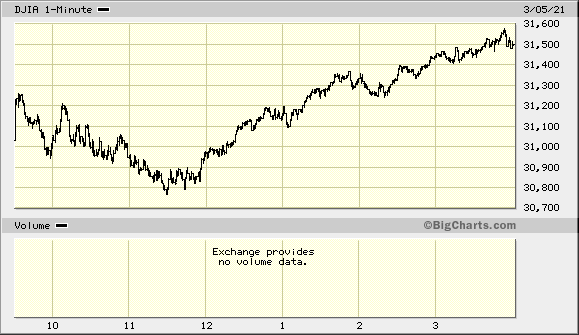
    Of course, that narrative is absolute hogwash. One look at the charts of the major indices prove that there were forces at work other than a superlative jobs report which contributed to the quick and sustained upticks in the price of stocks on Friday, March 5.


    Dow Jones Industrial Average


    NASDAQ


    S&P 500

    The above charts show the Dow, NASDAQ, and S&P 500 for the day. It's clear that all of them responded positive at the open, but quickly faded, then caught bids and continued to rally for the rest of the session. That action can't logically be tied to a smashing jobs report. If that had been the case (non-farm payroll data was released at 8:30 am ET), stocks would have been much higher at the open and remained at high levels through the day, as has been the case in all such instances in the past. No, the stock market could care less about another 379,000 slobs or slaves or plebes getting jobs. Interest rates, inflation fear, the stimulus bill, and other macro indicators have been moving this market.

    Further, eventual gains on all the main indices were uniquely uniform, not erratic and skewed, as has been the norm for many months. In other words, the NASDAQ is usually the leader or loser by an order of magnitude, but on this day, it was nearly in line with the others. See the "At the Close" figures at the bottom of this post.

    And, it all happened at the exact same time: 11:30 am ET, so the dramatic reversal can be attributed to either luck, every trader on the planet hitting their “BUY” buttons simultaneously, or the PPT… or a combination of those.

    Whatever the cause, US equity markets were saved from waterfall-like declines as was the case on Thursday. The hot jobs report provided the perfect alibi for the glad-handers on TV and over at the Wall Street Journal.

    Overall, the week was exciting, invigorating, and, in the end, constructive to the “all is well” narrative from the Fed. The Dow and NYSE Composite bounced off their 50-day moving averages, the S&P closed at its 50-day MA, and, while the NASDAQ ended the week below its 50-day moving average, it managed to claw itself out of correction territory on an intraday basis. The Dow and S&P 500 are both down by less than four percent from their very recent all-time highs. So, all around, success. Clink of glasses, pats on backs, jobs well done.

    For now.

    There will be hell to pay, it’s just not going to be paid this week. There’s still another week of trading ahead, and that will be devoted to parlor games involving the cretins currently in occupancy at the US Capitol, as the Senate ground out provisions in the COVID stimulus (the third in this series) bill handed to them by the House in record time, making some basically cosmetic changes and sending the bill back to the House for a final vote before passing it over to the current resident of the White House (whoever that may be).

    The morons have been posing and preening as usual, acting like they’re doing important work. The majority of these useless idiots have never done an honest days’ work in their lives. Instead, they’re wrecking the economy, the society, and countless lives with their bribery and theft masqueraded as “stimulus.”

    On that point, the people of the United States don’t need any more stimulus. The $1.9 trillion is being directed at state and local governments - a handout to shore up woefully underfunded pension accounts - an extension of additional unemployment insurance benefits, and $1400 checks to anyone earning less than $75,000 a year. Most measurements of net worth, income, retail spending and other data involving the general health of individuals and families are up sharply from a year ago when factoring in additional unemployment insurance checks for 35-45 weeks, stimulus checks, rent and mortgage moratoria, and other easy street incentives rolled out by governments over the past year.

    The money will be ill-spent, but much of it will go right into the coffers of major corporations listed on the various exchanges, either in the form of outright purchases or stock investments, boosting their top-and-bottom lines, making everything on Wall Street look entirely rosy and wonderful.

    Such appearances have to be kept up, unless the serfs storm the Capitol for real or the military turns its guns on the insiders rather than look like they’re protecting them.

    As weeks go, this one was fairly volatile, as all assets had rather outsized price movements. The big winner was OPEC+, as the price of oil rocketed higher when this cartel of oil-producers decided against production ramps. They, and the traders in oil futures, are attempting to convince everybody that there’s demand (that’s funny) and a shortage of supply (that’s even funnier). In any case, they’re doin OK, since WTI crude oil shot up this week from $61.50 to $66.28 a barrel and prices at the pump are sure to follow. A year ago, the price per barrel was $41 and dropping. Yes, we need stimulus checks… to pay for higher-priced gasoline and fuel oil.

    One problem, though, is that oil futures are in backwardation, with the prices for future contracts lower than the current price. Usually, it’s the other way around, a condition called contango. For instance, November WTI contacts are at $61.94. Who is willing to pay spot ($66.28) when you could buy it for less in eight months? Or, for $44.38 in August of 2023. That’s the bid right now. It’s backwards, thus, backwardation. Somebody - actually, a lot of people - don’t believe this high price is sustainable longer term.

    Not to be outdone, the treasury complex has gone completely bonkers. If the price of oil is flashing inflation signs, the 10-year note is a wailing siren for a liquidity crisis.

    On August 4, 2020 - incidentally, about the same time gold was setting a new all-time high - yield on the 10-year was a measly 0.52%. On Friday, March 5, 2020, it closed at 1.56%, triple the yield in just seven months. The short explanation is that investors are demanding a higher payout (interest rate) because they see more risk and more inflation on the immediate and mid-term horizons.

    Those buyers in 2020 accepting 0.52% or 0.93% (12/31/20) are completely back-doored on their investments. They paid premium prices for protection and now can’t sell those bonds unless they’re willing to accept a massive write down from par. Nobody wants a bond returning less than one percent when current issues are fetching 1.5% or more, especially when real inflation (dollar deterioration) - and not what the Fed or some government agency tells you - is running at six to eight percent or higher and about to go parabolic.

    Beyond the obvious, the Fed itself is snatching up all the TIPS (inflation protected) available to keep the inflation bugaboo as quiet as possible, but it’s raging right along. Anybody who buys groceries on a regular basis will tell you that. The best bond traders are not stupid. They clearly see the end of the 40-year secular bull market in bonds and anticipate a period of gnarly, grizzly bearish conditions for money. Conditions are very tight and about to get even tighter. Banks already are reluctant to lend, thus, the emergence of stimulus checks, mortgage and rent moratoriums, and a slow growth to no growth economy. The transition from lockdown to some kind of ordinary is going to be a long slog with many pitfalls and false perceptions, but the trend continues toward complete repudiation of the economic conditions in place and the death of fiat currencies, already worth tiny fractions of their original valuations.

    It’s taken more than 100 years since the Federal Reserve System was established in 1913, but they’ve managed to squeeze nearly every last penny from the dollar. The current estimate is that the dollar has lost 98% of its value over those 108 years. Congratulations to Jerome Powell and Janet Yellen. Here are your bags of merde.

    As the world emerges from lockdown hell, the recovery meme is tantamount to going from solitary confinement to the general prison population. Sure, it’s an improvement, but it still isn’t good. The bond market is imploding, and with it, the world’s towers of debt will crumble to dust.

    Keeping with the money-for-nothing theme, precious metals are deemed by the powers that be to be near worthless investments and not even good hedges against severe economic conditions. Gold was down 1.94% on the week, falling from $1734.40 to a close at $1700.80. Silver got clubbed like the proverbial baby seal, dropping from $26.68 the ounce to $25.24 at week’s end, a loss of 5.4%.

    While somewhat depressing for goldbugs and silver stackers, the low, low prices do represent a buying opportunity, if any price even within 10% of spot can be had at local or online dealers.

    Here are the most recent prices for common gold and silver items sold on eBay (numismatics excluded, shipping - often free - included:

    Item: Low / High / Average / Median

    1 oz silver coin: 33.99 / 52.00 / 40.77 / 39.54
    1 oz silver bar: 36.00 / 56.53 / 45.76 / 44.42
    1 oz gold coin: 1,845.04 / 1,929.10 / 1,876.79 / 1,879.00
    1 oz gold bar: 1,800.00 / 1,950.48 / 1,834.42 / 1,817.28

    What the current eBay prices are showing is that the most recent short raids in precious metals has caused some slippage at the retail end, but not to any severe degree.

    The new Single Ounce Silver Market Price Benchmark for this week is $42.62, a significant decline from last week's price of $44.34, and the first price decline in five weeks.

    Last, but certainly not least, here’s Max Keiser with a double dose of Stacy Herbert, explaining and extrapolating current economic conditions into real world applications.

    At the Close, Friday, March 5, 2021:
    Dow: 31,496.30, +572.16 (+1.85%)
    NASDAQ: 12,920.15, +196.68 (+1.55%)
    S&P 500: 3,841.94, +73.47 (+1.95%)
    NYSE: 15,251.83, +292.42 (+1.95%)

    For the Week:
    Dow: +563.93 (+1.82%)
    NASDAQ: -272.20 (-2.06%)
    S&P 500: +30.79 (+0.81%)
    NYSE: +241.37 (+1.61%)

    Saturday, March 6, 2021

    Rough Day On Wall Street; NASDAQ In Correction; February Payrolls Stunning

    (Editor's Note: This post was originally supposed to be posted at roughly 8:35 am ET, Friday, March 5. We tried. It was at that time that internet service was cut off, so, this post never actually made it to the internet. What happened is that some of our town's public service workers (always remember, when you seek incompetence, look straight to government) actually cut our service provider's main fiber connection to the internet (We have an email that proves it). Thus, not only Money Daily and Downtown Magazine were offline for most of Friday (finally got it back about 4:40 in the afternoon), so were many people and businesses in Monroe County, TN. We didn't notice that the post reverted back to draft form on Blogger until about 3:00 pm ET on Saturday. The same post on Downtown Magazine (dtmagazine.com), did, fortunately, get uploaded to the internet before service was abruptly interrupted. Sorry for any inconvenience this may have caused. -FR. Stocks took a serious nosedive on Thursday when Fed Chairman, Jerome Powell, failed to address recent volatility and other issues at a noon speech to the Wall Street Jobs Summit, carried live over the internet.

    While there was little indication that Powell was supposed to reassure markets at this juncture, from the tone of his remarks it appeared that the Fed Chairman was somewhat tone deaf to recent declines in stocks and a bond market rout that was producing runawway interest yield on the 10-year note.

    As close as the Chairman got to offering reassurances was the following:

    “I would be concerned by disorderly conditions in markets or persistent tightening in financial conditions that threatens the achievement of our goals.”
    --Jerome Powell

    If the Fed's goals are to heat up the pace of inflation (which has more or less been made official policy) and keep the stock market from imploding, he's not exactly batting 1.000. The various bond, stock and commodity market would be better served to not rely upon officials such as Powell or Treasury Secretary Janet Yellen for guidance as they've proven to be largely incompetent in both monetary and fiscal policy.

    The key takeaways from Thursday's carnage were:

  • The NASDAQ dipped into correction territory on an intraday basis when it marked below 12,757.61. On a closing basis, it would have to close at 12,685.50.
  • The Dow Jones Industrial Average fell more than 720 points early afternoon before retracing the losses by half.
  • The S&P 500 was down nearly 100 points, eventually closing down 51.
  • Yield on the 10-year note crested above 1.55%
  • Bitcoin fell roughly six percent and continues at lower levels
  • Silver dropped to its lowest level since late January
  • Gold continued its months-long decline, closing in NY below $1700 an ounce, down more than $300 from August highs
  • Unrelated, WTI crude oil shot up dramatically as the OPEC+Russia nations agreed to not boost production, putting pressure on prices worldwide. WTI closed above $64 on Thursday and continues higher ($65.39/barrel) in Friday's futures trading.

    What comes next for markets is a double-edge sword with March non-farm payroll data due out at 8:30 am ET and the US Senate embarking upon weekend debate of the $1.9 trillion COVID stimulus bill which faces an uncertain fate.

    Money Daily will stay with the narrative through the release of the payroll data in this posting, and will update on the Senate in Sunday's WEEKEND WRAP.

    Boring deeper into Thursday's stock rout, the only saving grace for Wall Street was the sudden appearance of bids - likely the work of the PPT - right at the day's lows at 2:00 pm ET. The NASDAQ priced at 12,555, which would have been an 11% decline from the recent closing high had the number persisted to the session's end.

    There may have been some dip-buying, but it was likely pretty thin and without spirit. With risk rising and the NASDAQ now having posted lower closes on nine of the past 13 sessions, it's doubtful that investors would be pouring money into anything that didn't offer the potential for outsized gains or at worst, price stability. Currently, there's little of either available.

    After closing at an all-time high of 31,961.86 on February 24, the Dow Industrials have closed lower five of the past six sessions and are down a mere 3.25% as of Thursday's close. Similarly, the S&P 500 made a record close of 3,925.43 on the same day as the Dow and is only down four percent over the past six trading days.

    What's dragged down the NASDAQ are high-flying tech stocks, which hasn't had much affect on the other indices. A four to six percent decline is surely nothing to worry veteran traders, particularly those with longer views of the market.

    Getting past Friday's non-farm payroll numbers and through the passage of some kind of relief bill from congress will not be easy. With the Senate comprised of 50 senators from each side of the aisle, passing the stimulus bill intact in the form sent over by the House is unlikely, though Democrats appear intent on ramming the legislation though on a partisan basis with Vice President Kamala Harris casting the deciding vote and Biden sure to sign it.

    Early next week may be somewhat rocky for markets, but while it's been only whispered, yield curve control (YCC) may be implemented by the Fed in short order, designed to keep longer-dated interest rates in line with the ultra-low short end of the treasury curve.

    The 10-year and 30-year bonds have been noisy of late because of the threat of inflation. Food prices have risen for the past nine months with no signs that they're abating soon. The outwardly absurd price of crude oil is also fueling inflation by raising prices at the gas pump, a condition that can only slow any nascent recovery as the COVID crisis winds down and more states and municipalities begin the reopening process.

    In less than two weeks, the FOMC assembles for a scheduled policy meeting on March 16 and 17. It is likely that, at the conclusion of that meeting, a statement designed to cool market conditions will be announced, returning markets to the preferred path of relentless gains. After all, there's an enormous amount of money being sloshed around by the Fed and Treasury, and when the public begins receiving $1400 checks, stocks are likely to be one of the main beneficiaries. The timing of a slight decline in the markets couldn't be better, ripe for retail speculation.

    March's non-farm payroll was expected to show 200,000 new jobs versus a gain of 49,000 in January and the unemployment rate unchanged at 6.3%. When the BLS released the data at 8:30 am ET, everybody was stunned as payrolls increased by 379,000 in February and the unemployment rate fell to 6.2%.

    Stock futures, already ramped higher in earlier activity, continued to climb, pointing to a positive open on Wall Street.

    Enjoy the warmer weather. Check back on Sunday for updates in the WEEKEND WRAP.

    At the Close, Thursday, March 4, 2021:
    Dow: 30,924.14, -345.95 (-1.11%)
    NASDAQ: 12,723.47, -274.28 (-2.11%)
    S&P 500: 3,768.47, -51.25 (-1.34%)
    NYSE: 14,959.41, -239.78 (-1.58%)


    Thursday, March 4, 2021

    Fearless Rick Predicts: Stocks, Silver, Bitcoin, Interest Rates, Real Estate

    I rarely write in the first person personal, but today I am doing so because today is special.

    Today, more than ever before, I feel confident about the economy and, more importantly, my understanding of where it is going, how it's going to effect people, and how specific markets are going to react.

    For background, I've been a writer since I was five years old. I was actually publishing my own magazine when I was six. I've owned newspapers, and I've been publishing on the internet since 1999. I started writing about economics, finance and markets in 2003. I'm 67, so, I think I've got the credentials, finally, to offer reasonably good information (not advice) on stocks, bonds, real estate, financial markets, maybe even a little about cryptocurrencies, particularly Bitcoin. On that last point, I have to thank Max Keiser and Stacy Herbert of the Keiser Report most of all, but also Michael Saylor, CEO of Microstrategy.

    Max Keiser and Stacy Herbert have been pounding the table on Bitcoin for over a decade. With Bitcoin at $50,000, I believe it's safe to say that they're right. Bitcoin is the future of money and the savior of wealth. Michael Saylor took the Bitcoin meme to a new level recently, investing his company's cash into it, to the tune of $4.45 billion.

    But let's get to the heart of the matter. I'm looking at stock market futures and other indicators here at roughly 7:30 am ET, and I'm seeing what looks to be a continuation of the recent sell-off in tech stocks, now spilling over into mainstream stocks. Futures were down a bunch just a few minutes ago, but they're quickly heading toward positive territory. As I write, S&P futures are down 8.50, Dow futures off 34, NASDAQ futures off 31. No big deal, right?

    Wrong. Big Deal. This market is diving headlong into a correction. Futures are full of fakery, maybe even moreso than the equity cash market, the COMEX, or unemployment statistics. There's my first prediction. The NASDAQ is right on the verge of a correction, of which the Dow, S&P, and NYSE will soon follow.

    Wednesday's massive losses on the NASDAQ were scary enough, but investors and the general public are going to get even more agitated in coming days. I'm not saying it's going to happen today or tomorrow or even next week, but it's probable that the NASDAQ will fall another 400-800 points in short order, dragging down the other indices into a 10% correction.

    Charts are telling the whole story very clearly. There was a correction in September of 2020 when the NAZ fell from 12,074 to 10,519. It nearly did it again in October, dipping from 11965 to 10822. Both times, the index fell below its 50-day moving average, but never got even close to the 200-day moving average.

    What happened next? The NASDAQ zoomed higher at a nearly 45 degree angle, left to right, all the way to a top tick at 14,175.12 on February 16, the Tuesday after Martin Luther King Day and one session after reaching the all-time closing high of 14,095.47 on the 12th. The index closed lower on the 16th, down nearly 48 points and it's been lower ever since.

    To get into correction territory (-10%), the NASDAQ has to dip below 12,757.61. That's about 250 points. It could do that at any time since it's already closed below the 50-day moving average as of yesterday. It will. It's almost a done deal. With the coronavirus scare fading fast, the media and the powers that be need something else with which to scare the public and the economy is always good for a quick fix.

    Scare enough people and they will sell their stocks, which is the intention, to shake out the weaker hands. A little rough patch in the stock market is also good for the political class and their $1.9 billion stimulus package which is now in front of the Senate. Nothing like a weak stock market to justify spending a couple trillion dollars.

    Now that I've gone and stuck my neck out on a correction, I'm going to stick it out just a little bit further and predict that the correction will not last long. The NASDAQ will go down to maybe 12,400, maybe even a little below 12,000 before the PPT or the Fed or Janet Yellen or anybody with a loud enough voice tells the world that stocks are cheap. It might even be at the next FOMC meeting (March 16-17), which means stocks get whacked down today, tomorrow, next week, then Jerome Powell and his merry band on central bankers ride to the rescue and stocks go straight up because they're there to support the markets and the economy and they see no inflation threat and look, the government just passed the stimulus bill, and so, all is good, we have spoken.

    That's how it works. It'a all rigged, a con game gone wild and I've finally seen it enough times to maybe make a few bucks off it. Don't short this market. You could have on the 16th or the 18th, but, if you did, you should be getting ready to cover.

    OK, so stocks are going to go down some, then right back up. Everybody's going to get $1400, cities and states are getting huge wads of cash, and thanks to the video with George Gammon below, we know that Janet Yellen is going to release another trillion dollars worth of additional QE over the next four months (he says so at about the 18:30-minute mark). And, that's confirmed thanks to this Bloomberg report detailing some of the intricacies of Yellen spending down Treasury's cash horde of $1.6 trillion to about $500 billion by the end of June. There will be tons of money sloshing around and much of it will go straight into stocks.

    Yellen's spending spree may have already begun. The main buyer is the Federal Reserve, which will add to its already bloated balance sheet. That would also help explain the inordinate rise in the 10-year yield, which really started taking off in February, around the time Yellen made her announcement. It was all there to see, but few understand the implications. I certainly cannot claim to understand how all of this works. It's extremely complex, as stated in the Bloomberg article. Maybe nobody understands it exactly, but surely well less than one percent of the public does, and probably a small number of traders do. What everybody does understand, or will come to understand, is that these huge sums of money changing hands at the top of the financial food chain will have major downstream effects to the markets and the economy.

    Moving on to a more obvious subject for prediction: What's the price of sirloin steak? To be honest, it's been so high for so long, I don't even bother to look any more. I'll take a stab that it's about $18 a pound. I'm here to tell you that it's going to be higher this summer and even higher by fall. At my local Ruth's Cris Steak House, a 16 oz. New York strip steak is $53, and a similar size Ribeye is $59. I happen to remember a time - not that long ago - when you could have a full dinner for two with those items on them, appetizers and tip for that price.

    So, I predict there will be inflation, and it will be rampant by fall. That's probably a no-brainer.

    Incidentally, and this should not go without notice, even though nobody in the financial media mentioned it, but the national debt (federal government debt) ripped past $28 trillion on Tuesday. It happened so fast, sooner than I had thought it would, I missed it too.

    How about silver? Well, since the reddit-inspired silver short raid a few weeks ago, the COMEX seems to be in a particularly nasty payback mood. Silver hit $30 on the ask on February 22nd and it's been straight down since, dropping to the low $26 range and briefly with a $25 handle overnight ($25.81). It wouldn't surprise me one bit to see silver on the COMEX at $23 or even lower. There's quite a bit of support in the $22-24 range, but even at today's price - if one were actually able to buy silver at spot or even spot +10% - it's a solid buy.

    I'd buy it now and buy more in coming weeks and months. The COMEX has silver rigged to the gills along with gold. They will go higher some day, when the Fed is trashed and the US dollar is absolutely worthless. We're close and getting closer, but that day is not today, and it’s probably not for some months if not years from now.

    So, OK, it's getting closer to 9:30 am, before which I intend to publish, so I'm going to move along, but first, note that initial unemployment claims hit 745,000 this morning, just announced at 8:30 am by the Labor Department. While on that subject, I think it's an easy call to say that unemployment is going to stay above five percent for a long time. There's no reason to work if you're collecting unemployment checks, and the politicians are making sure those still at home in their underwear most of the day are well supplied with cash.

    Bitcoin: It's going higher. At a trajectory that will be lower than the one from November, 2020 to February, 2021, Bitcoin will next rise to $70,000, before heading to $150,000 by September. If it does that, it's likely to double before the end of the year. So, on January 1, 2022, we all may be Bitcoin millionaires, with the price of one Bitcoin at $300,000 or higher. I'll be doing more on the logical limits to the price of bitcoin in future posts. (Hint: it's still very cheap. Buy some).

    On the matter of Bitcoin. If you know anything about it and you hopefully have some in your possession, ask your friends the following two questions: Do you have a PayPal account? The answer is likely to be yes. Then, ask, "do you own any Bitcoin?" Wait for the answer, and it it is no, ask them "Why not?" Fun for the whole family.

    Finally, interest rates and real estate: The yield on the 10-year note is going to stay put at around 1.45% to 1.55%. The Fed can't allow it to go much beyond that because it would not only affect stocks, but the mortgage market as well. Look for some volatility, but they'll tamp it down pretty soon. If they don't, my projections on stocks are going to be wrong. A yield of 1.65% on the 10-year would likely lead to a bear market in stocks and would also kill the housing market via rising mortgage rates. These things are inevitable, but just not imminent, in my view. Housing it vastly overpriced, by the way. I would not touch any real estate right now. It's all too expensive and due for a reversal on the scale of that which was seen in 2008-09. That will come later in the year or in 2022. There are too many people not paying on their mortgages or not paying rent for real estate not to crash.

    There you have it. I'm long stocks (soon), silver and bitcoin. If I could, I would sell real estate. I'm not a broker and currently have just enough real estate for myself, so I'm holding. I don't do fixed income. See my post titled, "Bonds. No Bonds." for reasons why. Overall, the timing is good to buy hard assets, including gold and silver, crypto, and then prepare to purchase real estate at bargain prices with the gains.

    Have a great day and week, and don't miss the video below.

    --Fearless Rick (FR)

    It doesn't get any better than than this video: George Gammon, the Rebel Capitalist, with the Robin Hood of Wall Street, Gregory Mannarino. Amazing insights from two of the leading investment and finance minds of our time.

    At the Close, Wednesday, March 3, 2021:
    Dow: 31,270.09, -121.43 (-0.39%)
    NASDAQ: 12,997.75, -361.04 (-2.70%)
    S&P 500: 3,819.72, -50.57 (-1.31%)
    NYSE: 15,199.19, -77.83 (-0.51%)