Tuesday, October 7, 2025

Government Shutdown Day 7: No Progress in Senate; House Won't Return Until October 14; Gold, Silver Continue to Advance

The federal government shutdown that began on October 1 enters its seventh day on Tuesday, a week without work or pay for up to 750,000 laid-off, laid-back federal employees and a week of working without pay for the rest of the government's roughly two million employees deemed exempt or essential including members of the military and air traffic controllers.

The Senate failed to pass either of the bills that would continue funding the government until November 21 again on Monday. It was the fifth time the chamber voted on competing bills forwarded by Republican and Democrat leadership. The Republican bill remains in the framework of the bill passed by the House more than two weeks ago. The Democrat version adds in funding for health care. Neither are close to reaching the 60 votes needed for passage and neither side is making concessions or changes to their legislation.

Across the chamber, the House of Representatives isn't expected to return to session until October 14. House Speaker Mike Johnson insists that the House has done its job by passing funding legislation and is only awaiting their colleagues in the Senate to get their act together and send a bill to President Trump's desk for his signature.

None of that appears to be any closer to reality than it was a week ago, despite Trump's comments Monday that progress was being made in the Senate. Negotiations, according to most reliable sources, are not taking place. Finger-pointing and the usual useless rhetoric are in season as the shutdown becomes a political football and begins to be weaponized by the White House. The latest rumblings are coming from airlines and airports, where air traffic controllers are operating as skeleton crews. On Monday, Burbank Airport in California was without any air traffic controllers for about six hours due to shutdown-related scheduling.

Should air traffic controllers slow down operations or report sick en masse, as they have done in other shutdown situations, the standoff between the politicians might reach a compromise sooner. However, airlines are still seeing only minor delays without much disruption. The situation has not reached anywhere near critical, so the shutdown is expected to last at least another week.

Wall Street remains ambivalent towards its Washington counterparts. Stocks gained again on Monday, with the S&P and NASDAQ making all-time highs again. The Shiller PE (CAPE) continues to rise, ending Monday at 40.23.

Gold and silver continue along an inexorable path twoard $4,000 and $50.00, respectively. WTI Crude Oil finished higher on Monday, counter to the longer term bearish trend.

Stock futures point to another higher open.

Conditions have not grown serious enough to warrant selling of stocks, yet.

At the Close, Monday, October 6, 2025:
Dow: 46,694.97, -63.31 (-0.14%)
NASDAQ: 22,941.67, +161.16 (+0.71%)
S&P 500: 6,740.28, +24.49 (+0.36%)
NYSE Composite: 21,765.00, +39.60 (+0.18%)


Sunday, October 5, 2025

WEEKEND WRAP: Government Shutdown Day Five: Stocks, Gold, Silver Gain; Oil Lower; Trump Pressures States by Withholding Funds; Age of Delusion Persists

WEEKEND WRAP: Government Shutdown Day Five: Stocks, Gold, Silver Gain; Oil Lower; Trump Pressures States by Withholding Funds; Age of Delusion Persists

Sunday, October 5, 2025, 11:34 am ET
The federal government's game of musical chairs, combined with finger-pointing, grandstanding, and bluffing, will be a week old by Tuesday, but that's still probably too soon for financial markets to begin pondering outcomes. For now, life in the U.S.A. continues on without a hitch. President Trump has been calling in some markers, withholding funds from states, especially those earmarked for green energy projects, the most prominent being New York, which pledged to its "woke" constituency back when Andrew Cuomo was still governor, that it would be fully "green" by 2030.

Like all other government promises and projections, that one is likely to never come to fruition, but that's a discussion for another day. Presently, there isn't much that would indicate that anything has gone awry. It's probably going to take a statement from Treasury Secretary Bessent for anybody to notice the cracks widening in the economy because many of the usual benchmark data releases are not going to happen while various agencies are on furlough.

In essence, markets are flying blind, keeping up hopes that the political hacks in D.C. will come to their senses and make a deal - even if it's only good for six weeks - to fund their operations. That sentiment is not going to last much beyond a few more weeks if the shutdown persists. While stocks continued to make new highs, there has been some leakage of money flows into fixed income, and, more importantly, to gold, silver, and bitcoin.

Stocks

The NASDAQ's 230-point drop from the high to the low on Friday may have been a warning shot fired. Similarly, the S&P shedding 45 points before finishing up less than 0.02% for the day, served notice that conditions are worsening, or, to put it in more mundane parlance, "things are getting a bit dicey."

Stocks took the government shutdown with the usual whistle past the graveyard. The rally off the April tariff lows remains in place, but the failure of the Dow Transports to confirm the move to record highs on the Industrials has Dow Theorists losing some sleep, not that anybody has time nor patience for fundamental analysis anymore.

One of the variants of the government shutdown was that the BLS wasn't around to fool everybody with phony employment numbers from September. In stepped ADP on Wednesday, announcing that the private sector lost 32,000 jobs over the month and August was revised down by 43,000. Adding in the 600-750,000 government employees taking time off via the shutdown, the number of job losses since the end of July is closing in on a million, and that's not including the government contractors who will be putting some - if not all - workers on leave shortly.

The longer the government keeps the "out of order" signs posted, the worse the already weak employment sector of the economy is going to become. That's usually something Wall Street can redefine as a positive because when private companies do it, it lowers expenses and boosts the bottom line. This time may be different, though it's to be expected that the Big Kahunas of finance won't come right out and say so.

The week ahead, outside of the shutdown dynamics, offers the first glimpses of third quarter earnings from a number of key companies. The week following will see earnings season kick into high gear, starting with the banks, but let's not get too far ahead of the game. Here are some items of interest looking forward:

Monday, October 6: Constellation Brands (STZ) reports, OpenAI's DevDay developer conference kicks off.

Tuesday, October 7: McCormick (MKC) reports 3Q earnings. Consumer credit (August), Federal Reserve's Atlanta President Raphael Bostic, Vice Chair Michelle Bowman, Governor Stephen Miran and Minneapolis FedRes President Neel Kashkari all have speaking engagements. Amazon's (AMZN) Prime Big Deal Days Begin. U.S. August trade deficit delayed, not reporting.

Wednesday, October 8: Bassett Furniture (BSET) reports 3Q earnings; FOMC Minutes from September meeting; Fed Officials, including Fed Governor Michael Barr, St. Louis Fed President Alberto Musalem speak.

Thursday, October 9: PepsiCo (PEP), Delta Air Lines (DAL), Levi Strauss (LEVI), Applied Digital (APLD), Helen of Troy (HELE) report 3Q earnings. Initial jobless claims (Week ending 10/4), Wholesale Inventories for August will not be reported. Fed Chairman Jerome Powell, Treasury Secretary Scott Bessent, and Fed Vice Chair for Supervision Michelle Bowman are all expected to speak at Fed’s Community Bank Conference.

Friday, October 10: University of Michigan Consumer sentiment for October will be reported; Monthly U.S. federal budget for September may not be (still in doubt). Chicago Fed President Austan Goolsbee, St. Louis Fed President Alberto Musalem have speaking engagements.

The Shiller PE (CAPE) closed out the week at 40.08, a 25 year high (since the dotcom bubble)

Treasury Yield Curve Rates

Date 1 Mo 1.5 mo 2 Mo 3 Mo 4 Mo 6 Mo 1 Yr
08/29/2025 4.41 4.34 4.30 4.23 4.17 4.01 3.83
09/05/2025 4.29 4.24 4.24 4.07 4.05 3.85 3.65
09/12/2025 4.24 4.24 4.20 4.08 4.02 3.83 3.66
09/19/2025 4.19 4.16 4.14 4.03 3.98 3.81 3.60
09/26/2025 4.22 4.20 4.17 4.02 4.00 3.83 3.67
10/03/2025 4.24 4.17 4.11 4.03 3.96 3.82 3.64

Date 2 Yr 3 Yr 5 Yr 7 Yr 10 Yr 20 Yr 30 Yr
08/29/2025 3.59 3.58 3.68 3.92 4.23 4.86 4.92
09/05/2025 3.51 3.48 3.59 3.80 4.10 4.72 4.78
09/12/2025 3.56 3.52 3.63 3.81 4.06 4.65 4.68
09/19/2025 3.57 3.56 3.68 3.88 4.14 4.71 4.75
09/26/2025 3.63 3.66 3.76 3.96 4.20 4.74 4.77
10/03/2025 3.58 3.59 3.72 3.90 4.13 4.69 4.71

Yields on notes and bonds fell this week, with the bulk of the moves happening Monday, as the market correctly sensed the government shutdown and fled risk assets for the safety of treasuries. Of course, the moves in bonds were dwarfed by those in the gold and silver markets, which are becoming increasingly explosive.

There's some irony here, as treasury notes and bonds, being government obligations, saw buying just as the government itself begins to run out of funding. The longer the government remains in "partial shutdown" mode, the riskier these obligations become, bringing into play the ages-old dilemma of promises for return ON one's money becoming a question of return OF one's money. Sooner or later - and the odds seem to favor sooner - a major Western government is going to formally default and $$ trillions will be lost in a matter of hours or days. Once that genie leaves the bottle, there will be no turning back and the fiat currency regime that has now reached an advanced age of 54 years (1971-2025) will embark upon the final collapse.

In the meantime, whichever government is in control in the United States or The United States, still appears to be capable of compromise, to end the shutdown and get back to the business of wheedling away at the wealth of the nation. It's beginning to look like this is going to drag on a few more weeks at least, and that the drama hasn't really yet begun.

Spreads were compressed over the week, with full spectrum down from +55 to +47, and 2s-10s retreating 12 basis points, from +57 to +45, tying for the lowest since the tariff tantrum in April of this year. If spreads continue to decline, banks will no longer have healthy lending margins, which always leads to a liquidity crisis.

A lot has been said recently about "Curve Control" policies being implemented by the Fed in order to maintain market stability. That would invlove more purchases at treasuries at lower yields, which would go straight to its balance sheet, which has been reduced from nearly $9 trillion down to near $6.5 trillion over the past three years. If the Fed has to begin making more purchases - and bear in mind that they're technically bankrupt already - they will be doing so with "magic money" created out of thin air, something of which global markets have had a belly full in recent years.

Spreads:

2s-10s
9/15/2023: -69
9/22/2023: -66
9/29/2023: -44
10/06/2023: -30
10/13/2023: -41
10/20/2023: -14
10/27/2023: -15
11/03/2023: -26
11/10/2023: -43
11/17/2023: -44
11/24/2023: -45
12/01/2023: -34
12/08/2023: -48
12/15/2023: -53
12/22/2023: -41
12/29/2023: -35
1/5/2024: -35
1/12/2024: -18
1/19/2024: -24
1/26/2024: -19
2/2/2024: -33
2/9: -31
2/16: -34
2/23: -41
3/1: -35
3/8: -39
3/15: -41
3/22: -37
3/28: -39
4/5: -34
4/12: -38
4/19: -35
4/26: -29
5/3: -31
5/10: -37
5/17: -39
5/24: -47
5/31: -38
6/7: -44
6/14: -47
6/21: -45
6/28: -35
7/5: -32
7/12: -27
7/19: -24
7/26: -16
8/2: -08
8/9: -11
8/16: -17
8/23: -09
8/30: 00
9/6: +06
9/13: +09
9/20: +18
9/27: +20
10/4: +5
10/11: +13
10/18: +13
10/25: +14
11/1: +16
11/8: +5
11/15: +12
11/22: +4
11/29: +5
12/6: +5
12/13: +15
12/20: +22
12/27: +31
1/3: +32
1/10: +37
1/17: +34
1/24: +36
1/31: +36
2/7: +20
2/14: +21
2/21: +23
2/28: +25
3/7: +33
3/14: +29
3/21: +31
3/28: +38
4/4: +33
4/11: +52
4/17: +53
4/25: +55
5/2: +50
5/9: +49
5/16: +45
5/23: +51
5/30: +52
6/6: +48
6/13: +45
6/20: +48
6/27: +56
7/3: +47
7/11: +53
7/18: +56
7/25: +49
8/1: +54
8/8: +51
8/15: +58
8/22: +58
8/29: +64
9/5: +59
9/12: +50
9/19: +57
9/26: +57

Full Spectrum (30-days - 30-years)
9/15/2023: -109
9/22/2023: -99
9/29/2023: -82
10/06/2023: -64
10/13/2023: -82
10/20/2023: -47
10/27/2023: -54
11/03/2023: -76
11/10/2023: -80
11/17/2023: -93
11/24/2023: -95
12/01/2023: -105
12/08/2023: -123
12/15/2023: -154
12/22/2023: -149
12/29/2023: -157
1/5/2024: -133
1/12/2024: -135
1/19/2024: -118
1/26/2024: -116
2/2/2024: -127
2/9: -117
2/16: -103
2/23: -112
3/1: -121
3/8: -125
3/15: -109
3/22: -112
3/28: -115
4/5: -93
4/12: -87
4/19: -77
4/26: -70
5/3: -85
5/10: -87
5/17: -94
5/24: -99
5/31: -83
6/7: -92
6/14: -113
6/21: -103
6/28: -96
7/5: -101
7/12: -108
7/19: -103
7/26: -104
8/2: -143
8/9: -131
8/16: -138
8/23: -141
8/30: -121
9/6: -125
9/13: -117
9/20: -80
9/27: -80
10/4: -75
10/11: -58
10/18: -54
10/25: -38
11/1: -18
11/8: -23
11/15: -10
11/22: -12
11/29: -40
12/6: -23
12/13: +18
12/20: +29
12/27: +38
1/3: +38
1/10: +54
1/17: +41
1/24: +40
1/31: +36
2/7: +32
2/14: +32
2/21: +31
2/28: +13
3/7: +24
3/14: +25
3/21: +23
3/28: +26
4/4: +5
4/11: +38
4/17: +44
4/25: +40
5/2: +41
5/9: +46
5/16: +52
5/23: +68
5/30: +59
6/6: +69
6/13: +67
6/20: +69
6/27: +66
7/3: +51
7/11: +59
7/18: +65
7/25: +55
8/1: +32
8/8: +37
8/15: +44
8/22: +41
8/29: +51
9/5: +49
9/12: +40
9/19: +54
9/26: +55

Oil/Gas

WTI crude oil closed out the week at $60.36, down sharply from the close on 9/26 at $65.19. While the decline was "unexpected" to some people in the business of tracking oil prices, it was no surprise to those following technical analysis. Oil, from Brent to WTI to Russian oil sold to India, China, and elsewhere, remains in a long term bear market, dating back to June 2022, when it peaked at $118/barrel, and more recently, in September, 2023, reaching a peak of $90.79. Simple math says WTI crude is down a third from two years ago with no end to the price decline or a bottoming evidenced anywhere.

The lower price for crude oil, running counter-cyclical to inflation, may be indicating something deeper and darker than the otherwise bubbling stock market is telling. The suggestion is that the global economy - which, despite protestations from climate change true believers, still runs on coal, oli, and natural gas - has been slowing for the better part of two years. There's evidence in Europe, to be sure, though one wouldn't see the same structure. European oil prices have been rising steadily and only recently stabilized, since the outbreak of the conflict in Ukraine in February, 2022.

European economies in the largest countries - Germany France, Italy, England - are on the brink of economic collapse. Energy prices in those countries have nowhere to go but lower, as people essentially go broke just trying to fund everyday needs. While lower prices for crude oil and petrol may offer some relief, it's on the back of a manufacturing slowdown of depression-era proportions.

U.S. gas prices were moderately higher over the course of the week, the national average at $3.12 Sunday morning, according to Gasbuddy.com.

State-by-state numbers show California remaining on top, steady at $4.65 per gallon, followed by Washington ($4.51), which was six cents lower and joined in the $4 club by Oregon ($4.12), also down. The lowest prices remain in the Southeast, with Oklahoma ($2.55) ranging in a multi-month low, followed by Mississippi ($2.66), Louisiana ($2.70) and Arkansas.

The Northeast remained, as a bloc, above $3.00, though Delaware ($2.96) and New Hampshire ($2.98), breaking below. Virginia ($2.97), West Virginia ($2.94), and Kentucky ($2.81) remained lower, though Ohio surged slightly to $3.00. Indiana ($3.01), Michigan ($3.08), and Illinois ($3.30) are the only midwest states above $3. All midewest states from Wisconsin, Minnesota, and North Dakota south to Missouri, Kansas, and Colorado are below $3/gallon.

Sub-$3.00 gas can be found in 26 states, up one from last week, concentrated in the South and Midwest with Ohio and Florida back above the line, but Wyoming, New Hampshire and Delaware dropping below. The entire Southeast, out to New Mexico ($2.88) is under $3.00 a gallon. Gas in next door neighbor New Mexico is $3.54, making border hops appealing to cost-conscious drivers, though the gap has narrowed by 11 cents from last week.

Bitcoin

Early Sunday morning, bitcoin reached a new all-time high of $125,178.70. It has backed off some $2000+ dollars since.

This week: $122,985.87
Last week: $109,980.20
2 weeks ago: $115,734.60
6 months ago: $83,366.77
One year ago: $62,619.78
Five years ago: $11,295.51

Money will flow to bitcoin if there's some trouble in stocks. However, should there be margin calls on a severe market break, bitcoin will be one of the first assets sold, ahead of gold and silver, which are more likely, this time around, to be held onto by speculators and anybody with functioning brains.

Precious Metals

Gold:Silver Ratio: 81.55; last week: 81.73

Per COMEX continuous contracts:

Gold price 9/5: $3,639.80
Gold price 9/12: $3,680.70
Gold price 9/19: $3,719.40
Gold price 9/26: $3,789.80
Gold price 10/3: $3,912.10

Silver price 9/5: $41.51
Silver price 9/12: $42.68
Silver price 9/19: $43.37
Silver price 9/26: $46.37
Silver price 10/3: $47.97

Money Daily's weekly survey on eBay and a quick price hunt on a number of online dealers revealed that silver cannot be purchased, except in large quantities or under unusual circumstances, for less than $50 per ounce, nor can gold be had under $4,000. The confluence of events, including a shortage in silver bullion, the government shutdown, recent and ongoing efforts by China, via the Shanghai Metals Exchange and vaulting facilities being readied in Hong Kong, Dubai and elsewhere, have turned the tables on the London price fixes, LBMA, and COMEX operations. Increasingly, gold, silver, platinum, and palladium price are being set elsewhere, reflecting a fundamental shift in global economies. Silver, especially, has been making record highs in just about every country except for the United States, which continues to maintain short positions, costing billions of dollars. Eventually, the U.S. is going to have to stop their foolish suppression games or pay severe consequences.

Prices continue to rise, and now that investment advisors are recommending 15-25% allocation to precious metals to their high net worth clients, prices will, almost without a doubt, skyrocket. There have been no pullbacks and nothing short of a major war or stock market crash can cause any. Even then, gold and silver might actually explode even higher as safe-haven assets. Those who have been patiently stacking and hoarding are soon to experience great financial rewards.

Here are the most recent prices for common one ounce gold and silver items sold on eBay (free shipping included, numismatics excluded):

Item/Price Low High Average Median
1 oz silver coin: 49.95 59.00 53.40 52.38
1 oz silver bar: 49.95 58.00 53.48 54.27
1 oz gold coin: 3,985.51 4,166.61 4,067.79 4,071.24
1 oz gold bar: 3,959.99 4,101.60 4,055.58 4,065.08

The Single Ounce Silver Market Price Benchmark (SOSMPB) made another new record high since Money Daily began recording in 2020, of $53.38, a healthy gain of $1.34 from the September 28 price of $52.04 per troy ounce.

Gold and silver continued to move higher, with silver leading the way over the near term. Year-to-date, gold is up 48.01%; silver, 64.06%, both up six weeks running as of Friday closes on the COMEX.

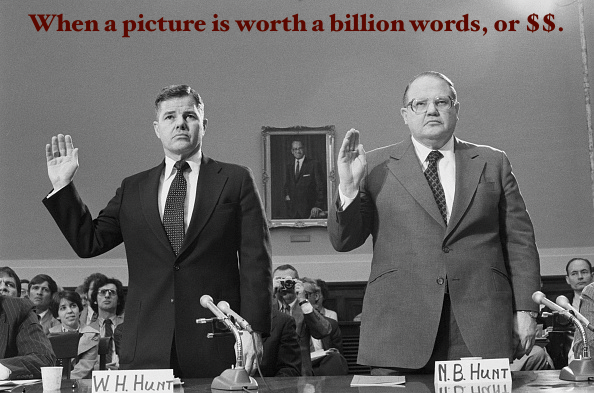
Speaking of the COMEX, silver is currently, and has been for a few weeks, in backwardation, a condition where the spot price is higher than the futures price. It was reported on Saturday that there is not a single out of silver available to short on the market, a condition, for all intents and purposes, has never occurred before. Additionally, the criminals at the COMEX raised margin requirements for all gold and silver contracts, but apparently not enough to slow down price gains. The CME and COMEX may have to resort to tactics last deployed in early 1980, as a response to the attempt by brothers Nelson Bunker Hunt, William Herbert Hunt and Lamar Hunt (collectively known as the Hunt Brothers) to corner the silver market.

As the story goes, on January 7, 1980, the COMEX board of governors announced that it would cap the size of silver futures exposure to 3 million ounces. Those in excess of the cap (Bunker was long on 45 million ounces; Herbert held contracts for 20 million) were given until the following month to bring themselves into compliance. That was too long a wait for the Chicago Board of Trade exchange, which suspended the issue of any new silver futures on January 21. Silver futures traders would only be allowed to square up old contracts. Silver contracts were "sell only."

The price of silver falling at an accelerated pace, the Hunt's were issued margin calls. The Bache Group wanted $100 more in collateral for the money they had lent the Hunts. On March 27, 1980, which has become known as "Silver Thursday", the price of silver fell to $10.80 per ounce, off a high of $50.42 in January. The Hunt Brothers were all but wiped out, reportedly losing over a billion dollars in one day, prompting Bunker to famously say, "a billion dollars ain't what it used to be."

WEEKEND WRAP

When everything blows up again, because it always does and this bubble bursting should be spectacular, maybe somebody like Elon Musk, Jeff Bezos, Bill Gates or Mark Zuckerberg will say, "a trillion dollars isn't what it used to be," an object lesson for us all, proceeding through the age of delusion.

At the Close, Friday, October 3, 2025:
Dow: 46,758.28, +238.56 (+0.51%)
NASDAQ: 22,780.51, -63.54 (-0.28%)
S&P 500: 6,715.79, +0.44 (+0.01%)
NYSE Composite: 21,725.40, +117.43 (+0.54%)

For the Week:
Dow: +510.99 (+1.10%)
NASDAQ: +296.44 (+1.32%)
S&P 500: +72.09 (+1.09%)
NYSE Composite: +247.89 (+1.15%)
Dow Transports: +110.09 (+0.70%)


Disclaimer: Information disseminated on this site should not be construed as investment advice. Downtown Magazine Inc., Money Daily and it's owners, affiliates and/or employees are not investment advisors and do not offer specific investment advice. All investments have risk. You should consult a professional investment advisor or stock broker or use your individual judgement when making investment decisions. By viewing this site, you hold harmless Downtown Magazine Inc., Money Daily, its owners, affiliates and employees against any and all liability. Copyright 2025, Downtown Magazine Inc., all rights reserved.

Friday, October 3, 2025

Day Three of the United States Incorporated Municipal Government Shutdown; Nothing Can Stop Gold, Silver Gains or Crude Oil's Decline

Editor's Note: Just about everything in this post relates to information gleaned from the video at the end. It is the intent of Money Daily to present information that is honest and truthful. Because of the complexities of the background information, some of what is presented in context may or may not be entirely correct, but, it is intended to supply an explanation of the current conditions as accurately as possible. Readers should be advised, as always, to do their own due diligence.

Well, everything in The United States of America Unincorporated appears to be just going swimmingly, and, that's because the "government shutdown" pertains to only the United States Incorporated Municipal Government based in Washington, D.C.

Pay attention to the names and capitalization of the "t" or "T" in "the" or "The" because it's important. See the video below for (some) clarification. It's indeed confusing.

In any case, the federal government, which is "the United States Incorporated Municipal Government" is what's supposedly shut down. If that is the case, the actual The United States - composed of the 50 individual sovereign states should be in charge of the affairs of the country. Being that the states themselves have become, quite literally and incorrectly, vassals of the federal government, the situation has become quite dicey and explains why President Trump was able to withold $18 billion in infrastructure funds from New York along with millions in counterterrorism funding for New York City.

If the "government" is shut down, how is it that Trump can do this? Simply, the United States Incorporated Municipal Government Shutdown, aka the federal government, isn't actually shut down, it is just operating with limited funds. Trump's withholding of funds to states, non-payment of essential workers and furloughs of roughly 750,000 non-essential employees are within his bailiwick. The president must do what he can to preserve funds in order to pay current bills, so, expect more of this kind of activity the longer the shutdown lasts.

If the government cannot find a way to resolve itself, it will indeed become bankrupt and will default on all kinds of contractual obligations like paying interest on loans, which is probably at the very root of this operation. As far as can be told, if the federal government, as it is currently constituted, defaults on obligations, the federal government, unable to function as an ongoing entity, will cease to exist, and then, and only then, will The United States of America Unincorporated be able to rightfully return to operation of the country under business entities known as the States of America Unincorporated Confederation and the United States Unincorporated Federal Republic, which have not bene functional since the Civil War.

If, at this point, you're confused, that's entirely understandable. The video below explains much of this, but, it's only a starting point. Money Daily is committed to educating itself and its readers, though the process in this time of crisis - and, despite outward appearances, this is a crisis, a constitutional crisis, though which one, of the three that exist, is uncertain - is bound to be laborious and sometimes veer off into unknown territories of knowledge.

Whatever the case, this is the understanding of what's currently underway, and, it may actually have a positive end game. The shutdown was seemingly engineered by the Senate. By failing to approve the bill forwarded by the House, lacking the 60 votes need to overcome a filibuster, they set the stage for the government to operate without funding, curtailing the ability to appropriate funds to the various agencies. While the government can operate only on funds currently in the coffers of the U.S. Treasury, borrowing, via auctions of treasury bills, notes, or bonds, would be a moot point until funding is approved. The money may be there, but it cannot be dispensed.

It's like a father holding his son's allowance until he finishes mowing the lawn and taking out the trash. The money's there. It's just not going to be doled out (appropriated).

The long game in this shutdown drama (we hope) is for the government to eventually default, or, at least, judging by the actions of the president, Senate, and the House, that's the impression. The government is purposely destroying itself, or, as the case may be, the part of it that has usurped power since the Civil War.

Bear in mind that President Trump is trying to withhold funds from states as much as he can, in effect, saving what's already been approved by congress from being spent. He will need that money to operate those parts of the government that he chooses to keep functioning. Additionally, nothing is going to happen until both houses of congress are back in session, because they need, at some point, to work out an funding package, or, at least that's the optics at present. Whether that is the master plan - to default - is not presently discernible, but, since neither house will be in session until Monday, October 6, when the Senate returns, the shutdown will last at least through this weekend. On Tuesday, October 7, the House reconvenes and will be in session, along with the Senate until Friday, October 10, according to Roll Call's handy congressional calendar [PDF].

In the meantime, life goes on in the markets with or without government interference. The usual first Friday of the month Non-farm Payroll numbers will not be available today, since the BLS is one of the agencies not currently operational. It's probably good timing, since the report for September, despite having its usual unreliable data, was likely to be somewhat distressing, showing the country actually losing jobs rather than creating them. For what it's worth, investors will have to fall back to the ADP monthly employment report, issued on Wednesday, for guidance concerning the current employment picture.

ADP's September report was less-than-encouraging, showing a loss of 32,000 jobs in the private sector. Additionally, ADP conducted a preliminary re-benchmarking of the National Employment Report based on full-year 2024 results from the Quarterly Census of Employment and Wages (QCEW) released by the Bureau of Labor Statistics (BLS), resulting in a reduction of 43,000 jobs in the September report while revising August 2025 from 54,000 to -3,000. Just like that, 97,000 jobs went "poof."

Wall Street, whistling past the grave as it always does, completely ignored the implications of a shrinking labor force and powered to record highs again on Thursday, focusing on the AI hype machine to keep stocks floating. It's worth pointing out that while AI promises all manner of improvements to human existence, little has been achieved other than big tech companies like Google, Microsoft, Apple, et. al., promising to spend $$ billions on infrastructure including massive server farms and power generating facilities. Implementation of AI as the entry point to search engines, particularly Bing and Google, have served only to privide dodgy information and anger a horde of webmasters who feel they are not being compensated for information they've provided.

Stocks have performed admirably in the face of the government shutdown. Through Thursday's close, the Dow is up 272 points, NASDAQ ahead by 360, and the S&P up 71. The S&P set another record high close on Thursday, sending the Shiller PE (CAPE) to 40.08, the second-highest level on record.

Other than being hammered down on the COMEX twice this week, first, on Tuesday overnight and again, savagely, on Thursday during New York hours, gold and silver also advanced nicely through the carnage. An hour before the opening bell for stocks, gold is $3,885 and silver, $47.48 per ounce. Price gains in precious metals recently have been satisfactory, but may be presaging the kind of wild swings that will happen when currencies begin failing, which could be soon, as in months, not years, though those kinds of events are usually delayed by major wars, which the world - at least from a Western perspective - seems hellbent towards.

Bitcoin received quite a boost through the week of the shutdown, adding about $8,000 to quote over $120,000, the highest in six weeks. Similar to the AI chorus of cheerleading, bitcoin proponents continue to harp on about how the vaporware that is crypto is undervalued, some suggesting bitcoin's true price should be upwards of $200,000 or $1 million. These dreamers may actually be proven right in the case of a government default.

WTI crude oil is having a rough week, with the price per barrel looking to fall below $60, a weekly decline of about 10 percent. The combination of an enormous supply glut, slack or declining demand, and higher production quotas for OPEC are beginning to be realized. WTI at $50-55 or lower looks to be dead ahead.

With all of the current confusion, headwinds and tailwinds, stock futures are set up for a positive, though sliding toward unchanged, open. Dow futures: +62; NASDAQ futures: +14, S&P futures: +4.

OK, ready to get really confused about what's really going on in the country known as The United States of America? Watch...

At the Close, Thursday, October 2, 2025:
Dow: 46,519.72, +78.62 (+0.17%)
NASDAQ: 22,844.05, +88.89 (+0.39%)
S&P 500: 6,715.35, +4.15 (+0.06%)
NYSE Composite: 21,607.97, -32.03 (-0.15%)


Government Shutdown, Day Two: Nobody Cares, Stocks Higher; Gold, Silver Up, Crude Oil, Gas Prices Lower

In September and August 2000, the dividend yield on the S&P 500 fell to an all-time low of 1.11%. As of September 30, that figure is 1.19%.

In layman's terms, that means if you invested in a company with that kind of yield, outside of gains in the share price, it would take about 84 years to get your money back. If one were to reinvest the dividends annually, it might lower the time period to about 58 years. Naturally, one would hope the stock increased in value by many multiples over that period of time.

The average share of stock traded on the NYSE is held for something like 17 minutes. Dividend yield matters only to people or institutions with extremely long investment horizons, but this extremely low level of dividend yield for S&P stocks only serves to feed into the theory that stocks are completely, brazenly, overvalued and this is the largest ever bubble that's ever existed.

In the current environment, dividends don't matter.

The Bloomberg market wrap headline after Wednesday's close: Stocks Hit Record as Traders Shrug Off US Shutdown. That pretty much says it all. This government "shutdown", of whatever one wishes to call it, is a very large charade, engineered by the very people elected by the U.S. citizenry to keep the government operational and providing benefits to the country.

OK, you can stop laughing now. Everybody knows that congress and the president are more interested in passing legislation that benefits themselves first, their cronies and campaign contributors second, and Joe and Jane Sixpack, last. Whatever it is they (the uniparty) expect to accomplish with this deep state deep fake, Wall Street seems to be all in favor of it, because, rather than selling stocks in a kind of safety trade, stocks hit record highs on Day 1 of the Great Government Shutdown of 2025.

So, when people working in the private sector recieve their paychecks today, tomorrow, or next week, they need to ask these stupid questions:

1. If the government is shut down, where does the tax taken out of my paycheck go?

2. Under what authority are they taking money out of my paycheck?

Answers:

1. Nobody knows.

2. You let them.

There are no stupid questions; just stupid people asking.

Day Two of the government shutdown starts with stock futures diverging, though the NASDAQ futures are soaring, up 140 points at 8:30 am ET. S&P futures are up 17, while Dow futures are down 21.

Gold and silver essentially treaded water overnight. Earlier this morning, gold trade as high as $3,916.80 on the COMEX and silver hit $47.80. WTI crude has been beaten down recently, reflecting revisions by the EIA showing a sizable glut of crude on the market and OPEC raising production quotas. WTI dipped briefly below $61/barrel this morning and is trading just above that level an hour prior to the cash open for stocks.

Gas prices around the U.S. are slightly higher today, skewed by the West coast states of California, Oregon, and Washington, which are all averaging over $4.00. If those are excluded the national average - today at $3.16 - would be under $3.00. States in the Southeast, in particular, have been below $3.00 for a year or longer. When WTI finally catches down into the 50s, gas prices in places like Mississippi and Oklahoma may fall below $2 per gallon.

Despite claims of the horrors of a government shutdown, nothing seemed to change noticeably on Wednesday nor early Thursday morning. There were no plane crashes other than a runway collision at low speed, no injuries other than the aircraft, at LaGuardia Wednesday night. Mail was delivered mostly on time. Amtrak trains ran late, as usual. Social Security checks went out, food stamps were redeemed around the country.

The Government Shutdown of 2025 has the potential of receiving the "nothingburger" moniker, except for Trump threatening to permanently fire hundreds of thousands of useless, non-essential government workers "in a day or two" according to the White House. Democrats don't seem particularly interested in getting the government re-opened any time soon.

Wall Street is juiced again over AI, the hype machine working overtime. Trillions are going into technology. Apparently, the billionaire oligarchs believe AI will bring massive improvements to humanity.

Green lights, everywhere. What could go wrong?

At the Close, Wednesday, October 1, 2025:
Dow: 46,441.10, +43.21 (+0.09%)
NAADAQ: 22,755.16, +95.15 (+0.42%)
S&P 500: 6,711.20, +22.74 (+0.34%)
NYSE Composite: 21,640.00, +75.46 (+0.35%)


Wednesday, October 1, 2025

Government Shutdown Day One; What Happens Next? Stock Futures Lower; Gold, Silver Continue Moving Higher

Though they made it look like they were trying by voting on both the Democrat proposal and House bill late Tuesday, the Senate failed to advance any bill, effectively leaving the federal government temporarily unfunded, shutting down the government for the first time, ironically, since Trump was president back in his first term (2018-19).

At the stroke of midnight, the government officially shut down, partially. Many so-called "essential services" remain open.

The government shutdown is likely have a dramatic impact on the U.S. economy. The Congressional Budget Office (CBO) estimates that a shutdown could furlough roughly 750,000 federal workers each day, resulting in non-payment of about $400 million in wages daily. Employees deemed essential, such as those in national security, law enforcement and air traffic control, would be required to report to work without pay until funding resumes. The U.S. Postal Service remains open. Social Security checks and

Past shutdowns have led to closed national parks, slowed passport processing, delayed small-business loans, disruptions in food safety inspections, and delays and/or flight cancllations at airports around the country. Government closures have cost the economy billions of dollars though employees who are temporarily laid off eventually recieve their back pay. Thus, a government shutdown is like a paid holiday for many federal employees, except that they get paid when they return to work.

This one has a bit of a different odor to it. Democrats say they are digging in their heels over cuts to Medicaid that would be of benefit to illegal migrants and make COVID-era Affordable Care Act (ACA) enhanced premium tax credits permanent. They are looking to restore $1 trillion to $1.5 trillion cut from Medicaid and Obamacare programs that were lost via the passage of President Trump's "big, beautiful bill" this past summer.

For their part, Republicans aren't budging either. They insist that spending taxpayer dollars on illegals is wasteful and treats taxpayers poorly. There are few people who would disagree with them on that point, yet, Democrats are insistent on restoring the funds. It feels more like a "uniparty" set-up, wherein both parties made purposeful arrangements to shut down the government and bust the economy. It won't take much to send the U.S. economy into a tailspin. Between the usual infighting in congress, Trump's tariffs, the worsening national employment situation, high inflation, and the general committment to continue funding killing fields in Gaza and Ukraine, a few weeks of the U.S. government without money, off its training wheels, so to speak, should tank it heading into the fourth quarter, which began Wednesday, along with the government's 2026 fiscal year.

While that may sound conspiratorial, the bigger picture suggests that is exactly what is happening. Even the Democrats cannot be so blatantly ignorant to shut down the government over funding for illegals that expire at the end of the year. As it stands, the proposal passed by the House and declined by the Senate would only have funded the government through November 21, or just more than seven weeks.

Both sides will try to lay blame for the shutdown on the opposing party, but the truth is that Republicans and Democrats alike are responsible for the massive deficits of the past decade and nobody in congress is willing to make the necessary cuts to government that the country needs to at least cut back deficit spending to something more reasonable, like $500 billion, rather than the projected $2 trillion the government will overspend in fiscal 2026.

Elected officials are sent to Washington to work for the people, but, for far too long, members of congress have treated themselves to the largesse of government through gross abuses, graft, and corruption, at the people's expense. There's a growing chorus of everyday Americans that wish the government would close up shop and stay closed. They want government to get out of the way and let Americans fend for themselves, without the overwhelmeing burdens of taxes and regulations that stand in the way of growth and prosperity for hundreds of millions of people.

It's important to keep in mind that the government shutdown, all the wailing and gnashing of teeth in the media, all the finger-pointing and recriminations are the work of the government itself and they should bear responsibility for whatever befalls the nation, no matter how severe the punishment.

In the meantime, Wall Street chose to sail past the crisis on Tuesday as if nothing was happening. Wednesday, the first day of the country run off its rails, effectively without a government, might begin to reveal a much different tone.

There are some aspects to the government shutdown that are just plain silly. For instance, people living in the Eastern or Central time zones should appreaciate the fact that the governent shut down in Washington, D.C. before the Dodgers took the field in Los Angeles for Game One of the National League Wild Card series with the Cincinnati Reds. It's so typically American to just plain not give a damn about politicians when there's a sports game at the same time. One would suppose that if the Russians nuked New York City, all the NFL teams except the Giants and Jets and whichever teams they were supposed to play would just take the field as usual on Sunday, Monday, and even Thursday night.

Whether or not one considers that dark humor amusing isn't the point. The point is that Americans, in their own self-abusing manners, prefer athletes to politicians almost every time.

Equally amusing and hinting that this shutdown was planned by both parties well in advance is that the House of Representatives isn't even in session [PDF] until October 7, and the Senate, after a single session on Wednesday (incidentally, Yom Kippur for all you Jew haters and anti-Semites) doesn't return until October 6. So, even if the Senate magically came to some kind of deal, the House couldn't even muster a up quorum. The crooks in congress can't even engineer a solid false flag crisis anymore, proving just how incompetent they really are.

For those wondering what's open, what's closed and what else, Politico offers a fairly extensive review.

As the opening bell approaches, stock futures are trending lower. Dow: -130; S&P: -28; NASDAQ: -117.

Gold is continuing to make all-time highs, around $3,897.70 at 9:00 am ET. Silver also ramped higher overnight, settling in around $47.50 prior to the stock market open.

J.P. Morgan has published a $6,000 target for gold, while Jefferies has gone even further, predicting $6,500. In all honesty, gold and silver have no limits. As long as governments continue debaing their currencies, the prices of precious metals will continue to rise in relation to them. In the end, when all fiat currencies fail - and they will - gold will be revalued at something in the range of $20-30,000 and silver will be easily triple digits, probably $400-$500 per ounce. Get ready for it. The current gains are nothing to when the final reset occurs.

The shutdown could last days, weeks, or months, depending on how deeply the government wishes to harm itself and its citizens.

At the Close, Tuesday, September 30, 2025:
Dow: 46,397.89, +81.82 (+0.18%)
NASDAQ: 22,660.01, +68.86 (+0.30%)
S&P 500: 6,688.46, +27.25 (+0.41%)
NYSE Composite: 21,564.54, +66.99 (+0.31%)