Thursday, February 12, 2026

Stocks Continue Sluggish Trade, Seeking Catalyst; Cisco, AppLovin Report, Both Down 7%; Bombing Iran this Weekend?

It's been said, "never short a dull market," but this one is tempting.

Moribund trading persisted for the third straight session Wednesday. Not even the magical appearance of Bibi Netanyahu (sans the obligatory speech to congress and raucous applause) could send the averages higher... or lower. There was nothing about which to be excited, as earnings reports continued to suggest weakness in many diverse categories. Ford stumbled. Lyft didn't get off the ground. KraftHeinz, after combining two iconic American brands doesn't know if it should separate them again. Humana loses money, and Mattell, well, nobody is buying toys because there aren't any kids.

The BLS January jobs report of 130,000 new jobs didn't inspire confidence. Rather, more snickering at the obvious failure of another government agency. While the January jobs number was less-than-believable, the annual revision, slashing 862,000 seasonally-adjusted jobs from the 2025 tally, demonstrated the folly of trusting any government numbers, at any time. They're always subject to revision, and always seem to be lower than originally reported.

Thus, the forces arguing for lower interest rates, which includes the president, every one of his cabinet members (via their oath of loyalty), and every empty suit on Wall Street, have more ammunition backing their argument. No jobs! We must hav lower interest rates to goose the economy! Don't worry about inflation.

That's where their argument ends. Inflation is here to stay. Lower interest rates will only make it worse. But, they're hell-bent on their quest because of midterms, political control, and other mindless matters that masquerade as governance in Washington, D.C.

More companies reported fourth quarter earnings after the bell on Wednesday:

  • Cisco (CSCO) - beat top and bottom, forecast left doubts, shares down 7% pre-open
  • Applovin (APP) - speculator's darling, drops 7% pre-market
  • Aurora (AUR) - continues series of losses, misses top line, shares flat

Thursday, before the open saw a few more:

  • CROCS (CROX) - US sales down, foreign sales up, stock up 15%
  • Birkenstock (BIRK) - revenue miss, shares flat

Not much to get the animal spirits moving there.

After the close Thursday, a few with a little more heft will offer their reports: Pinterest (PINS), Rivian (RVN), Coinbase (COIN), DraftKings (DKNG), Applied Materials (AMAT), Expedia (EXPE), Dutch Bros. (BROS).

Bitcoin continued to fall, dropping below $67,000 early this morning. Gold is under pressure Thursday morning, down around $5 to $5,078, holding key level. Silver continues to search for direction, trading lower Thursday morning, at $82.93, also holding at recent consolidation levels.

Futures, of course are higher. Dow: +171; NASDAQ: +118; S&P: +28.

Initial jobless claims came in at 227,000 for the most recent week, helping futures move higher, though the unemployment claims numbers are as squirrelly as the BLS NFP.

Looks like another day for drifting along until the U.S. lobs bombs at Iran, an inevitability, and tomorrow is Friday the 13th, the Super Bowl is over, and March Madness isn't for another month. Gotta have some entertainment.

At the Close, Wednesday, February 12, 2026:
Dow: 50,121.40, -66.70 (-0.13%)
NASDAQ: 23,066.47, -36.03 (-0.16%)
S&P 500: 6,941.47, -0.34 (-0.00%)
NYSE Composite: 23,479.72, +81.62 (+0.35%)


Wednesday, February 11, 2026

Inflate AND Die; January Jobs up 130,000, Netanyahu to Arrive in DC; Many 4th Quarter Results Poor

Sluggish trading persisted on Tuesday, perhaps slowing in anticipation the White House visit by Israel's Benjamin Netanyahu, or the delayed release of January Non-Farm Payrolls, which are expected to show an annual revision of close to one million fewer jobs than reported.

While Netanyahu was expected to land in D.C. at some undisclosed time, the jobs report was released an hour before the opening bell, revealing that employment rose by 130,000 in January. This is almost certainly a lie. Traditionally, businesses lay off people after the holidays. To believe that the U.S. added 130,000 jobs in a month that was impacted by two major snowstorms and government employment down 34,000 for the month is ludicrous at face value.

The BLS reports that total nonfarm payroll employment for November was revised down by 15,000, from +56,000 to +41,000, and the change for December was revised down by 2,000, from +50,000 to +48,000. Expect another revision - to January - next month.

Making themselves look even more politically-contrived, the BLS added their annual adjustment, to wit:

The seasonally adjusted total nonfarm employment level for March 2025 was revised downward by 898,000. On a not seasonally adjusted basis, the total nonfarm employment level for March 2025 was revised downward by 862,000, or -0.5 percent.

So, the January jobs fiasco issued, stock futures shot straight up, gold and silver sent straight down, anticipating something, surely not rate cuts with the job market so strong, unless the captains of collusion commerce don't believe the government either.

With everybody wondering about the future of interest rates (the cost of borrowing, upon which Wall Street thrives), the problem according to the Associated Press (AP) is this:

One of the reasons the U.S. stock market has remained close to records is the expectation that the Fed will continue cutting interest rates later this year. Lower rates can give the economy a boost, though they can also worsen inflation.

The Fed seems to have created its own mousetrap. It can lower rates to boost the economy, but there goes the currency, down the rabbit hole of hyper-inflation, and that has been exactly the plan all along. The Federal Reserve could care less about the lives of the miserable "little people." Their dual mandate is just one of the lies that allows them to continue the counterfeiting operation that creates money out of thin air.

Ask yourself, if you had the power to create as much money to spend on whatever you like, what would you do? Naturally, you'd create as much money as needed to buy up all the things you desire, give some to your friends and/or relatives, and enjoy the sweet life. If you are not a monster, you might even give some to the people who you see not doing as well. Make their lives a little better. It's just human nature, and that's exactly what the Fed has been doing, slowly, almost imperceptibly, for decades. After 113 years, they and their friends are all very well off, and they've completely dismissed the fates of the rest, allowing them to best fend for themselves.

When the currency collapses under its own weight, they will still own the finest properties, homes, yachts, businesses, and physical goods they need to live well and pass along to their heirs. Everybody else will have whatever they've managed to scrape together, but many won't have any income because there are fewer good jobs, and those who were dependent on government handouts - including those on food stamps, pensions and Social Security - won't have much and they will spend whatever government stipends survive just to stay alive. Some will lose their homes; others will starve to death or die from medical conditions they cannot afford to have treated. This is a process already in motion. First, hyper-inflation, then, depression. There may be a World War thrown in there for good measure.

If that sounds like the economy extant today, it is because the United States is in the late stage of collapsing the currency. The $US is worth less than two percent of what it was originally, back in 2013. Where a buck could buy a haircut, a dinner for two

In 1913, the average inflation rate was approximately 2.06% per year, leading to a cumulative price increase of about 3,173.96% over the years. For example, $100 in 1913 is equivalent to about $3,273.96 today in terms of purchasing power. Put another way that makes more sense, today's dollar would have been worth about $32 in 1913.

In 1913, one dollar ($1) could have purchased a bottle of Bordeau wine (39¢), a pound of fresh camembert cheese (30¢) and a tin box of Bent's Water Crackers (28¢) and gotten three cents back.

Try that today.

For good measure, here's a BLS report from June 28, 1913 [PDF]. Scroll down to page 25 to see the prices for various groceries in different cities, beginning with Atlanta, GA, where a pound of sirloin steak had risen from 20 cents in 1912 to 27.5 cents in 2013. People were upset...

What should be impacting the market, other than the prospect for war and phony statistics by government agencies are earnings reports. After the bell on Tuesday, these companies reported fourth quarter results:

  • Ford (F) - reported worst quarterly miss in four years, shares flat on positive guidance (OK, sure)
  • Lyft (LYFT) - big miss, operating loss, ridership down, shares off 15% pre-market
  • Gilead Sciences (GILD) - bottom line beat, poor forecast, shares lower 1-2%
  • Mattel (MAT) - EPs 0.39 vs. 0.54 expected, stock craters -30%
  • Robinhood (HOOD) - revenue miss, stock down 8% pre-market
  • Cloudfare (NET) - earnings beat, raises outlook, stock up 14%

  • Wednesday, before the open these companies reported:
  • Humana (HUM) - reports quarterly loss, poor outlook, shares down 6% pre-open
  • KraftHeinz (KHC) - pauses plan to split the company, outlook negative, stock is down 8%
  • Shopify (SHOP) - revenue beat, strong guidance, stock up 14%
  • T Mobile (TMUS) - new subscribers fewer than expected, stock down 5%

McDonald's (MCD) will report after the bell Thursday.

Great economy, no? U.S. citizens getting played again.

Trump likely to tell Bibi, "we're gonna need a bigger war."

At the Close, Tuesday, February 10, 2026:
Dow: 50,188.14, +52.27 (+0.10%)
NASDAQ: 23,102.47, -136.20 (-0.59%)
S&P 500: 6,941.81, -23.01 (-0.33%)
NYSE Composite: 23,398.11, +57.37 (+0.25%)


Tuesday, February 10, 2026

Stocks, Commodities Trade Sideways as Volatility Takes Time Off; December Retail Sales Flat; Earnings Trickle In; Dow Hits New Record

Possibly suffering from fatigue, stocks and commodities limped along on Monday, dragging te Dow Jones Industrial Average to a second straight record close.

Recently volatile commodity markets in gold and silver were subdued for a change, along with bitcoin, all of which traded inside relatively tight ranges.

Tuesday morning saw December Retail Sales flat compared to November, and up 2.4% year-over-year, not even keeping pace with inflation, yet another sign that the U.S. economy isn't actually the "hottest" in the world, but that consumers are having an increasingly-hard time making ends meet.

Also on Tuesday, more companies reported full year and 4th quarter 2025 results. Among them:

  • Coca-Cola (KO) was short on revenue estimates; the stock is trading 2% lower pre-market
  • CVS Health (CVS) met estimates but is flat in pre-market trading due to concerns over Medicare fraud
  • Fiserve (FISV) disappointed with flattish earnings, down 3.5% before the bell
  • S&P Global (SPGI) beat on revenue, missed on EPS, poor guidance sends stock 15% lower
  • AstraZeneca (AZN) attributes strong Q4 to cancer drugs, stock up 1-2%
  • Marriott (MAR) in line with estimates, up 3.5%

Stock futures are flat-lining, gold and silver are down modestly. Gold, $5,058; silver, $81.87

Looks like another slow session ahead of tomorrow’s delayed January Non-farm Payrolls.

At the Close, Monday, February 9, 2026:
Dow: 50,135.87, +20.20 (+0.04%)
NASDAQ: 23,238.67, +207.46 (+0.90%)
S&P 500: 6,964.82, +32.52 (+0.47%)
NYSE Composite: 23,340.74, +87.92 (+0.38%)


Monday, February 9, 2026

WEEKEND WRAP: Lies and Consequences

Even with the limited, heavily-redacted release of the Epstein Files, it's now become crystal clear that the world is dealing with the deepest institutional corruption the world has ever known, encompassing high levels of government, banking and commerce, the primary focal points the United States, European Union, and nations of the British Commonwealth.

Adherence to post-World War II economic, political, and military policies has encumbered most of the Western nations with excessive debt, spreading poverty, lowered standards of living, extreme wealth inequality, elevated levels of censorship, perpetual military conflicts, corporate oligarchies, a tiered legal system, lawfare, and a complete repudiation of the rule of law by an elite control bureaucracy, compromised elected and high-ranking officials, business leaders and media complex.

Guided by an Orwellian propaganda narrative, the general populations of Western countries are blind to the truth, shielded from the sheer scope of power and rapacious public policies that have brought the West to the brink of self-destruction. Control mechanisms deeply embedded in finance, law, and societal norms present a reality based on half-truths, conjecture, and outright lies.

No ordinary citizen of these countries is free in any sense of the word. Governments at all levels, in collusion with banking, financial, and media institutions control currency, commerce, regulations, education, health, culture, speech, and rights, closing in on what people are allowed to do, or think.

The social contract in democratic society was never supposed to be a one-way street in which elites do whatever they like without consequences, dictating to the masses the limitations of their freedoms, how they run their lives, what they can keep for themselves and what constitutes tribute. Citizens have inalienable rights, not protections granted by government. This is the great divide. In order to be free and experience liberty in all its expansive expressions, individuals need rely on government for nothing beyond national defense and the rule of law. Instead, Western nations have reversed roles. Governments demand to rule over the people, rather than the people giving consent to the government.

These convulsions of everything that in the past made for great nations and free people, has engendered a neo-fascism that can no longer be hidden and threatens the survival of the nations and states and the people themselves. These are dangerous times.

A couple of salient, anecdotal points are prescient. Freedom of information is essential and it is being denied in various manners. Stories hidden behind subscription services and paywalls that contain the core kernels of truth should be available to all, for free, not for a fee.

Opaque or absence of regulations, especially in commerce and finance, should be plain, simple, and easily understood. Complexity and censorship encourages collusion, cheating, obfuscation, and outright lying. Untruth or lack of honesty has become endemic in the leading institutions, which helps explain why trust in government, media, finance, and medical authorities have dropped to unsustainably low levels.

Understanding the ramifications of this article, The Hijacking of Bitcoin and the accompanying video...

gives credence to just how far down the rabbit hole go the Epstein Files and how deeply intertwined are current government operatives in everything that matters: your money, your property rights, your lives.

Regrettably, Money Daily does not possess the resources available to present the whole story. It can, however, serve as a guide, pointing to the most important facets of the current condition. That's the purpose of links and embedded videos.

There are few people who understand just how dangerous conditions are currently. Sourcing information about Roger Ver - known in some circles as "Bitcoin Jesus" - and viewing his interview with Tucker Carlson provides a step toward self-education and revelation.

Rather than being a bystander to extreme, six-sigma motions in financial markets, the time has come to question why the price of silver rises to $121 and then falls to $76 in one day's trading, or why stocks dropped like rocks three days this week, but were saved by a glorious, out-of-the-blue, massive Friday rally (a repeating theme) that sent the Dow Jones Industrial Average to a record close.

It's time to understand what's happening and take action.

Stocks

Stocks rocked up and down over the course of the week with varying results among the big three indices.

A major selloff in the tech space, driven by doubts over excessive CapEx on AI buildout and an implosion in software issues, sent the NASDAQ reeling.

Friday's massive rally lifted the Dow to a record close, but failed to deliver the NASDAQ from its fourth straight weekly decline and the S&P from falling for the third time in the past four weeks.

Outperforming everything was the Dow Jones Transportation Average, up a whopping eight percent on the week. Airlines and shippers comprise most of the 20 stocks on the average, now having exceeded all expectations after a rapid advance from the end of November, lifting the index by more than 4,000 points. The major reversal began off the Liberation Day lows in April when the index stood at 12,470.80, closing this week at 19,892.36, a gain of 59.5% in 10 months.

The advance in the Transportation Average seems a bit out of kilter, given that many of the companies involved (AA, UAL, FDX, UPS, etc.) haven't been exactly blowing the tops off earnings, though most have been cutting jobs and operating expenses, which makes enough sense from a "do more with less" perspective.

Other than the Dow, the NYSE Composite showed the strength in small caps. Emerging markets are also faring well. The S&P ended flat for the week.

Weekly:
Dow: +1,223.20 (+2.50%)
NASDAQ: -430.61 (-1.84%)
S&P 500: -6.73 (-0.10%)
NYSE Composite: +500.28 (+2.20%)
Dow Transports: +1592.05 (+8.075)

December retail sales will be the first important data drop of the week on Tuesday, followed Wednesday by the delayed January jobs report. Also delayed from its original date because of the brief government shutdown is January CPI on Friday.

The week ahead will feature more earnings reports with a couple of Dow components mixed in (McDonald's, Coca-Cola, Cisco):

Monday: (before open) Apollo (APO), Cliffs (CLF), SallyBeauty Holdings (SBH); (after close) Silvercorp Metals (SVM), Upwork (UPWK), GoodYear (GT)

Tuesday: (before open) Coca-Cola (KO), CVS Health (CVS), Fiserve (FISV), S&P Global (SPGI), AstraZeneca (AZN), Marriott (MAR); (after close) Ford (F), Upstart (UPST), Lyft (LYFT), Gilead Sciences (GILD), Mattel (MAT), Robinhood (HOOD), Cloudfare (NET)

Wednesday: (before open) Humana (HUM), KraftHeinz (KHC), McDonald's (MCD), Shopify (SHOP) T Mobile (TMUS); (after close) Cisco (CSCO), Motorola Solutions (MSI), Applovin (APP), Aurora (AUR)

Thursday: (before open) CROCS (CROX), Birkenstock (BIRK); (after close) Pinterest (PINS), Rivian (RVN), Coinbase (COIN), DraftKings (DKNG), Applied Materials (AMAT), Expedia (EXPE), Dutch Bros. (BROS)

Friday: (before open) Wendy's (WEN), Advance Auto Parts (AAP), Enbridge (ENB), Moderna (MRNA)

Treasury Yield Curve Rates

Date 1 Mo 1.5 mo 2 Mo 3 Mo 4 Mo 6 Mo 1 Yr
01/02/2026 3.72 3.71 3.66 3.65 3.62 3.58 3.47
01/09/2026 3.70 3.68 3.63 3.62 3.62 3.57 3.52
01/16/2026 3.75 3.72 3.68 3.67 3.66 3.60 3.55
01/23/2026 3.78 3.71 3.72 3.70 3.67 3.61 3.53
01/30/2026 3.72 3.73 3.75 3.67 3.69 3.61 3.48
02/06/2026 3.72 3.72 3.74 3.68 3.70 3.59 3.45

Date 2 Yr 3 Yr 5 Yr 7 Yr 10 Yr 20 Yr 30 Yr
01/02/2026 3.47 3.55 3.74 3.95 4.19 4.81 4.86
01/09/2026 3.54 3.59 3.75 3.95 4.18 4.76 4.82
01/16/2026 3.59 3.67 3.82 4.02 4.24 4.79 4.83
01/23/2026 3.60 3.67 3.84 4.03 4.24 4.78 4.82
01/30/2026 3.52 3.60 3.79 4.01 4.26 4.82 4.87
02/06/2026 3.50 3.57 3.76 3.98 4.22 4.80 4.85

Interest rates were significant;y higher mid-week than they were on Friday, so the table above may be a little bit misleading. On Wednesday, yields on 2s were 3.57%: 3s, 3.64%; fives, 3.83%; sevens, 4.05%; 10s, 4.29%; 20s, 4.86%, and 30s, 4.91%.

The big drops into the Friday close reveal the extent of the Feds YCC (Yield Curve Control), making everything seem cool when the fact is that markets are overheating. Jumping out of the stock market frying pan and into the fixed income fire - and then back again - indicates just how frayed markets have become, everybody seeking a relief valve or escape hatch at the same time, and, almost miraculously, finding one.

Losers are retail plungers who zig when everybody else is zagging and don't fully comprehend the mechanics of herd behavior. In the end, the treasury complex is as much the snake eating its tail as any other metaphor. The scheme of having stablecoins replace actual sovereigns as net purchasers of U.S. debt is an incestuous torture chamber that will keep the American Dream alive a little longer, provided nobody awakens to the debt disaster unfolding. When will government debt become too burdensome? If $38 trillion isn't enough, how about $50 trillion? At current levels, that's a mere six years away.

What escaped notice this week because of the "inside baseball" nature of heavy institutional money playing alongside monetary policy games at the Fed is that stocks and bonds were heading south at the same time. Let's see, Stocks going down, money more expensive to borrow? How's that going to work out? Fast footwork by the New York Fed's buying desk andf the PPT are roughly the only things keeping Armageddon from busting down the front door.

It's a shame the smart guys have miscalculated. Trump's pass-through on the midterms originally required a short recession last year and a strong recovery in 2026 (create a problem, solve it rationale). That all blew up when he TACO'd a few days after "Liberation Day" back in April. Somewhere, sometime, somebody is going to let all the juice out and allow a proper flush of non-performing assets, companies, logic, but the can kicking remains in place because there is nobody willing to bear the pain of being right, especially Trump, who will continue to kick the can down the wrong road until it goes right over a cliff, the economy and his loss of majorities in congress with it. He'll be impeached next year, if not earlier, and then real fireworks! Can't wait!

Spreads remain elevated. It would appear that once spreads and the yield curve begin to flatten out the truth will begin to see the light of day. No jobs, no industry, no expansion. GDP and CPI are lies that cannot fully cover up the actual carnage. If the Fed and Wall Street ever stop relying on those ancient, deeply-flawed metrics to make policy and investment decisions, the world will become unrecognizable, ugly at first, sturdy afterwards. The adjustment period will be trying, but that's a dream for another day...

Spreads:

2s-10s
2025
1/3: +32
1/10: +37
1/17: +34
1/24: +36
1/31: +36
2/7: +20
2/14: +21
2/21: +23
2/28: +25
3/7: +33
3/14: +29
3/21: +31
3/28: +38
4/4: +33
4/11: +52
4/17: +53
4/25: +55
5/2: +50
5/9: +49
5/16: +45
5/23: +51
5/30: +52
6/6: +48
6/13: +45
6/20: +48
6/27: +56
7/3: +47
7/11: +53
7/18: +56
7/25: +49
8/1: +54
8/8: +51
8/15: +58
8/22: +58
8/29: +64
9/5: +59
9/12: +50
9/19: +57
9/26: +57
10/3: +45
10/10: +53
10/17: +56
10/24: +54
10/31: +51
11/7: +56
11/14: +52
11/21: +55
11/28: +55
12/5: +58
12/12: +67
12/19: +68
12/26: +68
2026
1/2: +72
1/9: +64
1/16: +65
1/23: +64
1/30: +74
2/6: +72

Full Spectrum (30-days - 30-years)
2025
1/3: +38
1/10: +54
1/17: +41
1/24: +40
1/31: +36
2/7: +32
2/14: +32
2/21: +31
2/28: +13
3/7: +24
3/14: +25
3/21: +23
3/28: +26
4/4: +5
4/11: +38
4/17: +44
4/25: +40
5/2: +41
5/9: +46
5/16: +52
5/23: +68
5/30: +59
6/6: +69
6/13: +67
6/20: +69
6/27: +66
7/3: +51
7/11: +59
7/18: +65
7/25: +55
8/1: +32
8/8: +37
8/15: +44
8/22: +41
8/29: +51
9/5: +49
9/12: +40
9/19: +54
9/26: +55
10/3: +47
10/10: +43
10/17: +42
10/24: +48
10/31: +61
11/7: +69
11/14: +70
11/21: +68
11/28: +62
12/5: +97
12/12: +109
12/19: +111
12/26: +111
2026
1/2: +114
1/9: +112
1/16: +108
1/23: +104
1/30: +115
2/6: +113

Oil/Gas

WTI crude closed out the week at $63.50, down significantly from last week's close of $65.74. While there remains an oil glut, geopolitical tensions stemming from the stalled out military action against Iran are keeping the price elevated for now. The U.S. position continues to be one of threatening Iran with complete destruction should its leaders not comply to extreme U.S. terms, one of which is lowering the range of its missiles so that they could not reach Israel, an absurd demand that verifies exactly what the U.S. is being led to do.

The U.S. national average for gas at the pump rose two cents, to $2.89.

California ramped up another 12 cents this week, to $4.43 per gallon, the highest in the nation. Washington ($3.99) moved to within a whisker of rejoining Cali in the $4+ club. Oregon ($3.49), was up 11 cents. After three weeks under $3.00, Arizona popped to $3.09. The lowest prices remain in the Southeast, with Oklahoma far below any other state, at $2.27, followed by Arkansas ($2.40), Louisiana and Mississippi ($2.42). The remaining Southeast states, from North Carolina ($2.69) west to New Mexico, are all wellbelow $2.69, except Florida ($2.89).

In the Northeast, prices were steady and consistently low. Only Pennsylvania ($3.13) was above $3.00. New York held steady at $2.97, along with Vermont ($2.98).

In the midwest region, where the price relief has been significant, Illinois remained the highest, at $3.00, up ten cents from last week, with Michigan and Indiana far behind at $2.80. Kansas was the lowest ($2.42), followed by North Dakota and Missouri ($2.52) and Wisconsin ($2.55).

Sub-$3.00 gas was reported in 41 of the lower 48 states, two fewer than last week, leaving only California, Washington, Nevada, Oregon, Illinois, Arizona, and Pennsylvania, at $3.00 or above.

Bitcoin

This week: $71,145.72
Last week: $77,242.74
2 weeks ago: $88,556.82
6 months ago: $113,941.10
One year ago: $99,655.54
Five years ago: $39,255.36

See the opening statement in this week's post for information on bitcoin. People with deep roots in bitcoin and other crypto developments are have been sounding alarm bells since 2017, but the effectiveness of the censorship cartel has shrouded the truth from the general public. The truth about bitcoin's hijacking by financial thugs needs to be exposed to the light.

Moving forward, anybody interested in private transactions devoid of the snooping evil-eyed deep state might want to investigate Monero, Zeno, Zcash, Zcoin.

Bitcoin hit a low of $61,395 in the early morning hours of Friday, February 6. The same people who provided the money to bail out the stock markets also bailed out bitcoin because the two asset classes - along with the Treasury market - are completely intertwined. The deep state cannot allow any of their favored asset classes to fail or - for political purposes - even suffer deep corrections, though bitcoin advocates would likely offer a different opinion, the crypto market in general having been reduced by half or more over the past four months.

Bitcoin, being tied to stablecoins and CBDC development, requires deeper scrutiny. No matter what the condition is, it's certainly not looking like the ultimate panacea of the old-line advocates.

Precious Metals

Gold:Silver Ratio: 63.66; last week: 57.74

Futures, per COMEX continuous contracts:

Gold price 1/9: $4,518.40
Gold price 1/16: $4,601.10
Gold price 1/23: $4,983.10
Gold price 1/30: $4,907.50
Gold price 2/6: $4,988.60

Silver price 1/9: $79.79
Silver price 1/16: $89.94
Silver price 1/23: $103.26
Silver price 1/30: $85.25
Silver price 2/6: $77.53

SPOT:
(stockcharts.com)
Gold 1/9: $4,508.08
Gold 1/16: $4,595.42
Gold 1/23: $4,989.23
Gold 1/30: $4,886.71
Gold 2/6: $4,964.07

Silver 1/9: $79.34
Silver 1/16: $89.94
Silver 1/23: $102.95
Silver 1/30: $84.63
Silver 2/6: $77.98

According to the best expert voices - Alasdair Macleod, Craig Hemke, Andrew Maguire and others - nobody sold a single ouce of gold or silver over the past week. Why would they? Most individual stackers have been sitting on their hands and acquiring precious metals for years, even decades. A short term correction didn't change their convictions, especially when the price of gold dropped back to where it was just two weeks prior and silver is about where it was four to five weeks ago and the volatility doesn't appear to be waning.

Whatever causes one assigns to the pullback in precious metals over the past week or so, the overriding narrative hasn't changed one iota. Western governments continue to inflate by debasing their sovereign currencies, the COMEX and LBMA are criminal enterprises engaged in suppression tactics to further the illusion of mighty dollars, euros, pounds, and yen. For silver in particular, the ongoing supply shortagehasn't been fixed overnight and won't be any time soon.

In the aftermath of the phenomenal recent price dislocation, China has responded with a few new regulations, cracking down on stablecoins and asset tokenization and the Shanghai Futures Exchange imposed restrictions on opening new positions for six groups of accounts, saying the account groups breached intraday opening transaction thresholds in related contracts, violating Article 16 of the Shanghai Futures Exchange Measures for the Administration of Abnormal Trading Behavior. The exchange imposed regulatory measures restricting the opening of new positions in the affected contracts.

The truth matters. While the SHFE didn't name names, it's notable that JP Morgan moved its precious metals trading division to Singapore in late November. A slap on the wrist from Shanghai regulators isn't likely to deter the gang that already paid a nearly $1 billion fine for manipulating metals markets in the U.S., especially with China's markets closed for Chinese New Year. For the Shanghai Stock Exchange and Shenzhen Stock Exchange, the trading suspension schedule for the 2026 Lunar New Year holiday is from February 13 to February 20, with trading resuming on February 23, 2026. Similar closures are in place for the physical Shanghai Gold Exchange (SGE) and SHFE.

Active traders should keep those dates in mind while the underworld of stackers and goldbugs can sit back and enjoy the show.

Silver is in backwardation once again, thanks to a second round of paper games Wednesday and Thursday, leading to a strong rebound Friday.

Here are the most recent prices for common one ounce gold and silver items sold on eBay (free shipping included, numismatics excluded):

Item/Price Low High Average Median
1 oz silver coin: 79.95 108.00 95.64 96.00
1 oz silver bar: 90.30 110.00 99.15 99.25
1 oz gold coin: 5,235.12 5,436.00 5,322.92 5,317.53
1 oz gold bar: 4,900.00 5,359.99 5,222.44 5,233.67

The Single Ounce Silver Market Price Benchmark (SOSMPB) took another big drop this week, falling to $97.51, a decline of $9.11 from the February 1 price of $106.62 per troy ounce. The weekly movement reflects wider volatility in world markets and between physical and paper prices.

The weekly eBay price survey revealed that retail dealers and casual buyers and sellers are either ignoring spot prices altogether or are adding severe premiums, likely the latter in terms of dealers, most of which don't have the cash resources to hedge against the recent wild swings, so they protect themselves by keeping prices exorbitantly ahead of spot and buying well below. Coin shops have been inundated with gold and silver sellers who are angry at prices offered. Most anybody who is selling their bullion or coinage does not appreciate the dynamics of the market and the positions of the small dealers. They only have stars in their eyes over the massive gains in precious metals and have no rationale about the future. Tight economic conditions for the middle and lower classes (90% of Americans) are also exacerbating the selling while across the oceans Indians and Chinese citizens are buying metals hand over fist, evidencing the difference in culture. Asians are savers, Americans and Europeans (bound by fiat money) are taught to spend.

WEEKEND WRAP

It's OK to watch the Super Bowl later today. It might even be OK to miss work tomorrow. The Monday following the Super Bowl is the most missed day of work of the entire year. Take a break. If you read any of this week’s prose or followed any of the links, you certainly deserve one.

At the Close, Friday, Fenruary 6, 2026:
Dow: 50,115.67, +1,206.95 (+2.47%)
NASDAQ: 23,031.21, +490.63 (+2.18%)
S&P 500: 6,932.30, +133.90 (+1.97%)
NYSE Composite: 23,252.81, +519.50 (+2.29%)

For the Week:
Dow: +1,223.20 (+2.50%)
NASDAQ: -430.61 (-1.84%)
S&P 500: -6.73 (-0.10%)
NYSE Composite: +500.28 (+2.20%)
Dow Transports: +1592.05 (+8.075)


Disclaimer: Information disseminated on this site should not be construed as investment advice. Downtown Magazine Inc., Money Daily and it's owners, affiliates and/or employees are not investment advisors and do not offer specific investment advice. All investments have risk. You should consult a professional investment advisor or stock broker or use your individual judgement when making investment decisions. By viewing this site, you hold harmless Downtown Magazine Inc., Money Daily, its owners, affiliates and employees against any and all liability. Copyright 2026, Downtown Magazine Inc., all rights reserved.

Saturday, February 7, 2026

Rough Week for All Asset Classes with Increased Volatility in Stocks, Crypto, Precious Metals; Bitcoin Down More Than 50% Past Six Months

It's been a trying week for just abot anybody invested in anything. From bitcoin, to stocks, to precious metals, financial markets spent the week gyrating, with most o fthe movement to the downside.

The major average, through Thursday’s close, have been rattled. Of the big three, only the Dow is positive, up a mere 16 points. Any minor drop would send the industrials to its fourth straight weekly loss. The NASDAQ is the biggest loser on the week, down three straight sessions and three consecutive weeks. With Thursday's close, it is down 921 points on the week, a loss of nearly four percent. A fourth straight weekly decline seems almost certain for the once-loved, tech-heavy index.

The S&P 500 has also logged losses the past three sessions. Down just more than two percent, its 140-point loss on the week is troubling. These are America's largest companies and many of them have already reported earnings for the fourth quarter of 2025, with spotty results. A large contingent of S&P companies have beaten estimates but issued sobering guidance, which triggered selling in many issues.

Of particular focus are the companies involved with the AI buildout. Alphabet, Microsoft, and Thursday night, Amazon reported earnings and issued guidance with expanded CapEx spending. They've all been snet lower. Investors got ahead of the trend with Amazon, sending the stock to a four percent loss on Thursday, and another eight percent lower after the close and into the pre-market based on their lavishly-planned AI spending.

Additionally, the crypto space continues to be ravaged and has become a liquidity event. With bitcoin bottoming at $61,395 Thursday night, former "hodlers" and speculators hoping for continued advances have become disenchanted with the entire space. Bitcoin has been more than halved since its all-time highs above $124,00 in early October, 2025, and other popular "coins" have been slashed.

In just the last six months, Ethereum (ether) has shed 46%, Cardano is down 63%, and XRP has dropped 53%. The entire blockchain bonanza has suddenly gone tilt because investors, whales, true believers and suckers alike have found no actual use case in scale for any of it. Originally promoted as peer-to-peer anonymous currency outside the purview of governments and regulations, the entire crypto universe has been turned into nothing short of privacy-invasive tokens, with all transactions recorded, tracked, and taxed, as Wall Street and the D.C. horde descended on the fledgling sector with its usual glaringly-obvious intrusions.

Cyrpto has become a melting pot of criminality, slush funds, and liquidity taps. There's literally no mass adoption of bitcoin and its thousands of imitators and the next shoe to drop will be bitcoin miners giving up, with blockchain rewards dwindling and costs either remaining high or soaring higher, mostly CPU prices and electricity expenses. The dismantling of the entire crypto structure of developers, financiers, and users is likely to happen with more alacrity than most people could have imagined. In the case of a recessionary deflation, many of the "coins" and projects will be left to founders or abandoned and bankrupted. It's a very serious problem, for which neither the market nor the crypto evangelists have any solutions.

After the close Thursday, a few important earnings announcements:

  1. Reddit (RDDT) - beat top and bottom, issued strong guidance, $1 billion share repurchase, stock up 6-7% pre-market
  2. Amazon (AMZN) - down 8% pre-market after guiding towards excessive CapEx
  3. Strategy (MSTR) - hammered lower during cash session on bitcoin losses, down 72% over past six months, up 9% pre-market on bitcoin bounce
  4. Roblox (RBLX) - beat, strong guidance sending shares up 8% pre-market

Friday, before the opening bell, a few more earnings releases by:

  1. Biogen (BIIB) - minor beat, shares up 1% pre-market
  2. AutoNation (AN) - 4Q sales below estimates, stock gyrating, down 5% Thursday, up 4% pre-market
  3. Under Armour (UAA) - reports beat, shares up 2%

Beyond stocks and crypto, the usual bastions of safety, gold and silver, have witnessed volatility rarely experienced in the commodities sector, though dislocations and rapid gains and losses are beginning to define what is becoming a 24-hour, global market, especially for precious metals, including platinum and palladium. Silver especially has been whipsawed this week, trading in a range from a low of $65 per ounce to above $91, currently up overnight to $75.35. Gold has been somewhat less volatile, bounding between $4.660 and $5,080 this week. Thursday morning has spot gold at $4,925.50.

Stock futures are ripping higher a half hour before the U.S. opening bell.

Dead cat bounce incoming.

At the Close, Thursday, February 6, 2026:
Dow: 48,908.72, -592.58 (-1.20%)
NASDAQ: 22,540.59, -363.99 (-1.59%)
S&P 500: 6,798.40, -84.32 (-1.23%)
NYSE Composite: 22,733.32, -242.28 (-1.05%)


Thursday, February 5, 2026

Bitcoin Losses Will Fuel More Speculation, Money, Job Losses; Earnings Reports Faltering; Next 90 Days Appear Troublesome

Bitcoin is crashing, tech stocks are dropping, and investors are scrambling to find the next best thing.

Prudent investors, a significant minority which would likely include anyone with more then five percent of their assets in precious metals (about 5% of all U.S. investors) are rotating into industrials, basic materials, miners, and cash.

As bitcoin dipped into territory not seen since November, 2024, this headline catches the eye:

Bitcoin sinks below $70,000 after Bessent says the US government can't tell banks to bail out crypto

The story, by Ines Ferré and Grace O'Donnell, was updated Thursday, February 5, 2026 at 7:02 am ET. It has generated more 1,800 comments and counting, most of them not friendly toward bitcoin and crypto in general. Most articles on Yahoo! Finance are lucky to receive a couple hundred comments, making this one a standout.

The headline itself relays an important signal: In what universe does the Secretary of the Treasury even consider "bailing out" any risk asset. Further, in what parallel bizarro-universe does a sitting representative - Rep. Brad Sherman, D, CA-32) - even ask such a question. As a financial powerhouse, the U.S. is in uncharted waters. Refreshingly, Bessent balked at the notion repeatedly, informing the House Financial Services Committee on Wednesday that he doesn't have the authority to instruct banks to buy bitcoin or any other cryptocurrency.

He also dismissed the notion that the U.S. Treasury would prop up bitcoin.

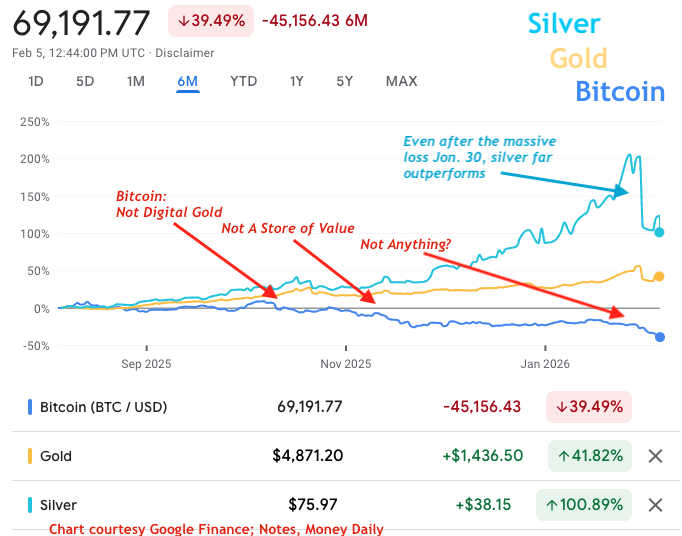
That was the good news. The bad news came from far outside congressional chambers, on trading desks around the world, as bitcoin, the granddaddy of the crypto universe. continued its deep decline from a high of $124,310.60 on October 7, 2025, to it's current low, as of this writing, at 8:35 am ET, of $69,345.04, a four-month drop of 44.22%, with no end in sight.

The chart below paints an unpleasant picture of bitcoin's demise, comparing it to two other alternatives to the U.S. dollar, which actually are stores of value, mediums of exchange and have been money for thousands of years. It speaks for itself.

With bitcoin "whales" discovering that their hands are bleeding from repeated attempts to catch the falling crypto knife, the rout is likely to accelerate from here. In terms of fundamental analysis, there was pocket of support from $75,000 to $85,000, but that's already gone. The next stop is in a range around $64,000. After that, it's free-fall down to $30,000 or lower.

At some point, as with all speculative assets, sone people will become interested in buying bitcoin, but at what price? $50,000, $35,000, $20,000? Because bitcoin is divisible out to eigt decimal points, it's possible for the price of one bitcoin (of the 20 million already out there) to fall under one dollar. It's conceivable that one wallet could hold all the bitcoin in the world, at $0.001 per unit. where it eventually resides depends on liquidity and levels risk management by miners, who won't be so eager to spend fortunes on computers and energy to mine the blockchain, and the OG whales who own 90% of the available stock.

As bitcoin proceeds down the path to insolvency, which would likely be defined by criminals refusing to accept it, all the other crypto plans will be washed down the drain with it. Blockchain technology is a useful function. Truing to turn it into value seems now to have been a fool's errand.

The money that brought bitcoin to its previous glorified heights is the same money that is exiting, bringing down to what appears to be some very undignified lows. A lot of money is changing hands and it will be looking for places to go. Some will sit in cash. Some will go into stocks, some to precious metals, some to other speculative assets. Hardly any of it will go into fixed income, like corporate bonds or treasuries.

At the same time, it appears the promise of the other great speculation, AI, has lost its mojo. It's not so much that AI is useless - it has great potential and is already employed in a good number of business activities - it's that the money being spent pursuing profits from selling subscription services by the big tech names doesn't add up. Google, Amazon, Meta, Microsoft and others are pouring hundreds of billions into data centers without a clear pathway to profitability and Wall Street has sniffed it out.

Just last night, Alphabet (GOOG), parent of Google, released blowout fourth quarter numbers, sending the stock soaring after hours, but overnight, the mood changed, as investors worried about the massive CapEx the company is planning. Google said it would significantly increase its 2026 capital expenditure to between $175 billion and $185 billion, more than double its 2025 spending.

Shares of Alphabet are down five percent pre-market.

Elsewhere, Microsoft Corp. reported solid earnings last week, but investors zeroed in on stagnating growth in its Azure cloud-computing business and the more than $100 billion it’s expected to dole out in capital spending this year. Consequently, the stock tumbled 10%, and the selling has carried over into this week. Microsoft is down more than 15% since January 28.

Thursday, before the open, a few more names of companies reporting fourth quarter results and their pre-market moves:

  • Shell (SHEL) - big miss, worst in five years, shares down 2.5%
  • Estee Lauder (EL) - restructuring, tariffs harmed earnings, stock down 10%
  • Barrick (B) - solid earnings, stock down 2.5%
  • ConocoPhillips (COP) - earnings miss, stock down 3-4%
  • Bristol Myers Squibb (BMY) - earnings beat, shares up 2%
  • Cummings (CMI) - revenue beat, EPS miss, shares down 4%

Not looking very happy Thursday morning, gold and silver are also being wrecked again. Gold is down $138 at $4,832; silver is down $13 at $75. Stock futures are crashing across the board: Dow: -161; NASDAQ: -174; S&P: -41.

If you liked crypto, there are some bridges for sale...

At the Close, Wednesday, February 4, 2026:
Dow: 49,501.30, +260.31 (+0.53%)
NASDAQ: 22,904.58, -350.61 (-1.51%)
S&P 500: 6,882.72, -35.09 (-0.51%)
NYSE Composite: 22,975.59, +94.38 (+0.41%)


Wednesday, February 4, 2026

ADP Reports January Job Gains of 22,000; Economy at Stall Speed; Government Lies Rampant as Friday's Non-Farm Payrolls Delayed

There's probably a very good reason the U.S. government pulled off a partial shut down over the weekend, resolved on Tuesday, when the House of Representatives approved the very slight, marginal changes to the appropriations bills sent to the Senate last week.

Democrats in the Senate, with a handful of Republicans, balked at the appropriations over the activities of ICE in Minnesota and elsewhere, refusing to pass funding for DHS, calling for reforms of the ICE (Immigration and Customs Enforcement) agency inside DHS. Similar to the grandstanding over health care subsidies back in October, the outrage over ICE was another carefully-crafted canard.

The Obamacare subsidies, which were suspended by the Big, Beautiful Bill back in July, got an extension in the House, but is currently stalled in the Senate, the result, for now, no subsidies. Remember what happed to the October Non-Farm Payroll data during the last shutdown? Gone missing. Vanished. Poof.

On Monday, the BLS announced that because of the government shutdown - less than four days, Saturday through late Tuesday - the NFP January report scheduled for this Friday, along with a couple other releases including JOLTS, was going to be delayed. No new release date has been given thus far. So, there's the reason for the short shutdown. January's jobs numbers - mind you, the month following the holidays usually a time at which retail lays off thousands - must be just plain horrific and the politicians, who would never lie to the American people, figured out a convenient way to hide them for a while.

If all of this sounds like too much conspiracy theory, well, draw your own conclusions, but Wednesday morning, ADP issued the January national employment report for private businesses, showing a gain of 22,000 jobs for the month. That is basically stall speed and comes on the heels of the government reporting GDP for the third quarter of 2025 of 4.3% (released December 23) and the fourth quarter estimate (delayed due to the October shutdown and yet to be released) of 4.2%.

If the U.S. economy is growing at an accelerated pace, then labor might want to be sharing in the general prosperity, but it's not. The White House and congress cannot square the circle of lies they've been passing along to the American public. The economy isn't growing, USA is not the "hottest" country on the planet, according to the Boaster-in-Chief, jobs are hard to find and there's a recession and probably a stock market crash dead ahead.

The government can't reveal the lies yet. They need a couple more weeks or maybe just days before the eventual rug-pull. Maybe big money is already exiting, as the major averages have been down slightly the past three weeks and Tuesday wasn't very pretty.

Stocks were down significantly Tuesday, but a late-day rally (for no apparent reason) clawed back roughly half of the losses on the Dow, NASDAQ, and S&P.

Corporate profits aren't helping the narrative much. They've been spotty so far.

After the close on Tuesday, the following companies reported fourth quarter results:

  1. Amgen (AMGN) - met expectations, stock flat pre-market
  2. Chubb (CB) - solid results, stock up 2%
  3. Advanced Micro Devices (AMD) - earnings beat, strong guidance, stock down 10% pre-open
  4. Chipolte Mexican Grill (CMG) - declining traffic, same store sales, shares down 2.5%
  5. SuperMicro (SMCI) - strong earnings beat, stock up 8.5%

On Wednesday, before the open:

  • Novo Nordisk (NVO) - bad forecast, stock down 4%
  • Lilly (LLY) - blows away estimates, stock up 7%
  • Uber (UBER) - revenue growth, poor forecast, stock down 1%
  • Abbvie (ABBV) - beat, upbeat guidance, stock down 4%
  • Boston Scientific (BSX) - cautious forecast, stock down 8%
  • CME Group (CME) - slight top and bottom line beat, stock flat.

Gold and silver have rallied back strong over the past two days. Gold: $5,041.80; silver: $91.33. Futures are split with the NASDAQ lower.

Be prepared.

At the Close, Tuesday, February 3, 2026:
Dow: 49,240.99, -166.67 (-0.34%)
NASDAQ: 23,255.19, -336.92 (-1.43%)
S&P 500: 6,917.81, -58.63 (-0.84%)
NYSE Composite: 22,881.21, -4.44 (-0.02%)


Tuesday, February 3, 2026

No JOLTS, No Jobs As U.S. Government Partially Shuts Down Again; PayPal, Rambus, Fubo Among Poor Earnings Reports; Iran, Nothing

The U.S. federal government is a dysfunctional mess.

For the second time in under six months, congress has failed to fund the world's largest bureaucracy. This is the stuff of third world nations, a status which the United States seems intent on pursuing.

Because the government has been partially shut down, economic reports which are normally released the week of each month will be delayed. The Bureau of Labor Statistics (yeah, those dolts) announced on Monday, according to CNN:

“The Job Openings and Labor Turnover Survey release for December 2025, Metropolitan Area Employment and Unemployment release for December 2025, and the Employment Situation release for January 2026 will be rescheduled upon the resumption of government funding,” Emily Liddel, associate commissioner for the BLS’ Office of Publications and Special Studies, said via email.

Now, this is odd, because two of these reports concern data from December of last year, so the information is probably in the hands of the bureau's number-crunchers, the only issue, supposedly, should be the timing of the release. If the government is still shut down as of today (Tuesday), the JOLTS report, which was scheduled for release today is understandably delayed, but, if it's not released ASAP after the government partially reopens, then one might suspect that for some reason, the government doesn't want the data made public right away. It's embarrassing.

Worse, the January Non-farm payrolls should be sent up as soon as the government reopens, whenever that is. It's probably going to suck (that's a technical term), possibly showing the U.S. is actually losing jobs rather than create them, putting the lie to President Trump's claim that America is the "hottest" country in the world, a claim many people freezing under severe winter conditions would likely dispute.

That's OK. America can depend on the private firm, ADP, for a fairly accurate reading of employment. Their monthly employment report will be released on Wednesday, as usual, unless the government plans on shutting them down as well. You never know. It could happen. After all, this latest fiasco is all because Senate Democrats and a handful of RINO Republicans didn't want to fund DHS because of the fracas in Minnesota, where ICE agents have killed two people in the past few weeks and the situation on the ground remains one close to an insurrection, with paid protesters harassing federal agents who are attempting to capture and deport illegal human aliens (yes, these aliens are human and they're in the country illegally). It's hard to understand why people are protesting mandated law enforcement, but, then again, it's Minnesota, it's very cold, and people are easily persuaded to do stupid things, given money, incentive, or other stupid prizes.

Meanwhile, it appears President TACO has done it again, spending millions of U.S. dollars to send an "armada" half way around the world to threaten a country - Iran - which is no threat to the United States, though it may be to its neighbor, Israel. The president wants Iran to cease its nuclear-enrichment program which the president said was "obliterated" back in June and also would like the Iranians to - now this would be funny if it wasn't so tragically insane - limit the range of their missiles so they would not reach Israel.

OK. Sounds fair. Our carrier fleet and the IDF can attack you all you like, but you can't shoot back. That's like having a basketball game between the Lakers and the Celtics at Boston Garden in which there's a backboard and basket at one end of the court and none at the other. Final score: Celtics 189, Lakers 0. See how that works? Apparently, the president either has a very twisted sense of humor or none at all, maybe both, since he's proven to himself that impossibilities only exist in smaller people's minds, not his.

Well, that's what we've got, almost. On Monday, the president announced a trade deal with India, in which America is reducing its tariffs on Indian imports from 50% to 18%, India reduces its tariffs to zero on American imports, the Indians will buy oil from the U.S., and possibly Venezuela (which the president insists he's "running") and stop buying oil from Russia. All good, except that there's nothing in writing and India has not indicated that it would stop buying Russian oil. It's suspected that they will continue for the time being or until Trump sends the U.S.S. Lincoln battle group over the ocean to loiter near Mumbai or New Delhi.

Epstein files. Nobody is supposed to know what's in them and the DOJ is making sure that only people that don't matter are accused of fooling around with underage girls because no elected officials would ever do that kind of thing.

All this makes the Wall Street casino look good by comparison, which is double good since the president needs something to boast about, and stocks were up "bigly" (actually, the term "bigly" is a misnomer. It was derived from Trump's first term, when he actually mumbled "big league," but the press and social media didn't quite pick up on it. Oh, well) on Monday, and you can bet your bottom dollar that stocks will be up on Tuesday, whether the government remains partially shut down or not, because, well, America's the hottest country in the world.

Oh, and those wicked, 8-sigma moves in gold, silver, platinum, and palladium, totally normal. Absolutely. Happens all the time. Not rigged to save banks from huge losses. Nope.

After the Close Monday, Rambus (RMBS) - bad, down nine percent pre-market; Palantir (PLTR) - they have no competition, up a mere 11% pre-open; and Teradyne (TER) - awesome, up 10%, all reported fourth quarter results.

Tuesday, before the opening bell:

  • Fubo (FUBO) - missed, stock down 18%
  • Merck (MRK) - beat, poor guidance, drugs about to become generic, down 2%
  • Pfizer (PFE) - beat, barely, but nobody is taking the jab, since covid is a fictional disease, down 5%
  • Pepsico (PEP) - beat top and bottom, up 2%, everybody likes junk food and sugar
  • PayPal (PYPL) - missed estimates, guidance so poor they changed CEOs, down 17%

You've been briefed. Thank you for your inattention to these matters, especially the Epstein files.

At the Close, Monday, February 2, 2026:
Dow: 49,407.66, +515.19 (+1.05%)
NASDAQ: 23,592.11, +130.29 (+0.56%)
S&P 500: 6,976.44, +37.41 (+0.54%)
NYSE Composite: 22,885.65, +166.33 (+0.73%)


Sunday, February 1, 2026

WEEKEND WRAP: Wait Until Monday; Silver, Gold, Bitcoin Marked Down on Final Session of January; Stocks Drop; Iran Still Quiet; Oil Spikes Higher

For the record, no amount of bitcoin is going to "fix this."

The last trading day of the month, Friday, January 30, was a bummer for just about everybody, except those invested in oil or natural gas. Everything got sent lower, but especially gold, silver, and bitcoin, the alternatives to fiat currencies that are supposed to save the backsides of all of humankind in the event of a black swan event, systemic collapse of the global economy, or the outbreak of a military conflict between the great powers.

Nothing like that happened, but still, everything, all of a sudden, went down the drain. Somewhat.

Silver, the single asset that had risen the most over the past month, six months, year, etc., dropped by an ungodly amount, from a high of around $121/ounce intraday to close, on the spot market, at $84.63. While the sudden drop alarmed some newbies, seasoned veterans of COMEX/LBMA paper price slams noted that the price was back to where it was on January 13, just a little more than three weeks ago. Silver's one day loss of $30.32 (-26.26%) came on the heels of a tripling in price in 2025, and a meteoric rise from $71.64 at the end of December. At its peak closing price of $118.45, silver was up 65% just in the month of January.

Gold, while it the one day decline of some $489 on January 30 was remarkable, it closed at $4,889.40 on the spot market, about where it was trading on January 22nd, a week and a day prior.

There was little in the way of panic other than the aforementioned newbies and people in paper trades like GLD or SLV. Most experts in the precious metals had been calling for a correction for most of the past two weeks. They got it, albeit in very abrupt fashion and in a larger manner than expected.

Stocks swooned to finish the month and left the Dow, NASDAQ and NYSE Composite with losses on the week, the S&P and Dow Transports up, though both the gains and losses were hardly noticeable, leaving the January Barometer still slightly above break even.

That barometer, which is accurate about 75% of the time, says that a positive January leads to full-year gains. It's not very useful as any kind of gauge since stocks, like the S&P 500 have finished lower for the year only seven times since 1983. So, since the S&P ended the year higher 35 out of the past 42 years - a win rate of 83% - what happens in January isn't statistically important anyway.

Here are where major investments ended January and year-to-date:

Dow: +1.73%
NASDAQ: +0.95%
S&P 500: +1,37%
NYSE Composite: +3.25%
Dow Transports: +5.43%
Gold: +9.31
Silver: +11.23
WTI Crude Oil: +14.49%
Bitcoin: -11.36%

Those numbers offer better perspective. Other than bitcoin, everything was up for the month and so far, 2026, looks pretty good. As for magic crypto money, it isn't too early to beat that particular horse. It's not dead yet, but it sure looks - borrowing from the Rolling Stones description of Mick Jagger's friend, Mr. Jimmy, in the classic, "You Can't Always Get What You Want" - pretty ill (more on this analogy below).

As far as losing money for real and on paper on and off official accounts, precious metals fans are all saying, "wait until Monday," when foreign markets open and trading resumes in Singapore, Shanghai, and other financial centers. Actually, 6:00 pm ET Sunday is when Asian markets open, so, the nervous Nellies don't have long to wait to see how things shake out.


Stocks

General stock performance in terms of the major averages in January was slightly less than hoped for, though one can hardly be disappointed in the longer term results. After all, the S&P 500 has returned 26%, 25%, and 18% the past three years. That's a cumulative gain of 85%, or, a nearly doubling of your money in three years, and that's not counting dividends.

On closer inspection, the Dow, NASDAQ, and S&P have all had three consecutive weekly losses to close out January, and while the S&P did close at an all time high on Tuesday, 1/27 (6978.60) and made an intraday high on Thursday (7002.28)

The U.S. calendar is loaded with economic data releases in the week beginning February 2. S&P Global Manufacturing PMI, ISM Manufacturing PMI, and ISM Manufacturing Prices come out on Monday. JOLTS job openings are announced on Tuesday. ADP private payrolls plus S&P Global Services and Composite PMI are all slated for Wednesday morning. Initial jobless claims, as usual, come Thursday, and Firday's January Nonfarm Payrolls, expected to be 45-65,000, close out the week.

The week ahead is overflowing with earnings reports. Here are some of the more widely-held and notable:

Monday: (before open) Walt Disney (DIS), Hess Midstream (HESM), Napco (NSSC), Tyson (TSN); (after close) Rambus (RMBS), Palantir (PLTR), Teradyne (TER)

Tuesday: (before open) Fubo (FUBO), Merck (MRK), Pfizer (PFE), Pepsico (PEP), PayPal (PYPL); (after close) Amgen (AMGN), Chubb (CB), AMD (AMD), Chipolte Mexican Grill (CMG), SuperMicro (SMCI)

Wednesday: (before open) Johnson Controls (JCI), Novo Nordisk ((NVO), Lilly (LLY), Uber (UBER), Abbvie (ABBV), Boston Scientific (BSX), CME Group (CME); (after close) Alphabet (GOOG), Qualcomm (QCOM), O'Reilly Auto Parts (ORLY), Snap (SNAP), Crown Castle (CCI)

Thursday: (before open) Shell (SHEL), Estee Lauder (EL), Barrick (B), ConocoPhillips (COP), Bristol Myers Squibb (BMY), Cummings ((CMI); (after close) Reddit (RDDT), Amazon (AMZN), Strategy (MSTR), Roblox (RBLX)

Friday: (before open) Roivant Sciences (ROIV), Biogen (BIIB), CBOE (CBOE), AutoNation (AN), Under Armour (UAA)


Treasury Yield Curve Rates

Date 1 Mo 1.5 mo 2 Mo 3 Mo 4 Mo 6 Mo 1 Yr
12/26/2025 3.70 3.69 3.72 3.64 3.66 3.58 3.49
01/02/2026 3.72 3.71 3.66 3.65 3.62 3.58 3.47
01/09/2026 3.70 3.68 3.63 3.62 3.62 3.57 3.52
01/16/2026 3.75 3.72 3.68 3.67 3.66 3.60 3.55
01/23/2026 3.78 3.71 3.72 3.70 3.67 3.61 3.53
01/30/2026 3.72 3.73 3.75 3.67 3.69 3.61 3.48

Date 2 Yr 3 Yr 5 Yr 7 Yr 10 Yr 20 Yr 30 Yr
12/26/2025 3.46 3.54 3.68 3.89 4.14 4.76 4.81
01/02/2026 3.47 3.55 3.74 3.95 4.19 4.81 4.86
01/09/2026 3.54 3.59 3.75 3.95 4.18 4.76 4.82
01/16/2026 3.59 3.67 3.82 4.02 4.24 4.79 4.83
01/23/2026 3.60 3.67 3.84 4.03 4.24 4.78 4.82
01/30/2026 3.52 3.60 3.79 4.01 4.26 4.82 4.87

With the FOMC standing pat on the federal funds target rate at 3.50-3.75%, one month bills drifted lower, from 3.77 to 3.72, Thursday and Friday. Thus far, the Federal reserv's attempts at Yield Curve Control, focused on the 10-year note benchmark, has kept fixed income markets from signaling anything but complacency. However, stresses are evident from the elevated level of the 30 year yield (4.87%), and widening spreads.

While yield on the 10-year note rose a mere two basis points, to 4.26, it does continue creeping higher. The two-year yield of 3.52% - eight basis points below last Friday - widened the already massive spread on 2s-10s to +74, while full spectrum (30-days to 30-years) also expanded, to 115 basis points. Both are at or near the highest levels in two years, which is overall healthy.

What Fed officials are likely more concerned about is the structure of bond buyers. Foreigners are increasingly not increasing their purchases, opting for the latest reserve currency, gold, instead. The Fed faces the under-appreciated problem of too much debt issuance by the federal government against a declining, skeptical buying community, and that may be the point of the current administration: to untether the U.S. from reserve currency status and allow free markets to determine credit-worthiness.

Considering that the U.S. dollar has fallen from 107.44 the day before Trump's inauguration to a low of 96.22 (January 27, 2026) before Friday's abrupt jump to 97.15, that appears to be one campaign promise the upon which the president has delivered. The lower dollar makes exports more marketable, though it has the opposite effect on imports, a matter to which most U.S. consumers can readily understand. Simple math says that as the cost of living increases, the standard of living declines. Truth, and an indication of the intent of tariff policies.

Spreads:

2s-10s
2025
1/3: +32
1/10: +37
1/17: +34
1/24: +36
1/31: +36
2/7: +20
2/14: +21
2/21: +23
2/28: +25
3/7: +33
3/14: +29
3/21: +31
3/28: +38
4/4: +33
4/11: +52
4/17: +53
4/25: +55
5/2: +50
5/9: +49
5/16: +45
5/23: +51
5/30: +52
6/6: +48
6/13: +45
6/20: +48
6/27: +56
7/3: +47
7/11: +53
7/18: +56
7/25: +49
8/1: +54
8/8: +51
8/15: +58
8/22: +58
8/29: +64
9/5: +59
9/12: +50
9/19: +57
9/26: +57
10/3: +45
10/10: +53
10/17: +56
10/24: +54
10/31: +51
11/7: +56
11/14: +52
11/21: +55
11/28: +55
12/5: +58
12/12: +67
12/19: +68
12/26: +68
2026
1/2: +72
1/9: +64
1/16: +65
1/23: +64
1/30: +74

Full Spectrum (30-days - 30-years)
2025
1/3: +38
1/10: +54
1/17: +41
1/24: +40
1/31: +36
2/7: +32
2/14: +32
2/21: +31
2/28: +13
3/7: +24
3/14: +25
3/21: +23
3/28: +26
4/4: +5
4/11: +38
4/17: +44
4/25: +40
5/2: +41
5/9: +46
5/16: +52
5/23: +68
5/30: +59
6/6: +69
6/13: +67
6/20: +69
6/27: +66
7/3: +51
7/11: +59
7/18: +65
7/25: +55
8/1: +32
8/8: +37
8/15: +44
8/22: +41
8/29: +51
9/5: +49
9/12: +40
9/19: +54
9/26: +55
10/3: +47
10/10: +43
10/17: +42
10/24: +48
10/31: +61
11/7: +69
11/14: +70
11/21: +68
11/28: +62
12/5: +97
12/12: +109
12/19: +111
12/26: +111
2026
1/2: +114
1/9: +112
1/16: +108
1/23: +104
1/30: +115


Oil/Gas

WTI crude closed out the week at $65.74, up sharply from last week's close of $61.28 and the second consecutive week closing out above $60 and the highest price for oil since late September. Wile there remains an oil glut, geopolitical tensions and the practice of oil tanker seizures have lowered confidence and increased risk, taking price higher. Unless the Trump administration dials back some of the bellicose rhetoric and all of the kinetic activity around Venezuela, Greenland, and especially Iran, the price of oil is going to continue to rise, putting an end to the low-price vacation that's been had by U.S. and European drivers who fill up regularly.

The U.S. national average for gas at the pump remained at $2.87 for a second straight week. Frigid conditions across most of the country and rising Mideast tensions contributed to the near term price gains.

California ramped up another dime this week, at $4.31 per gallon, the highest in the nation. Washington ($3.89) was a seven cents higher, but still leaving the Golden State alone in the $4+ club. Oregon ($3.38), was up six cents. Arizona held steady at $2.96, remaining under $3.00 for the third straight week. The lowest prices remain in the Southeast, with Oklahoma, the low-price leader, down a nickel to $2.34, followed by Louisiana ($2.36), and Mississippi at $2.38, Arkansas at $2.40, and Texas ($2.43). The remaining Southeast states, from North Carolina west to New Mexico, are all below $2.69, except Florida ($2.91).

In the Northeast, prices were steady and consistently low. Only Pennsylvania ($3.08) was above $3.00. New York gained a bit, to $2.97, along with Vermont ($2.98).

In the midwest region, where the price relief has been significant, Illinois regained the high ground, at $2.90, with Michigan close behind at $2.89. Kansas was the lowest ($2.43), followed by North Dakota ($2.45) and Minnesota ($2.50).

Sub-$3.00 gas was reported in 43 of the lower 48 states, same as last week, leaving only California, Washington, Nevada, Oregon, and Pennsylvania, at $3.00 or above.


Bitcoin

This week: $77,242.74
Last week: $88,556.82
2 weeks ago: $95,065.81
6 months ago: $113,941.10
One year ago: $99,655.54
Five years ago: $39,255.36

More and more, bitcoin appears to be dead money and this week's decline sets in motion further drops into a previously-dangerous zone below $74,000. All the "hodler" types have effectively moved into the next-door-neighbor's basement, unable to support their crypto lifestyle. Since crypto as a whole is the greatest scam since the 17t-century tulip mania, or maybe Charles Ponzi's Florida Real Estate debacle, it figures that the granddaddy of the crypto community (now a whopping 17 years along), might take some of the biggest lumps first. While bitcoin gets battered like a farmhand wife, others, like Ethereum, Dogecoin, Solana, and Cardano have taken their fair share of abuse (another Rolling Stones reference).

Year-to-date, here's the performance of bitcoin and others:
Bitcoin: -11.36%
Ether: -22.33%
Dogecoin: -12.08%
Cardano: -13.23%
Solana: -18.93%

What fun!

Taking the moral from the Rolling Stones analogy, coiners may take comfort in, "You can't always get what you want, but if you try sometimes, you get what you need." If it's out of the system currency you desire, there's still gold, silver, and moving to South America available. Best of luck.


Precious Metals

Gold:Silver Ratio: 57.74; last week: 48.46

Futures, per COMEX continuous contracts:

Gold price 1/2: $4,341,90
Gold price 1/9: $4,518.40
Gold price 1/16: $4,601.10
Gold price 1/23: $4,983.10
Gold price 1/30: $4,907.50

Silver price 1/2: $72.26
Silver price 1/9: $79.79
Silver price 1/16: $89.94
Silver price 1/23: $103.26
Silver price 1/30: $85.25

SPOT:
(stockcharts.com)
Gold 1/2: $4,331.09
Gold 1/9: $4,508.08
Gold 1/16: $4,595.42
Gold 1/23: $4,989.23
Gold 1/30: $4,886.71

Silver 1/2: $72.25
Silver 1/9: $79.34
Silver 1/16: $89.94
Silver 1/23: $102.95
Silver 1/30: $84.63

As everybody probably already knows, gold and silver took a pretty big hit on Friday, January 30. Analysts and pundits have been warning about a pullback, and boy, did they ever get one. Being that it was so abrupt and recent, one can only speculate as to the cause. Everybody didn't all at once decide it was time to take profits and cash in their coins, bars and jewelry. That would have been an impossibility. In fact, many dealers have closed their doors temporarily or put limits on redemptions, some offering 10 or 20% below spot and only on quantities of 100 or more ounces of silver or 10-20 ounces of gold. Local coin shops are being terrorized by fast-moving prices and seller demands. Buyers seeking silver close to spot will be sadly disappointed, as the weekly eBay survey shows median and average prices for silver remaining above $100 per ounce.

It's likely to take an extended period of sub-$100 silver prices to depress retail demand significantly enough to get premia down closer to spot, so the mantra for most of Sunday remains: Wait Until Monday. Holders of bullion, coins, stackers, goldbugs and owners with physical metal in their possession aren't about to unload here. The table's been set. What happened was some squirrels got into the banquet hall and ran roughshod over the china, crystal, and silverware. Once the little rodents are routed, precious metals can get back to what they do best, protecting wealth from evil influences.

One note on Friday's collapse: the only public fund investing in silver futures in mainland China, UBS SDIC Silver Futures Fund, a listed open-ended fund, was suspended for the whole day Friday, the second such halt since January 22.

Noting that, the slam in gold and silver may have been necessary to keep a significant bank (UBS) from defaulting on multiple obligations and becoming insolvent, which is not something, like pregnancy, one can accomplish half-heartedly. One is either pregnant or not. Same with insolvency. Many financial institutions that have frolicked in the precious meadows fields for years with shorting antics may be feeling not a small amount of pain presently.

In case anybody thinks that Friday's action - as unusual as it was - is a one-off, likely not to be repeated, this could be only the beginning of extreme measures taken by LOFs (Lovers of Fiat) in opposition to sound money advocates.

Here are the most recent prices for common one ounce gold and silver items sold on eBay (free shipping included, numismatics excluded):

Item/Price Low High Average Median
1 oz silver coin: 96.00 119.75 107.57 107.62
1 oz silver bar: 94.00 112.94 105.64 105.63
1 oz gold coin: 5,077.39 5,304.62 5,183.69 5,190.00
1 oz gold bar: 5,103.19 5,281.08 5,169.09 5,128.93

The Single Ounce Silver Market Price Benchmark (SOSMPB) took a pretty big hit this week, falling to $106.62, a decline of $10.38 from the January 25 price of $117.00 per troy ounce. The weekly movement reflects wider volatility in world markets and growing retail investment in smaller, finished products, from grams to 1/2-ounce, 1-ounce, 5-ounce, and 10-ounce coins and bars.


WEEKEND WRAP

Incidentally, the FDIC announced on Friday the first bank failure of 2026. Metropolitan Capital Bank & Trust operated a single office in Chicago with total assets of $261.1 million as of September 30, 2025. First Independence Bank agreed to assume deposits totaling $212.1 million at closing. Not anything big, at all. Just another case of unsound speculation by people who are supposed to know better.

Not a big deal. Monday is coming soon enough.

At the Close, Friday, January 30, 2026:
Dow: 48,892.47, -179.09 (-0.36%)
NASDAQ: 23,461.82, -223.30 (-0.94%)
S&P 500: 6,939.03, -29.98 (-0.43%)
NYSE Composite: 22,719.32, -156.13 (-0.68%)

For the Week:
Dow: -206.24 (-0.42%)
NASDAQ: -39.42 (-0.17%)
S&P 500: +23.42 (+0.34%)
NYSE Composite: -37.84 (-0.17%)
Dow Transports: +100.68 (+0.55%)


Disclaimer: Information disseminated on this site should not be construed as investment advice. Downtown Magazine Inc., Money Daily and it's owners, affiliates and/or employees are not investment advisors and do not offer specific investment advice. All investments have risk. You should consult a professional investment advisor or stock broker or use your individual judgement when making investment decisions. By viewing this site, you hold harmless Downtown Magazine Inc., Money Daily, its owners, affiliates and employees against any and all liability. Copyright 2026, Downtown Magazine Inc., all rights reserved.

Friday, January 30, 2026

Trump Nominates Kevin Warch for Next Fed Chairman; Gold, Silver Down Sharply with Foreign Markets Closed; Stock Futures Signaling January Flat or Lower

Assessing the performance of the major indices over the course of the week, returns through Thursday’s close show the Dow down 27 points, the NASDAQ ahead by 183 (+0.78%), and the S&P 500 up 53 (+0.77%).

As the final day of trading for January approaches, the major indices haven't shown much, as most of the action has been in commodities, particularly, gold, silver, and platinum, with crude oil catching a bid late in the month (+13.20%). The majors are tightly bunched for the month, and year-to-date, with the Dow leading with a 2.10% gain, followed by NASDAQ (+1.91%) and the S&P (+1.80%).

Silver led the way in the first month of 2026, with a gain of 42%, with gold up 17% year-to-date, both of those reflecting drawdowns overnight on the 29th into the morning of the 30th. Both were considerably higher as of Thursday's close, the COMEX gamers taking their best shot as the week and month draws to a close. Prices for precious metals remain much higher in Shanghai, Singapore, Dubai, Mumbai, and elsewhere. The drawdown is U.S. specific as market fragmentation continues to wreak havoc on U.S. coin dealers and refiners.

It's been widely reported that coin shops are being very judicious in their buying, as they have been flooded with customers looking to unload their gold and/or silver and a number of refiners - to whom the dealers offload inventory - have either closed their doors temporarily due to overstocked conditions and/or are delaying payment for up to a month. This has caused frustration for sellers who routinely expect to receive prices near spot, but are being low-balled or shut out entirely. One place at which reasonably fair prices can be had is on eBay, the online marketplace having the unique characteristic to react to price fluctuations in nearly real time.

Weighing on all markets is the declining dollar, which has fallen to levels on the DXY not seen in four years (96.62), in addition to tensions in the Middle East as U.S. warships steam closer to Iran, threatening an imminent assault.

At 7:00 am ET Friday morning, President Trump announced that he was naming Kevin Warsh as the next Chairman of the Federal Reserve, his term to begin on May 15, pending confirmation by the Senate, which is pretty much a formality as Warsh has strong credentials (Harvard Law, Fed Governor 2006-2011).

Trump's choice didn't help markets, sending almost everything lower as Warsh is considered to be hawkish on interest rates. Around 8:30 am ET, Dow futures are down 262, NASDAQ futures are off 180, and S&P futures are down 36 points. Gold and silver have been savaged, with silver at 96.91 and gold down 379 points, right at $5,000. Of course, most of this is for show. Once foreign markets open on Monday (they're already closed for the week), precious metals will likely stage a fairly strong rebound, but for now, all the doubters and reality-deniers will have their day.

Stocks will need some catalyst if they're to finish the month in positive territory and they'll get a little boost from the likes of American Express (AXP), Verizon (VZ), Chevron (CVX), ExxonMobile (XOM), Colgate Palmolive (CL), all of which reported fourth quarter earnings Friday morning.

In pre-market trading, American Express (AXP) is down 2.5%, Verizon (VZ) is up 4.5%, Chevron (CVX) is flat, ExxonMobile (XOM) is ahead by nearly two percent, and Colgate Palmolive (CL) is up 2.75%.

Visa (V) and Apple (AAPL) reported after the bell Thursday. Both are down marginally, though SAP (SAP) is up by nearly two percent in pre-market trading.

This weekend might avail itself an opportune time to bomb Iran, as there's no major football games (Super Bowl is next weekend), stock market is closed (always Trump's preferred time to begin military actions) and stocks figure to be down to end the week. Will Trump give the go-ahead or will it be another TACO moment?

The January barometer may end up stuck at zero after today, giving stock jockeys little impetus going forward.

At the Close, Thursday, January 29, 2025:
Dow: 49,071.56, +55.96 (+0.11%)
NASDAQ: 23,685.12, -172.33 (-0.72%)
S&P 500: 6,969.01, -9.02 (-0.22%)
NYSE Composite: 22,875.46, +75.36 (+0.33%)


Thursday, January 29, 2026

Gold Soars with U.S. Attack on Iran Imminent; Earnings Keeping Major Averages Near All-Time Highs

Overnight, gold reached a high of $5596.20 as U.S. military assets stream into the Middle East in preparation for what looks certain to be a heavy assault on the nation of Iran.

President Trump has called on Iran to abandon its nuclear ambitions or face a U.S. military incursion just months after telling the world that America's bombers had "obliterated" Iran's nuclear apparatus.

Apparently, that's not the case.

Just in the past two weeks, a U.S. and Israeli-led false flag color revolution protest failed to topple the Iranian regime, resulting in the capture, arrest, and execution of thousands of Mossad and CIA operatives along with their internal supporters. The "revolt" was thwarted by Iran block transmissions from Starlink, which the instigators were using to relay messages and coordinated disruptions. Reportedly, Iran received technical assistance from China in disabling the low-orbit satellites that transmit internet signals and have been used widely in Ukraine to target Russian assets.

With a U.S. and Israeli assault imminent, gold has ripped higher. It first crossed $5,000 on January 25. It took just three days to reach $5,500 and beyond.

Silver, which has recently been advancing at a more rapid pace than gold, has taken a back seat for now, though it surpassed $120 an ounce overnight and is currently showing a spot price of $119 just a half hour before the opening bell for U.S. stocks. Gold continues to hover in a range from $5,520 to $5,550, though it will likely advance higher once the almost certain attack commences. The most likely time for the U.S. to launch its assault would be over the weekend. President Trump hs shown a preference to not make military moves during market hours. He considers the stock market a yardstick for his exemplary economic performance.

Investors and speculators appear to be weighing the geopolitical event alongside earning reports from major tech companies. After the close Thursday, Tesla (TSLA), Meta Platforms (META), Microsoft (MSFT), and IBM (IBM) all reported and Thursday morning saw another raft of high-profile companies jumping on the earnings bandwagon. Caterpillar (CT), Royal Caribbean (RCL), Altria (MO), Lockheed Martin (LMT), Southwest Airlines (LUV), Mastercard (MA), Nokia (NOK) Blackstone Group (BX), and Nasdaq (NDAQ) have all issued reports in the past three hours.

Heading into the open, a cautious advance market has Dow futures up 18 points, NASDAQ futures of 33, and S&P futures ahead by 15.

The gloves are off, kids.

50,000 on the Dow, $10,000 gold and $200 silver are distinct possibilities this year if we don't all get nuked first.

At the Close, Wednesday, January 28, 2026:
Dow: 49,015.60, +12.19 (+0.02%)
NASDAQ: 23,857.45, +40.35 (+0.17%)
S&P 500: 6,978.03, -0.57 (-0.01%)
NYSE Composite: 22,800.11, -78.12 (-0.34%)


FOMC Policy Decision on Tap; Japan Bonds Stabilized, for Now; Trump Threatens Iran with Missile Strikes; Ukraine Over and Done?

Earnings season is in full swing.

Reporting after the close Thursday were PPG (PPG), Enova (ENVA), Texas Instruments (TXN), Logitech (LOGI), and Seagate (STX).

Wednesday before the open saw AT&T (T), Corning (GLW), General Dynamics (GD), Progressive Insurance (PGR), Starbucks (SBUX), ADP (ADP), ASML (ASML), GE Verona (GEV) throw out fourth quarter and full year numbers.

After the close Wednesday, post-FOMC policy decision, Lam Research (LRCX), Tesla (TSLA), Meta Platforms (META), Microsoft (MSFT), IBM (IBM), Las Vegas Sands (LVS), Levi's (LEVI), and LendingClub (LC) will issue reports.

The Fed is almost 100% certain to keep the federal funds rate at 3.50-3.75%. Any clues from Chairman Powell's presser will move markets north or south. If he signals rate cuts ahead, it's boom time. If he is more sanguine, stocks may take that as a sign that he intends to keep rates at or near where they are currently for the remainder of his term as Chair, which ends in May. Seemingly the most likely path, markets may slow the pace of the rally until President Trump anoints appoints the next Fed Chair. That should be around the start of the third quarter, plenty of time to juice the economy with big cuts ahead of the midterms. July, September, and October would appear to be on the list of FOMC meetings at which cuts would be announced.

Generally speaking, today's FOMC policy decision is little more than a sideshow, as ae earnings announcements. What the Fed is currently knee-deep in is the Japan problem. There has already been a coordinated central bank intervention dropping the USD/JPY from 158 down to 152, which bought some time, though the collateral damage strengthened the euro and pound. The entire exercise is a futile one; eventually all the fiats fail, as they have throughout history, every time. The only matter is whether the destruction of the international financial order will be swift and painful or slow and grinding. Either way, the end game will result in great pain, the U.S. will lose its exceptional privilege of the world's reserve currency, and the the BRICS countries will be calling the shots.

That's the long game, which nobody can time to perfection, and why gold especially has taken flight to new heights.

On the earnings front, briefly, Texas Instruments delivered a fourth quarter above expectations and positive forward guidance, highlighted by increased demand for its analog chips as an integral element in powering AI-related data centers. Pre-market, shares are flying, up more than seven percent.

Logitech (LOGI) beat estimates: Q3 EPS of $1.93, up 21% year-over-year, while revenues grew 6% to $1.42B, but the stock is down two percent pre-open.

PPG (PPG) reported $1.51 per share, missing estimates of $1.57 per share. This compares to earnings of $1.61 per share a year ago, making investors unhappy and selling off by more than two percent.

AT&T (T) is up two percent based on a solid quarter that beat estimates. The company saw improved subscriber growth and issued positive guidance.

General Dynamics (GD) reported fourth-quarter profit of $1.14 billion and EPS of 4.17, beating estimates for 4.11. Shares are flat.

Somewhat of a rarity, Starbucks (SBUX) shares are up more than six percent pre-market as the company's earnings miss estimates, but the chain's U.S. traffic grew for the first time in two years.

ASML was the morning's big winner, as the Netherlands-based chip equipment manufacturer saw strong order flow in the fourth quarter based on AI rollouts, announced plans to cut 1,700 jobs and raised its 2026 sales outlook amid increased AI-related investments. Shares of the company are up five percent prior to the opening bell.

Led by tech, NASDAQ futures are up nearly 200 points just before 9:00 am ET; S&P futures are sporting an 11-point gain while Dow futurs are flat.

Gold has soared again overnight, leaping as high as $5,310 and currently trading in a range around $5,250. Silver has taken a back seat this morning, but still advanced to as high as $116 and is holding around $114. Shanghai reports silver prices at $131, a spread of more than $15 above U.S. prices and indications for higher price targets overall. Silver is targeting $140-150 for March, gold, $6,000. The rally in precious metals, which has been on a torrid pace since October of 2025, is still in its early stage.

Any missteps by government or financial authorities is likely to send metals into overdrive, which is remarkable considering their recent moves, but there are a slew of issues on the table, the biggest being U.S. resumption of threats against Iran, general malaise in Minnesota, and the buffering of Japanese bonds keeping the yen afloat with coordinated intervention. The U.S. cannot afford to have Japan's central authority sell U.S. treasuries and upset the delicate balance between inflation and growth in the U.S. A yield on the 10-year note of anything above 4.80% (currently 4.25%) would signal distress globally.

While Secretary Bessent and Fed Chair Powell continue to monitor the situation in Iran, they risk a revolt in the form of a loss of confidence. To date, they ='ve managed to keep the treasury complex within reasonable bounds, but a military strike on Iran could send yields - along with gold and silver - soaring. The monetary authorities are holding their own in the face of increasingly-dangerous policies from the Trump administration. The military has been moving assets into the area for weeks and appear to be preparing for an attack which would likely set off a major conflict. Iran is on high alert and will bomb Israel and U.S. bases throughout the region if they are assaulted.

Trump and the neocons throughout the Washington establishment continue to play with fire. Sooner or later, somebody is going to get burned. Meanwhile, it seems that the U.S. and Europe have given up on Ukraine and may be pondering moving the narrative to the Middle East, hoping their constituents won't notice their massive failure, allowing Russia a military victory and complete control of Ukraine.

At the Close, Tuesday, January 27, 2025:
Dow: 49,003.41, -408.99 (-0.83%)
NASDAQ: 23,817.10, +215.74 (+0.91%)
S&P 500: 6,978.60, +28.37 (+0.41%)
NYSE Composite: 22,878.22, +49.08 (+0.22%)