Sunday, August 31, 2025

WEEKEND WRAP: Stocks Take A U-Turn as Gold, Silver Explode Higher; Trump Tariffs Under Pressure; Bond Spreads Widen; Happy Labor Day!

Editor's Note: Due to time global developments, time constraints, and physical obligations (holiday weekend happenings) this edition of the WEEKEND WRAP strayed somewhat from the usual format. Follow developments beginning Tuesday (9/2) when markets re-open. - FR

The last week of August, in advance of the U.S. Labor Day three-day weekend holiday, was consequential in a number of areas, but mainly in international finance and precious metals.

This post, while striving to be as circumspect as possible, cannot possibly cover all of the issues adequately. Readers are advised to follow the links provided.

There were three big developments this week concerning precious metals:
1. Gold closed above $3,500 on the COMEX
2. Silver closed above $40 on the COMEX
3. Gold has surpassed U.S.$ in central bank balance sheets globally.

The global importance of that third item cannot be understated. In essence, the U.S. dollar is no longer the world's reserve currency. It has been replaced by GOLD.

De-dollarization by a wide swath of mostly BRICS-aligned nations buying gold, combined with the rising price of gold and the declining value of U.S. treasuries pushed the value of central bank holdings of gold past those of U.S. cash and U.S. debt obligations held mainly in Treasury bills, notes, and bonds.

It bears repeating: the US$ is no longer the world's reserve currency. Gold is, and that trend is still in an early stage of development. This was first reported by Otavio (Tavi) Costa on August 29, via X, citing Bloomberg as a source, so this is surely not alt-media hyperbole.

The ramifications of this development are monumental, epochal and ongoing. Anybody who has not seen this development coming over the past few years and made no adjustments to portfolio allocations has nobody to blame but themselves, financial advisors be damned. On that note, there is a growing trend among wealth managers (even big ones like JP Morgan Chase) to advise clients to allocate five or more percent of their portfolios to gold, which, in the infinite wisdom of such leeches on the financial system, would be to derivatives, such as the GLD ETF or other such "paper" vehicles.

While the paper chase may be fine for high net worth individuals, it's not the real thing, as in bars or coins, stored in a vault, preferably in one's own possession or with reliable access to. As events unfold, rich folks can thank their otherwise "brilliant" advisors for missing out on gold more than doubling in price over the past three years. Increased buying at this juncture is exactly what gold needs to become a complete precious metals mania, similar to the late 1970s.

Moving on...

A federal appeals court ruled Friday that President Donald Trump had no legal right to impose sweeping tariffs on almost every country on earth but left them in place until October 14, in anticipation of what will likely be an expedited Supreme Court hearing on the matter.

With the October 14 date in mind, there are other key events between now and then, including the September 16-17 FOMC meeting, at which the committee members are expected to cut the federal funds rate from its current 4.25-4.50% level by 25 or 50 basis points. As events unfold, odds may lean for the 50 basis point cut, especially if weakness in tech stocks that emerged this past week continues.

Prior to the Fed meeting is Friday's August Non-farm Payroll release from the BLS, which may put U.S. labor conditions in a more transparent light. Expectations for a light reading of less than 100,000 new jobs and possibly a negative number could add fuel to the rate-cut fire.

The 30th of September marks the end of the 2025 fiscal year and one of the largest deficits in the history of the federal government, currently standing at 1.63 trillion through the end of July, according to the U.S. Treasury.

The U.S. congress comes back to the nation's capital after its usual August recess, a development that is certain to be significant, given the weight of issues now before Washington lawmakers. From tariffs to Ukraine, the Middle East, immigration and crime issues, the blathering from the corruption center of the Western world is certain to be non-stop and full of finger-pointing, posturing, and laced with invectives. As another unacceptable deficit is thrust upon American taxpayers, the cretins who assume to be in control will do little to remedy any of the conditions that face the country.

The following was derived and parsed from an AI query, so, please, do your own due diligence.

U.S. tariff policy, if they stand after October 14, will have profound effects on U.S. exports. A bipolar economic world is evolving in its face.

The most consequential effect of the tariffs is accelerated consolidation of the BRICS+ bloc. By collectively being targeted by U.S. trade policy, these nations are incentivized to deepen trade relationships within the bloc, creating a self-reliant economic ecosystem.

Evidence comes in the form of China sourcing soy from Brazil instead of the U.S., BRICS nations redirecting energy exports (oil, LNG, propane) to each other, and developing alternative financial messaging systems to SWIFT.

The world will increasingly split into two competing economic spheres of influence: an eroding U.S.-centric and the BRICS+-centric expansion. This will force nations to choose sides, leading to further supply chain fragmentation and "friend-shoring."

The efficacy of U.S. tariffs and sanctions is another major stumbling block for the West. The tools of economic coercion (tariffs, sanctions) are losing their force because the target countries have created viable alternatives. The U.S. can no longer assume its market is indispensable.

Despite tariffs, the U.S. trade deficit is widening dramatically ($103.6B). This is because the global response is more about diversification than capitulation. Countries like India simply find other partners within the BRICS framework, ultimately reducing demand for U.S. exports, to the detriment of American farmers and energy producers.

Future U.S. administrations will find it increasingly difficult to use trade policy to achieve geopolitical goals. The more these tools are used, the faster the rest of the world builds immunity to them, reducing long-term U.S. leverage.

The volatile "seesaw pattern" of trade data reflects businesses gaming the system around tariff deadlines rather than healthy economic growth, creating artificial booms and busts in specific sectors (e.g., gold, copper, clothing imports surging before tariffs). The record import surge in July was a direct result of companies stockpiling goods before new tariffs hit. This artificially inflated economic numbers, but will likely lead to a sharp drop in subsequent quarters, creating instability.

This volatility makes it difficult for businesses to plan, invest, and hire, ultimately acting as a drag on sustainable economic growth in the U.S. particularly and Europe tangentially. It projects a future of greater economic uncertainty and supply chain inefficiency.

As economic tools become less effective, U.S. power is declining. There is an increased risk of escalation into military brinksmanship or conflict to reassert dominance and divert domestic attention from economic pain. Rather than avoid the devastating effects of war, the U.S. appears to be on a path of advancing belligerence. Inability of the NATO countries to accept reality belies this dynamic. Unable to cripple Russia economically through sanctions and energy wars, the conflict risks escalating to a more dangerous level.

The projection of a future wherein the United States' formerly unilateral economic power is diminishing relative to a more multipolar world is apparent. Tariff and sanctioning tactics and compromised media outlets are creating statistical and economic noise that masks a deeper, more troubling strategic trend: the rapid organization of a rival economic bloc that is learning to operate without reliance on the U.S. market or financial system.

The long-term projection is of a world fracturing into competing blocs, with increasing economic volatility, reduced market access for U.S. exporters, and a higher risk of geopolitical conflict.

Stocks

U.S. stocks began catching down to the rest of the world on Friday, taking an abrupt U-Turn that was mostly reflected in the NASDAQ, but barely caused a scar on the weekly figures. Any sane person would expect that to mark the continuance of the bear market sentiment that Dow Theorists understand to be still in place.

Friday and the weekly drop was led by the Dow Transports, which now can be reliably considered a leading indicator. The often overlooked Dow Jones Transportation Average has been between a bear market (-20%) and a correction (-10%) for most of 2025 and displayed its usual weakness this past week.

Wall Street, considering the cloudy environment in which it operates, will probably take the long holiday weekend to sharpen their salesmanship tactics, trying to convince those already not "all in" that stocks are the best investments ever. This ride is about to get a little bumpier.

The economic calendar will be dominated by employment, with ADP private payrolls out on Wednesday and the BLS Non-farm Payroll for August hitting pre-market on Friday.


Treasury Yield Curve Rates

Date 1 Mo 1.5 mo 2 Mo 3 Mo 4 Mo 6 Mo 1 Yr
07/25/2025 4.37 4.46 4.46 4.42 4.42 4.31 4.09
08/01/2025 4.49 4.46 4.44 4.35 4.30 4.16 3.87
08/08/2025 4.48 4.43 4.39 4.32 4.27 4.15 3.93
08/15/2025 4.48 4.42 4.35 4.30 4.22 4.12 3.93
08/22/2025 4.47 4.38 4.36 4.27 4.21 4.08 3.87
08/29/2025 4.41 4.34 4.30 4.23 4.17 4.01 3.83

Date 2 Yr 3 Yr 5 Yr 7 Yr 10 Yr 20 Yr 30 Yr
07/25/2025 3.91 3.86 3.95 4.15 4.40 4.92 4.92
08/01/2025 3.69 3.67 3.77 3.97 4.23 4.79 4.81
08/08/2025 3.76 3.70 3.84 4.03 4.27 4.84 4.85
08/15/2025 3.75 3.73 3.85 4.07 4.33 4.91 4.92
08/22/2025 3.68 3.64 3.76 3.98 4.26 4.84 4.88
08/29/2025 3.59 3.58 3.68 3.92 4.23 4.86 4.92

The yield curve remained partially inverted with the nexus (low point) at 2-and-3-year maturities.

Chairman Powell's Jackson Hole speech had "legs" which spread into treasuries from 30-day bills out to the 10-year note, after which the curve rapidly elevates.

Spreads widened significantly, with 2s-10s reaching +64, an extreme level, the highest since Money Daily began recording. Full spectrum advanced back to prior levels, at +51, as yields at the short end fell and those at the long end rose.

Spreads:

2s-10s
9/15/2023: -69
9/22/2023: -66
9/29/2023: -44
10/06/2023: -30
10/13/2023: -41
10/20/2023: -14
10/27/2023: -15
11/03/2023: -26
11/10/2023: -43
11/17/2023: -44
11/24/2023: -45
12/01/2023: -34
12/08/2023: -48
12/15/2023: -53
12/22/2023: -41
12/29/2023: -35
1/5/2024: -35
1/12/2024: -18
1/19/2024: -24
1/26/2024: -19
2/2/2024: -33
2/9: -31
2/16: -34
2/23: -41
3/1: -35
3/8: -39
3/15: -41
3/22: -37
3/28: -39
4/5: -34
4/12: -38
4/19: -35
4/26: -29
5/3: -31
5/10: -37
5/17: -39
5/24: -47
5/31: -38
6/7: -44
6/14: -47
6/21: -45
6/28: -35
7/5: -32
7/12: -27
7/19: -24
7/26: -16
8/2: -08
8/9: -11
8/16: -17
8/23: -09
8/30: 00
9/6: +06
9/13: +09
9/20: +18
9/27: +20
10/4: +5
10/11: +13
10/18: +13
10/25: +14
11/1: +16
11/8: +5
11/15: +12
11/22: +4
11/29: +5
12/6: +5
12/13: +15
12/20: +22
12/27: +31
1/3: +32
1/10: +37
1/17: +34
1/24: +36
1/31: +36
2/7: +20
2/14: +21
2/21: +23
2/28: +25
3/7: +33
3/14: +29
3/21: +31
3/28: +38
4/4: +33
4/11: +52
4/17: +53
4/25: +55
5/2: +50
5/9: +49
5/16: +45
5/23: +51
5/30: +52
6/6: +48
6/13: +45
6/20: +48
6/27: +56
7/3: +47
7/11: +53
7/18: +56
7/25: +49
8/1: +54
8/8: +51
8/15: +58
8/22: +58
8/29: +64

Full Spectrum (30-days - 30-years)
9/15/2023: -109
9/22/2023: -99
9/29/2023: -82
10/06/2023: -64
10/13/2023: -82
10/20/2023: -47
10/27/2023: -54
11/03/2023: -76
11/10/2023: -80
11/17/2023: -93
11/24/2023: -95
12/01/2023: -105
12/08/2023: -123
12/15/2023: -154
12/22/2023: -149
12/29/2023: -157
1/5/2024: -133
1/12/2024: -135
1/19/2024: -118
1/26/2024: -116
2/2/2024: -127
2/9: -117
2/16: -103
2/23: -112
3/1: -121
3/8: -125
3/15: -109
3/22: -112
3/28: -115
4/5: -93
4/12: -87
4/19: -77
4/26: -70
5/3: -85
5/10: -87
5/17: -94
5/24: -99
5/31: -83
6/7: -92
6/14: -113
6/21: -103
6/28: -96
7/5: -101
7/12: -108
7/19: -103
7/26: -104
8/2: -143
8/9: -131
8/16: -138
8/23: -141
8/30: -121
9/6: -125
9/13: -117
9/20: -80
9/27: -80
10/4: -75
10/11: -58
10/18: -54
10/25: -38
11/1: -18
11/8: -23
11/15: -10
11/22: -12
11/29: -40
12/6: -23
12/13: +18
12/20: +29
12/27: +38
1/3: +38
1/10: +54
1/17: +41
1/24: +40
1/31: +36
2/7: +32
2/14: +32
2/21: +31
2/28: +13
3/7: +24
3/14: +25
3/21: +23
3/28: +26
4/4: +5
4/11: +38
4/17: +44
4/25: +40
5/2: +41
5/9: +46
5/16: +52
5/23: +68
5/30: +59
6/6: +69
6/13: +67
6/20: +69
6/27: +66
7/3: +51
7/11: +59
7/18: +65
7/25: +55
8/1: +32
8/8: +37
8/15: +44
8/22: +41
8/29: +51


Oil/Gas

WTI crude oil closed out the week at $64.01, a dollar below the high of $65.04 on Monday, but nearly unchanged from the prior week's close at $63.77. Fundamentals do not support price increases almost anywhere in the world.

Crude has hovered between correction and bear market since the January 15 peak of $78.71. Because oil is not subject to tariffs and most people, after basic necessities like rent, mortgage payments, and food, cannot afford excessive fuel purchases (demand destruction), a supply glut is possibly building. After Labor Day, leisure driving tails off significantly, so demand will slow, reducing the need for crude. It's the one bright spot in an overall dismal situation, wherein the government receives all the benefits (money) from the tariffs and consumers pay via increased prices. The tariffs will ultimately be seen as bad public policy resulting in global chaos or depression.

Gas prices have leveled off over the past month and remain near the low end, but were up about four cents, to $3.18 on Sunday, as Gasbuddy.com reports. Leave it to the price-gouging energy giants to rip prices higher even with plenty of cheaper fuel already in gas station tanks. The disturbing hubris of the elites never ends.

State-by-state numbers show California remaining at the top, up six cents, at $4.59 per gallon. The lowest prices remain in the Southeast, with Mississippi the cheapest, at $2.71.

The Northeast and Midwest, out to Michigan and Illinois, are all $3.00-plus.

Sub-$3.00 gas can be found in 20 states, the same as last week, exclusively concentrated in the South and Midwest, most marginally higher.


Bitcoin

This week: $108,241.07
Last week: $114,536.60
2 weeks ago: $118,309.30
6 months ago: $86,273.05
One year ago: $59,123.20
Five years ago: $10,166.73

Bitcoin took a beating this week and has not performed nearly as well as precious metals over the past month, highlighting the difference between "digital gold" and the real thing.

1 month performance (July 30 - August 29, 2025)
Gold: $3,516.10, +$192.10 (+5.78%)
Silver: $40.75, +$2.46 (+6.42%)
Bitcoin: 107,906.70, -10,269.50 (-8.69%)


Precious Metals

Gold:Silver Ratio: 86.28; last week: 86.75

Per COMEX continuous contracts:

Gold price 8/1: $3,416.00
Gold price 8/8: $3,458.20
Gold price 8/15: $3,381.70
Gold price 8/22: $3,417.20
Gold price 8/29: $3,516.10

Silver price 8/1: $37.10
Silver price 8/8: $38.51
Silver price 8/15: $38.02
Silver price 8/22: $39.39
Silver price 8/29: $40.75

It's possible that the gains in gold and silver on Friday, adding to the already rapidly-advancing price structure, may be the beginning of a mania for precious metals. Be on the lookout (BOLO) for print, TV, radio, and internet ads hawking gold or willing to buy gold, as those are adequate signals that the general public has been awakened.

There's little doubt that the usual suspects will try to suppress prices in coming days and weeks, but it appears that their efforts are increasingly less effective and soon to fail. The wheels of the Western economic wagon have been falling off since 2008 and accelerated with the pandemic. We are witnessing wholesale dollar destruction on a grand, global scale. Now the wagon itself is beginning to splinter, eventually ending up in pieces on the dirt road of economic, political, and social calamity.

Stack harder.

Sunday's survey on eBay displayed higher prices for gold in particular. It appeared that silver had already peaked last week, but that now appears to have been only a disguise for the coming hyperbolic move to record levels. The focus is clearly on gold, but silver's move on Friday was dramatic and a welcome development.

Here are the most recent prices for common one ounce gold and silver items sold on eBay (numismatics excluded, free shipping):

Item/Price Low High Average Median
1 oz silver coin: 39.00 52.00 45.67 45.00
1 oz silver bar: 45.00 54.47 48.88 47.98
1 oz gold coin: 3,569.40 3,724.96 3,629.75 3,607.36
1 oz gold bar: 3,485.00 3,670.45 3,608.47 3,613.30

The Single Ounce Silver Market Price Benchmark (SOSMPB) rose modestly for the week, albeit to a new record high since Money Daily began recording in 2021, of $46.88, a gain of $0.18 from the August 24 price of $46.70 per troy ounce.


WEEKEND WRAP

It's kind of disturbing that Americans celebrate "Labor Day" just as congress returns from a month-long holiday. In a just and righteous world, American workers and small business employers would take all of September off and refuse to pay taxes. Sadly, American exceptionalism has been supplanted by elitism, foisted upon the public by inflation and propaganda.

We must do better.

At the Close, Friday, August 29, 2025:
Dow: 45,544.88, -92.02 (-0.20%)
NASDAQ: 21,455.55, -249.61 (-1.15%)
S&P 500: 6,460.26, -41.60 (-0.64%)
NYSE Composite: 21,151.46, -13.58 (-0.06%)

For the Week:
Dow: -86.86 (-0.19%)
NASDAQ: -40.99 (-0.19%)
S&P 500: -6.65 (-0.10%)
NYSE Composite: +1.35 (+0.01%)
Dow Transports: -197.16 (-1.22)


Disclaimer: Information disseminated on this site should not be construed as investment advice. Downtown Magazine Inc., Money Daily and it's owners, affiliates and/or employees are not investment advisors and do not offer specific investment advice. All investments have risk. You should consult a professional investment advisor or stock broker or use your individual judgement when making investment decisions. By viewing this site, you hold harmless Downtown Magazine Inc., Money Daily, its owners, affiliates and employees against any and all liability. Copyright 2025, Downtown Magazine Inc., all rights reserved.

Friday, August 29, 2025

Trump Betrays Base, Sending More Arms to Ukraine, Closes De Minimus Exemption, Urges Fed to Cut Rates, as PCE Rises

Just like boiling frogs or lobsters, the heat is rising gradually on American consumers, otherwise known as citizens, muppets, or chattel.

Trump’s overt betrayal of his base is astounding. Campaigning on ending the Ukraine conflict in one day and promising lower prices for Americans, Trump has done little if anything to relieve his countrymen of a rising cost of living as living standards continue to deteriorate and the Ukraine war intensifies, the recent summit in Alaska with Russia and meeting with European allies afterward, all in the name of peace, provided cover for escalating the conflict.

Most people identified as middle or lower classes in the United States can barely get through a week without reaching for a credit card to pay everyday expenses. Food prices have remained high and continue to increase. Rents are outrageous and buying a home is almost completely unattainable for anybody making less than $100,000 a year.

Late Thursday, President Trump approved an $825 million arms sale to Ukraine that will include extended-range missiles and related equipment. Trump's timing on this latest betrayal could not have been better, right before a three-day weekend celebrating slavery labor.

The Trump administration has also close the de minimus exemption on shipments coming into the United States. For years, packages coming into the United States valued at under $800 were exempt from tariffs. That will no longer be the case. The new policy places tariffs on all shipments into the U.S. unless they are under $100 and identified as "gifts." Good luck with that.

Inbound postal supply lines are beginning to experience bottlenecks because of the tariff collection issues, including Asia's Korea Post and SingPost, halting standard parcel services. Japan also warned of delays. In Europe, Norway, Finland, Austria, Belgium, Czech Republic, and the UK are suspending or limiting services. Deutsche Post/DHL halted all business parcels to the U.S. via postal networks. Shipments through Australia to the U.S. have been paused as well. FedEx and UPS are fighting a logistical nightmare from the new tariff fees, as their businesses specialize on small packages.

In effect, U.S. consumers will henceforth pay higher prices for imported food and goods because of the tariffs and added shipping and compliance costs. Companies that specialize in small packages, like DHL, have already halted shipments to the United States

Consumers and small businesses will suffer and trade will decline. American consumers of some products need not worry about higher prices because there won't be any available on the empty shelves of the few retailers remaining open.

At the same time the federal government will collect more taxes and congress will waste it on bailouts, the MIC, militarized policing, more lawfare, and tax breaks for the already wealthy campaign contributors.

The BEA announced the latest statistical lie Friday morning, the Personal Consumption Index, the Federal Reserve's favored inflation gauge (because it is the least accurate).

From the same month one year ago, the PCE price index for July increased 2.6 percent. Excluding food and energy, the PCE price index increased 2.9 percent from one year ago.

For the month of July, Real PCE, +0.3; PCE price index, +0.2; PCE price index, excluding food and energy, +0.3. Annualized, the so-called "Super Core" PCE (Services less Shelter) rose to 3.32%. Apparently, neither President Trump nor Fed Chairman Jerome Powell pay much attention to these numbers, as Trump has urged - and Powell now appears willing to comply - the Fed to lower interest rates.

Politicians and bankers come from the same cloth. They all lie, all the time.


Thursday, August 28, 2025

Stocks Continue to March Higher; Nvidia Somewhat Disappoints; Dollar General, Ollie's Top Retail 2Q Earnings; Gold, Silver Bid

U.S. stocks continued their relentless rally on Wednesday, as bourses in other countries struggled for gains. India's SENSEX has been particularly hard hit, down three of the past four sessions, while European stocks have chopped along to lower levels.

With Nvidia (NVDA) reporting generally positive results after the close Wednesday, invstors seemed concerned about the prospects for continued growth from the world's leading AI chip maker, the stock trending about two percent lower in the aftermarket and prior to Thursday's opening bell.

At the same time, gold and silver prices have spiked higher, with gold heading for record prices on the futures market, hitting $3,466 around 8:30 am ET. Silver was bid very strongly, with $39.72 the most recent price.

A number of important retailers reported Thursday morning.

Briefly, Dick's Sporting Goods (DKS) beat expectations and issued positive guidance, but the stock is marginally lower over concerns about its recent acquisition of Foot Locker.

Best Buy (BBY) reported modest sales recovery fr the most recnt quarter, but issued a warning of sorts, expressing a view that tariffs are complicating its turnaround efforts. Shares are down less than two percent in the pre-market.

Dollar General (DG), one of the nation's largest discount chains, reported strong earnings and raised fiscal year guidance, saying that shoppers are seeking bargains on household items, which is making their stores a destination for struggling consumers, though sales have been consistent. The stock is trading up about five percent prior to the open.

Surplus retailer Ollie's (OLLI) reported strong results for the second quarter, with revenue at $679.6 million versus analyst estimates of $661.9 million (17.5% year-on-year growth, 2.7% beat), and adjusted EPS of $0.99 against analyst estimates of $0.93, a 6.8% beat. Shares of the company are soaring pre-market, up as much as six percent.

At 8:30 am ET, the BEA issued the second estimate of second quarter real GDP, revising the initial estimate 0.3% higher, to 3.3% for the quarter.

Weekly unemployment claims were moderate, at 229,000 intial claims, down 5,000 from last week. Continuing claims remain stubbornly high, with nearly two million seeking work.

That news moved the neddle slightly, but U.S. stock futures fluctuated around unchanged. The Dow was the most prominent, up around 50 points less than an hour before the bell.

Strong showings by a handful of companies, consumer spending relatively stable, a solid employment market and GDP at 3.3% doesn't exactly scream "rate cut," though that continues to be the preferred path for the Fed following last week's Jackson Hole speech by Chairman Jerome Powell.

With the S&P making another record high close on Wednesday, the Shiller PE (CAPE) hit 39.04 and appears to be heading toward the record level of 44.19, made in December, 1999, at the peak of the dotcom boom.

This time the techology pushing stocks is AI. The biggest names in tech - Google, Amazon, Apple, Microsoft, Meta Platforms - have invested heavily in data farms and faster chips required to power the Large Language Models (LLMs) on which AI relies. There is some concern that the hundreds of billions spent on building out AI might be a bridge too far, as there have only been spotty financial results stemming from the boom, though it is still early in the game.

So far, this week has been positive for stocks, despite a handful of issues overhanging the markets, but, heading toward the end of the month and a three-day weekend, U.S. stocks appear to be in good shape.

At the Close, Wednesday, August 27, 2025:
Dow: 45,565.23, +147.16 (+0.32%)
NASDAQ: 21,590.14, +45.87 (+0.21%)
S&P 500: 6,481.40, +15.46 (+0.24%)
NYSE Composite: 21,132.43, +49.88 (+0.24%)


Wednesday, August 27, 2025

U.S. Stocks Continue to Defy Gravity, Even as Markets and Economies Elsewhere are Crashing; Trump and Federal Reserve at Odds

Attempting to figure out U.S. equity markets has become an exercise in futility.

Amid geo-political upheaval from heavily-indebted countries in Europe - France, Germany, and England in particular - tariff and inflation concerns in the U.S., ongoing conflicts in which the United States is deeply intertwined, and President Trump's unpredictable actions domestically, stocks have been oddly complacent and accommodating to shareholders, with all of the major indices at or near all-time highs.

Tuesday's trading was a case-in-point. While stocks were down everywhere from Asia to Europe, U.S. markets displayed remarkable resilience as if it was on its own trajectory and conditions in the rest of the world didn't matter, when, naturally, they do. Wall Street and the money fueling the rallies seems to have little in the way of conscience or risk assessment.

On Tuesday, in a rare move, Donald Trump fired Lisa Cook, a member of the Federal Reserve board of governors. The markets didn't even blink. Perhaps the assumption is that Trump's firing was more misdirection or revenge and that the Supreme Court will nullify the president's attempt to stack the board with appointees more favorably aligned with his "lower rates, now" mantra.

But, what if the court decides that the firing is within Trump's constitutional authority? It makes the Fed vulnerable to outside influence by setting a precedent that the current president can use to his political and economic advantage, along with future presidents who may use the firing mechanism as a tool of fiscal policy.

The Fed itself is not beloved by most people, especially consumers and anybody who has a credit card or mortgage. The Federal Reserve consistently acts in its own interests, not in those of the American public. If they did, the U.S. dollar would not have been ravaged by inflation over the many decades the Fed had control of the currency in the U.S. and the greenback was the reserve currency of the world.

Compared to its value at the Fed's birth in 1913, the dollar has lost nearly all of its value, debased by a minimum of 97% and currently on a trajectory to eliminate the last three percent of value within a very short time.

Still, the Fed stands between the government and constitution. Federal Reserve Notes, which Americans and most of the world regard as "money" are only IOUs, debt instruments created either out of thin air or by bank loans. While they continue to be a safe medium of exchange, they are by no means a store of value. They lose value consistently over long periods of time.

Beyond the relative security of everybody using the same currency as issued, the Fed also acts as a lender of last resort, especially during crises, as has been obviated as recently as 2008, when they bailed out most of the world's leading banking institutions. Should U.S. presidents gain control of the institution's policy mechanics, the next crisis could be the Fed's last, and maybe that's a good thing.

Heading into Wednesday's "Nvidia day" (the company reports after the close), futures have essentially flat-lined, which leads to no consensus on direction. How long stocks can remain bubbly is something nobody seems able to reasonably predict, only that they'll fly high until the next crisis hits, although one might consider the imminent economic collapse of both England and France, waving white and red flags, to indicate the next crisis is already well underway.

At the Close, Tuesday, August 26, 2025:
Dow: 45,418.07, +135.60 (+0.30%)
NASDAQ: 21,544.27, +94.98 (+0.44%)
S&P 500: 6,465.94, +26.62 (+0.41%)
NYSE Composite: 21,082.56, +81.99 (+0.39%)


Tuesday, August 26, 2025

International Sea of Red Greets U.S. Stocks as Tariffs, Inflation, Debt Begin to Bite at Fiat Regimes Globally; Bitcoin Hammered

If you like your deli meats to be of the fake variety, i.e., phoney baloney then the U.S. stock market is where you want to be.

On the heels of the big upside rally on Friday, sparked by Fed Chairman Jerome Powell's acquiescence to rate cut pressure, stocks took an alternate route to reality on Monday, shedding more than 300 points on the Dow, the S&P slip-sliding away, and the NASDAQ, which notably did not mark a new record high on Friday, pumping and dumping all in one strange session. Down more than 90 points just after the open, the index was up 75 by midday, only to lose is all and finish 47 points in the red.

Stock trades on the NAZ were probably made with assistance from AI, which has shown itself to be vastly overrated and magnificently overpriced in terms of what big tech firms have been spending on implementing newer, better, faster iteration of chatboxes. The Large Language Models (LLMs) that the likes of Google, Microsoft, Apple, X.com, and others have been developing have come with enormous up-front costs in material, learning, coding, and implementation, and the ongoing costs of maintaining the hardware for these massive server farms figure to be extreme, to the point of negative marks on company balance sheets.

While getting answers quicker than a Big Mac at a drive-through may be a marvel of technology, in basis terms, it costs a ton of money to find out who had the highest batting average in the National League in 2004 or what's the best way to make pizza at home. It used to be a matter of just cruising the internet until one found a site with the information, but, in their infinite knowledge and commitment to not being evil (looking at Google here), big tech decided to glom up all the traffic on the internet and keep it on Google or Bing or wherever the AI beast has been positioned, taking the best from the websites that produced the information in the first place and paying them nothing for it.

Webmasters and site owners around the world are very upset at this development, especially those which relied on traffic from the search engines for revenue, via ad programs such as Google AdSense, which the AI option has canabalized. Thus, Google gets more traffic and hits on their self-generative ads, websites get nothing for providing the information, and, ultimately Google just plain eats itself. So far, AI has done little other than stifle innovation on the internet and made more than a few humans a little bit dumber, as if that was a prerequisite goal of AI, which, it must be constantly remembered, stands for Artificial Intelligence.

Yes, there have been real profits and stock price jumps, but the piper is playing and he likes to get paid. It's beginning to look like the only real thing about AI was the hype, as in, it was really, really hyped to the max!

With stocks in the tech space rivaling valuations from the dotcom era, there's a high degree of risk in owning these names presently. Sure, in 1999-2000 the internet was the thing and all companies needed to do to launch an IPO was attach .com to their name and come up with some funny ad campaigns and $100-500 million would come into their coffers. The AI craze is a little bit different, because the internet is still there, it's more robust, and AI is just another app, or SaaS (Software as a Service) to be monetized by the tech titans.

Could be an "oopsie!" moment waiting to happen.

It's worth pointing out that the Dow Industrials made an all-time closing high on Friday, but the Transportation Average, which, according to Dow Theory, needs to confirm, is nowhere near record levels. For purists, the primary trend remains bearish.

While Monday's trading indicates that Friday's rally was built entirely on hype and hope, Tuesday's set-up is not encouraging for the bull camp. President Trump intensified efforts to oust Federal Reserve Governor Lisa Cook, fanning the flames of the ongoing rift between the Fed and the White House. Inflation concerns are sending bond yields higher as tariff issues intensify.

The Commerce Department reported orders for durable goods fell 2.8% after declining 9.4% in June. Around the world, stock indices are lower everywhere from Tokyo to New Delhi to Berlin and London. France is being ravaged, with the CAC-40 off more than 1.25%.

Stock futures in the U.S. are dropping a half hour before the open.

Gold and silver are bid, WTI crude oil is lower. Bitcoin continues to be sold off, dropping below $109,000 earlier Tuesday morning.

From the looks of things, if Friday's rally was a last hurrah for stocks in a buy the rumor, sell the news kind of way, the remainder of this week could become very interesting.

At the Close, Monday, August 25, 2025
Dow: 45,282.47, -349.27 (-0.77%)
NASDAQ: 21,449.29, -47.24 (-0.22%)
S&P 500: 6,439.32, -27.59 (-0.43%)
NYSE Composite: 21,000.56, -149.55 (-0.71%)


Sunday, August 24, 2025

WEEKEND WRAP: Dovish Powell Sparks Massive Asset Rally; Stocks, Bonds, Gold, Silver, Oil All Up Sharply; Inflation Will Rise

Jerome Powell's keynote address at the annual Jackson Hole Economic Symposium set off waves of buying Friday as the Chairman of the Federal Reserve signaled a September rate cut. After keeping the federal funds target rate at 4.25-4.50% for eight months, Powell tap-danced through a myriad of economic assumptions and vague possibilities, eventually arriving at the conclusion that it was due time for the Federal Reserve to change interest rate policy, leaning dovishly toward lower rates, longer term.

It wasn't so much that Powell, who will be replaced in May, capitulated to demands by President Trump for lower interest rates, but more that he saw the hand-writing on the soon-to-be-glistening new walls of the Eccles Building after two Trump appointees to the Federal Reserve voted their dissent last month to keeping rates on hold.

Powell's assumption that risks to employment outweighed those to inflation is likely incorrect, given Trump's own dual mandates of deportations and tariffs are positive for employment and negative for inflation. Powell just limped through his address in order to please his actual bosses on Wall Street.

The Chairman's message implied at least a 25 basis point cut in September - possibly 50 - with more cuts in November and December. As interest rate policy goes, lowering the federal funds rate always invites asset appreciation and just as certainly as night follows day, asset appreciation foments consumer price inflation. Adding a minimum 15% boost on imports, Americans are sure to see inflation reignited with the flame-thrower of tariffs.

While Wall Street was overjoyed and politicians slobbering over their new-found gains, the average American consumer was suffering repeated bouts of sticker shock at every trip to the grocery store.

Powell may like to believe that 2.7% is close enough to the Fed's Maginot line of two percent long term inflation to rationally lower interest rates, but he will be forever despised after leaving office when inflation reaches four or five percent or higher, next year, despite what the phony CPI calculations from the fudging data-crunchers at the Bureau of Labor Statistics (BLS) might report.

As the soap opera of Trump tariffs, deportations, and the government investing in private companies continues, America's middle class continues to shrink, all while the naked emperor in the White House praises Wall Street's success and increased flows to the U.S. Treasury, which benefit nobody other than the spendthrifts in congress and the overblown federal bureaucracy.

For now, American consumers continue being beaten like rented mules via higher prices, a debased currency, and the propagandized mainstream media, all in the name of MAGA and the bumper-sticker rhetoric narrative that "we're number one" as the American Dream fades into the sunset of empire.


Stocks

Friday's gains were good enough to lift the Dow Jones Industrial Average to a new record close along with the NYSE Composite and S&P 500. The NASDAQ made gains as well, but not enough to avoid a week that ended in the red, down a little more than 1/2 percent as the AI boom faced headwinds on valuation and capital expenditure concerns.

On Friday, the Advance-Decline ratio, which has consistently hovered around zero for most of the year, registered 10:1. Only the worst of the worst lost ground as even stocks that are basically bad investments gained. Everything was up, putting it mildly.

It's not that stocks are not massively overpriced, it's that Wall Street, by virtue of Powell's dovish position on interest rates, had a narrative with which it could run, luring more people into the casino to take up positions, while the insiders begin liquidating their own with considerable profits in days and weeks ahead. The one-day wonder of Friday's massive rally will be tested Monday and through the coming week to see if it has suitable legs.

With the catalyst of earnings reports coming to a close, companies of substance reporting the week ahead are the following:

Monday: (before open) Napco (NSSC); (after close) Semtech (SMTC)

Tuesday: (before open) BMO (BMO), Scotiabank (BNS); (after close) Ooma (OOMA), Box (BOX)

Wednesday: (before open) Abercrombie & Fitch (ANF), Kohl's (KSS), J.M. Smucker (SJM), Williams-Sonoma (WSM); (after close) Nvidia (NVDA), Crowdstrike (CRWD), Hewlett-Packard (HPQ); Urban Outfitters (URBN), Five Below (FIVE)

Thursday: (before open) Dollar General (DG), Best Buy (BBY), Dick's Sporting Goods (DKS), Ollie's (OLLI), CIBC (CM), TB Bank (TD); (after close) Dell (DELL), Gap Inc. (GAP), Petco (WOOF), Ulta Beauty (ULTA), Marvell (MRVL), Affirm (AFRM)

Friday: (before open) Alibaba (BABA), Frontline (FRO).

Obviously, much of the focus will be on Nvidia after the close Wednesday, but retailers like Kohl's, Best Buy, Urban Outfitters, Gap, Dollar General, Dick's and others may offer better insight to tariff and inflation realities.

The economic data calendar will be brisk, beginning Monday with July New Home Sales and the Dallas Fed's Manufacturing Index. Tuesday brings up July Durable Goods data, the Case-Shiller Home Price Index, Consumer Confidence, and the Richmond Fed. The EIA weekly report on crude and distillates appears Wednesday.

On Thursday, weekly unemployment claims are released along with the monthly PCE calculations and the second estimate of second quarter GDP. Friday's PCE Index will be closely watched after Powell's claim that inflation is either "well-anchored" or not much of an issue. The University of Michigan's Consumer Confidence poll will conclude data drops for August as the final trading session Friday precedes the three-day Labor Day holiday with markets, banks, and many businesses closed Monday, September 1.


Treasury Yield Curve Rates

Date 1 Mo 1.5 mo 2 Mo 3 Mo 4 Mo 6 Mo 1 Yr
07/18/2025 4.35 4.39 4.46 4.40 4.42 4.30 4.08
07/25/2025 4.37 4.46 4.46 4.42 4.42 4.31 4.09
08/01/2025 4.49 4.46 4.44 4.35 4.30 4.16 3.87
08/08/2025 4.48 4.43 4.39 4.32 4.27 4.15 3.93
08/15/2025 4.48 4.42 4.35 4.30 4.22 4.12 3.93
08/22/2025 4.47 4.38 4.36 4.27 4.21 4.08 3.87

Date 2 Yr 3 Yr 5 Yr 7 Yr 10 Yr 20 Yr 30 Yr
07/18/2025 3.88 3.84 3.96 4.18 4.44 4.99 5.00
07/25/2025 3.91 3.86 3.95 4.15 4.40 4.92 4.92
08/01/2025 3.69 3.67 3.77 3.97 4.23 4.79 4.81
08/08/2025 3.76 3.70 3.84 4.03 4.27 4.84 4.85
08/15/2025 3.75 3.73 3.85 4.07 4.33 4.91 4.92
08/22/2025 3.68 3.64 3.76 3.98 4.26 4.84 4.88

The yield curve, which has been partially inverted for the past six weeks and the better part of the past two years, is now inverted from 30-day bills out to 10-year notes, declining from 30-days out to 3-years, then reversing from thereon out to 30-year bonds with yields rising out to the longest maturities.

Chairman Powell's Jackson Hole speech managed to drop yields significantly. Notes of 2-year through 10-year durations dropped anywhere from seven to nine basis points. Bond vigilantes will be out in force, though recent machinations by the U.S. Treasury continues to distort the fixed income market, which is usually less than transparent and is now operational by a grab-bag of foreign investors, primary dealers, and stablecoin issuers, which are clouding the picture in unique manners.

Spreads:

2s-10s
9/15/2023: -69
9/22/2023: -66
9/29/2023: -44
10/06/2023: -30
10/13/2023: -41
10/20/2023: -14
10/27/2023: -15
11/03/2023: -26
11/10/2023: -43
11/17/2023: -44
11/24/2023: -45
12/01/2023: -34
12/08/2023: -48
12/15/2023: -53
12/22/2023: -41
12/29/2023: -35
1/5/2024: -35
1/12/2024: -18
1/19/2024: -24
1/26/2024: -19
2/2/2024: -33
2/9: -31
2/16: -34
2/23: -41
3/1: -35
3/8: -39
3/15: -41
3/22: -37
3/28: -39
4/5: -34
4/12: -38
4/19: -35
4/26: -29
5/3: -31
5/10: -37
5/17: -39
5/24: -47
5/31: -38
6/7: -44
6/14: -47
6/21: -45
6/28: -35
7/5: -32
7/12: -27
7/19: -24
7/26: -16
8/2: -08
8/9: -11
8/16: -17
8/23: -09
8/30: 00
9/6: +06
9/13: +09
9/20: +18
9/27: +20
10/4: +5
10/11: +13
10/18: +13
10/25: +14
11/1: +16
11/8: +5
11/15: +12
11/22: +4
11/29: +5
12/6: +5
12/13: +15
12/20: +22
12/27: +31
1/3: +32
1/10: +37
1/17: +34
1/24: +36
1/31: +36
2/7: +20
2/14: +21
2/21: +23
2/28: +25
3/7: +33
3/14: +29
3/21: +31
3/28: +38
4/4: +33
4/11: +52
4/17: +53
4/25: +55
5/2: +50
5/9: +49
5/16: +45
5/23: +51
5/30: +52
6/6: +48
6/13: +45
6/20: +48
6/27: +56
7/3: +47
7/11: +53
7/18: +56
7/25: +49
8/1: +54
8/8: +51
8/15: +58
8/22: +58

Full Spectrum (30-days - 30-years)
9/15/2023: -109
9/22/2023: -99
9/29/2023: -82
10/06/2023: -64
10/13/2023: -82
10/20/2023: -47
10/27/2023: -54
11/03/2023: -76
11/10/2023: -80
11/17/2023: -93
11/24/2023: -95
12/01/2023: -105
12/08/2023: -123
12/15/2023: -154
12/22/2023: -149
12/29/2023: -157
1/5/2024: -133
1/12/2024: -135
1/19/2024: -118
1/26/2024: -116
2/2/2024: -127
2/9: -117
2/16: -103
2/23: -112
3/1: -121
3/8: -125
3/15: -109
3/22: -112
3/28: -115
4/5: -93
4/12: -87
4/19: -77
4/26: -70
5/3: -85
5/10: -87
5/17: -94
5/24: -99
5/31: -83
6/7: -92
6/14: -113
6/21: -103
6/28: -96
7/5: -101
7/12: -108
7/19: -103
7/26: -104
8/2: -143
8/9: -131
8/16: -138
8/23: -141
8/30: -121
9/6: -125
9/13: -117
9/20: -80
9/27: -80
10/4: -75
10/11: -58
10/18: -54
10/25: -38
11/1: -18
11/8: -23
11/15: -10
11/22: -12
11/29: -40
12/6: -23
12/13: +18
12/20: +29
12/27: +38
1/3: +38
1/10: +54
1/17: +41
1/24: +40
1/31: +36
2/7: +32
2/14: +32
2/21: +31
2/28: +13
3/7: +24
3/14: +25
3/21: +23
3/28: +26
4/4: +5
4/11: +38
4/17: +44
4/25: +40
5/2: +41
5/9: +46
5/16: +52
5/23: +68
5/30: +59
6/6: +69
6/13: +67
6/20: +69
6/27: +66
7/3: +51
7/11: +59
7/18: +65
7/25: +55
8/1: +32
8/8: +37
8/15: +44
8/22: +41


Oil/Gas

WTI crude oil closed out the week at its highs, $63.77 in New York Friday afternoon, only because of the Jackson Hole speech by Fed Chair, Jerome Powell. Fundamental do not support much of any price increase anywhere in the world. Up from last Friday's $62.29, all of the gain made Friday to close out the week. It is unlikely to hold at that level since the actual "hike" by the Fed won't happen until mid September. Until then, it's all speculation and supply-demand driven.

Crude has hovered between correction and bear market since the January 15 peak of $78.71, currently down 17%, still seeking lower levels. It is not going back there because it is not suject to tariffs and most people, after basic necessities like rent, mortgage payments, and food, cannot afford excessive fuel purchases. Besides, after Labor Day, which is a week from Monday, summertime vacation driving tails off significantly, so demand for gasoline will be down, reducing the need for crude. It's the one bright spot in an overall dismal situation, wherein the government receives all the benefits (money) from the tariffs and consumers pay via increased prices. It is grossly unfair to the American public. It's bad policy that will ultimately result in global chaos or depression.

Gas prices have leveled off over the past month and remain near the low end, but were up a couple of cents to $3.14 on Sunday, as Gasbuddy.com reports.

State-by-state numbers show California remaining at the top, at $4.53 per gallon a nickel higher, with Washington a nearby second, $4.38. Other than Kentucky ($2.94) there are no states north of the 42nd parallel and east of Iowa and Missouri under $3.00. west Virginia is lowest ($3.01), with the high end dominated by populous states, Illinois ($3.39), Ohio ($3.33), Michigan ($3.29),and (Pennsylvania ($3.27).

In the Midwest, Kansas ($2.80) is the lowest, followed by Missouri and North Dakota ($2.86), Nebraska and Iowa, both $2.88.

All of the South, from North Carolina to New Mexico, is sub-$3.00, with Oklahoma the lowest in the country, at $2.63. The Sunshine State checked in at $2.90, down a whopping 16 cents from last Sunday.

Sub-$3.00 gas can be found in 20 states, two fewer than the prior week, exclusively concentrated in the South and Midwest.


Bitcoin

This week: $114,536.60
Last week: $118,309.30
2 weeks ago: $118,483.10
6 months ago: $92,066.20
One year ago: $64,153.97
Five years ago: $11,477.20

Crypto is nothing more than slave money for the 21st century. Repackaged fiat in flashy technology, none of it has any intrinsic value of any kind. It cannot be seen, touched, mined, melted, torn, or altered in any physical manner. Crypto, and bitcoin in particular, is fully a figment of global imagination, hoarded by whales, who own 90% or more of the vacuous creations.

It's understandable that stupid people would prefer vapor-money to physical gold and silver, though it needs to be pointed out that both of the precious metals - despite constant price suppression - have outperformed bitcoin year-to-date. Silver is up 35.29%; gold, up 29.44%; bitcoin, up 22.67%. These types are probably heavily into meme stocks, anime, and Pokemon as well.

Curiously, while bitcoin did bounce about $5,000 on Friday, launching from a five-week low of $112,061 to $117,063 within minutes of Chairman Powell's lip-flapping at Jackson Hole, but has since retreated and continues to lag precious metals. Those looking for alternatives to depreciating fiat currency might begin looking elsewhere, outside the crypto-universe.


Precious Metals

Gold:Silver Ratio: 86.75; last week: 88.95

Per COMEX continuous contracts:

Gold price 7/25: $3,338.50
Gold price 8/1: $3,416.00
Gold price 8/8: $3,458.20
Gold price 8/15: $3,381.70
Gold price 8/22: $3,417.20

Silver price 7/25: $38.33
Silver price 8/1: $37.10
Silver price 8/8: $38.51
Silver price 8/15: $38.02
Silver price 8/22: $39.39

If the Fed, the president and most of Wall Street insists on lowering interest rates, gold and silver will (should) soar. One can see the effect that the mere insinuation of lower rates did for precious metals on Friday.

Thank you, Mr. Powell.

The next levels to watch are obviously $40.00 for silver and $3,500 for gold. Since most of the Western economies are complete debt-service slaves to central banks, debasing their currencies as expeditiously as possible, the price of gold in fiat terms should be orders of magnitude higher in coming months and years. Stocks, money market funds, money in banks pale by comparison as measures of true wealth to precious metals, hard assets, and real estate.

Nothing more needs to be said. The price appreciation of precious metals since the pandemic years has outpaced all other asset classes and their durability, portability, and use as media of exchange are unparalleled. Soon enough, and already underway is fraction silver in denominations of under an ounce. eBay sellers and online dealers are hawking 1/2, 1/4, and 1/10-ounce and gram-weight silver bars and coins because it's nearing a point that the average stacker can't afford multiples of one ounce coins or bars, as already happened with gold.

One gram gold bars are now plentiful. One gram of silver is already worth more than $1 US, and that price is advancing. Countries with plentiful supplies of silver in reserve and in-ground - China, Peru, Mexico, Argentina - may soon consider issuance of silver coinage as currency, as fiat currencies begin to fail globally. It's not as far-fetched an idea as some may want to believe. Hugo Salinas Price, owner of the second largest gold mine and silver mines in the state of Durango, Mexico, has long advocated for a return to silver coinage.

Here are the most recent prices for common one ounce gold and silver items sold on eBay (numismatics excluded, free shipping):

Item/Price Low High Average Median
1 oz silver coin: 40.00 53.85 45.56 44.95
1 oz silver bar: 42.00 52.06 47.92 48.38
1 oz gold coin: 3,400.00 3,638.00 3,541.31 3,534.37
1 oz gold bar: 3,488.77 3,588.42 3,535.42 3,534.32

The Single Ounce Silver Market Price Benchmark (SOSMPB) rose modestly for the week, albeit to a new record high since Money Daily began recording in 2021, of $46.70, a gain of $0.62 from the August 17 price of $46.08 per troy ounce.


WEEKEND WRAP

Brace for impact! Inflation is coming back. No wonder people in Gaza are starving.


At the Close, Friday, August 22, 2025:
Dow: 45,631.74, +846.24 (+1.89%)
NASDAQ: 21,496.54, +396.22 (+1.88%)
S&P 500: 6,466.91, +96.74 (+1.52%)
NYSE Composite: 21,150.12, +331.52 (+1.59%)

For the Week:
Dow: +685.62 (+1.53%)
NASDAQ: -126.45 (-0.58%)
S&P 500: +17.11 (+0.27%)
NYSE Composite: +347.44 (+1.67%)
Dow Transports: +439.89 (+2.81%)


Disclaimer: Information disseminated on this site should not be construed as investment advice. Downtown Magazine Inc., Money Daily and it's owners, affiliates and/or employees are not investment advisors and do not offer specific investment advice. All investments have risk. You should consult a professional investment advisor or stock broker or use your individual judgement when making investment decisions. By viewing this site, you hold harmless Downtown Magazine Inc., Money Daily, its owners, affiliates and employees against any and all liability. Copyright 2025, Downtown Magazine Inc., all rights reserved.

Friday, August 22, 2025

Chairman Powell Set to Kick Off Jackson Hole Symposium; Stocks Lower for the Week; Rate Cut Expected for September

From a macro perspective, it's been a funky week as geo-politics criss-crossed with economic realities. Starting with hopes for peace in Ukraine, a botched White House meeting dashed those hopes by mid-week, as the U.S. and its European partners can't seem to understand that Russia is winning the war and thus will dictate terms of any peace agreement, not them. Last Friday's Alaska summit between Trump and Putin now appears to be a total waste of time and effort, other than Trump showing off some jets (Putin was not only not impressed, he laughed at the grandstanding).

Meanwhile, expert analysts have been poring over details of big tech AI spending, concluding, at least partially, that the half-trillion in announced expansions of data centers by the likes of Google, Amazon, Meta, Apple and others is probably a bitt too much for LLMs (Large Language Models) when the world is increasingly looking towards SLMs (Small Language Models) that could function inside robots, refrigerators, cars, drones, and apparel.

On Thursday, word that Walmart (WMT) missed their earnings expectations sent some people scrambling for the sell button, sending all indices lower, including the Dow, which had spent the prior six sessions flat-lining just below 45,000.

Naturally, those mysterious dip-buyers (NY Fed, ESF, PPT, etc.) came in just after 10:00 am ET and again in the afternoon to save the market's bacon, lifting all the majors off their lows.

Early this morning, in anticipation of Fed Chairman Jerome Powell's speech to kick off the annual Jackson Hole Economic Policy Symposium hosted by the Kansas City Fed, stock futures plunged and then magically recovered into positive territory. The Chairman is set to take the stage at 10:00 AM ET. The theme of the 2025 conference is titled "Labor Markets in Transition: Demographics, Productivity, and Macroeconomic Policy."

With high expectations that Powell will offer tacit indication of a September rate cut, the move in futures is intended to give market participants some positive reinforcement, even though cutting rates with stocks near all-time highs, grocery prices rising again and killing what remains of America's middle class, and tariffs adding to inflation pressures, is probably the last thing the Fed should be considering. It's almost as if the accumulated braintrust of the government and its think tanks and policy honchos have collectively lost their minds.

With the opening bell ringing in less than half an hour, stock futures are stoked. For the week, though Thursday's close, the Dow is down 160 points; NASDAQ is off 522, and the S&P is lower by 79.

Powell's speech will be available from a variety of sources on the web and might be one of the more revealing expositions of the year, setting the policy stage for the 4th quarter and into 2026.

At the Close, Thursday, August 21, 2025:
Dow: 44,785.50, -152.81 (-0.34%)
NASDAQ: 21,100.31, -72.54 (-0.34%)
S&P 500: 6,370.17, -25.61 (-0.40%)
NYSE Composite: 20,818.60, -46.95 (-0.23%)


Dow Industrials Flat-Lined Six Straight Sessions; Wamart Miss on EPS Sending Shockwaves Through Markets

While much attention has been paid to the recent swoon in tech stocks, with the NASDAQ down four of the past five sessions, losing sharply Tuesday and Wednesday, it would be easy to miss another market phenomenon occurring over the same period, that being the flat-lining of the Dow Industrials, which have closed fractionally higher and lower around a nexus at 44,922.27 for the past six sessions, actually closing at that exact price on both August 13 and August 19.

What has kept the Dow within a tight range could be any number of variables, though the most likely appears to be overhead resistance at the all-time high of 45,014.04. The index has exceeded that number on an intraday basis, but has consistently retreated from it, as if Adam Smith's "invisible hand" of market dynamics has exerted control over billions of shares of stocks represented by the index.

Perhaps the NASDAQ is a more telling manifestation of general market exhaustion, but the Dow Industrials failing to make new highs, even as the NASDAQ and S&P have crossed into fresh territory numerous times this year, is one that bears watching if only to dignify the claims of Dow Theorists that the rally off of April lows has been nothing short of a lengthy dead cat bounce into extreme valuations and that the Dow Industrials and Dow Transports continue to signal a primary bearish trend from which the market cannot escape.

The Dow's recent flat-line streak may be coming to an abrupt end as of Thursday, as futures are projecting a dismal open after Walmart (WMT) released second quarter earnings prior to the bell.

Being the world's largest retailer and a Dow Component, Walmart's miss on EPS in the second quarter is sending shock waves through global markets. Walmart reported EPS of 68 cents, short of the consensus estimate of 73 cents per share. Though the company has gained market share from other competitors with consistent lower prices on a wide range of goods and has raised guidance, investors are focusing on the results and the threat of margin pressure from tariff costs.

With the opening bell due to ring in just moments, Dow futures are indicating a negative open, with Dow futures off 165 points, NASDAQ futures lower by 100, and S&P futures sliding 25 points.

While it may not yet be time to panic, there is certainly a mood change on Wall Street, especially with Jerome Powell's keynote address at the Jackson Hole Economic Conference scheduled for Friday morning.

The next few sessions could go a long way toward determining the overall direction of markets in the near term.

At the Close, Wednesday, August 20, 2025:
Dow: 44,938.31, +16.04 (+0.04%)
NASDAQ: 21,172.86, -142.09 (-0.67%)
S&P 500: 6,395.78, -15.59 (-0.24%)
NYSE Composite: 20,865.55, +44.89 (+0.22%)

Wednesday, August 20, 2025

No Peace Deal in Ukraine, Thanks to European/American Neocons; BitBonds Emerge as Silly Solution; Target Down, Gold, Silver Up

Sorry to burst the peace bubble, but there's not going to be any kind of deal to
end the conflict in Ukraine. Not in the immediate future, anyway.

Whatever goodwill was achieved at the Alaska Summit between U.S. President Trump and Russian President Vladimir Putin on Friday, August 15, was squandered just a few days later by the completely botched multi-lateral meeting at the White House between Trump, Ukraine's illegitimate leader, Zelensky, and the midget politicians of Europe - Macron, Starmer, Meloni, and the grand lady of the EU, Ursula von der Leyen, among others.

While President Trump managed to get a call through to Putin while Zelensky and his "team" were still in the White House, signaling that Putin was ready to talk one-on-one with Zelensky, the participants then blundered into discussions about security guarantee arrangements for post-war Ukraine, including the ludicrous notion that Ukraine would purchase $100 billion worth of weapons from the U.S., financed by Europe, and the final, fatal kicker, that the U.S. would provide air support.

To think that Russia would agree to have the very nations that started the war, and continue to fund the war, provide ongoing security in the form of re-arming Ukraine with U.S. jets hovering in the background is the absolute clown-world-approved height of folly.

Maybe that was the intention all along. Ukraine doesn't want the war to end, nor does Europe, nor does the military-industrial-complex (MIC), which apparently has not just Trump's ear, but his whole face, foot planted firmly in his all-too-often wide open mouth.

These people - the Europeans and President Trump - lack class, diplomatic skills, but above all, common sense. If they don't plunge the world into further conflict and World War III, they'll be lucky to escape the wrath of their own citizens, something about which Trump has no concerns, since he's a lame duck president who cannot run again. If there's a God, or Karma, or aliens watching over planet Earth, the European leaders will lose any upcoming elections (maybe not Italy's Meloni, who appeared to be somewhere between mildly amused and wickedly perturbed during the White House affair), resign, or be forced out by their own legislators.

They don't deserve to lead anything greater than a half-hour field trip, let alone some of the major countries of Europe. Russian Foreign Minister Sergei Lavrov, a true diplomat, has, according to mainstream sources, Yahoo! and Politico, not ruled out a meeting between Putin and Zelensky, but has indicated that proper protocol be observed in a step-by-step manner, detailing each party's objectives, before such a face-to-face encounter should occur.

As usual, the Russians are being circumspect and cautious. They've been fooled too many times by the West and, apparently, won't be fooled again.

Naturally, the media spin on this will be along the lines of "Russia doesn't want peace," and "Russia played us," and "they're buying time," as Russian forces continue to steamroll through Ukrainian territory as Ukraine's military is on the verge of collapse, quickly running out of weapons and trained soldiers to operate them.

Russia is winning the war on the ground and has no good reason to seek peace other than on terms they dictate, not the half-baked, completely unacceptable proposals being trotted out by Trump and company. Thus, the war rages on and President Trump can do nothing to stop it other than whine because he refuses to take his foot out of his mouth and stomp it down on the neocon coalition of European leaders and in his own congressional delegation. Excuse the French, but "sacre bleu, what a bunch of morons."

The bottom line, so to speak, is that the U.S. government is broke, Europe penniless, each saddled with leadership that struggles to grasp even simple concepts like waging war on Russia's doorstep, with foreign (Ukrainian) troops using weapons they don't have and cannot afford is a losing battle.

Highlighting the desperation from the funding perspective, the idea of bitcoin-backed bonds has entered the conversation. "Bitbonds" have been touted as a potential solution to the federal government's fiscal cliff, wherein the U.S. Treasury needs to roll over $9 trillion in obligations over the next year. From a
Forbes article from April of this year, quoting a white paper by Andrew Hohns and Matthew Pines:

“If 132 million American households each invested $3,025,” the authors estimate, “20% of the $2 trillion BitBond issuance could be absorbed by domestic retail investors.”

The implications of this would be laughable, if not so dangerous, beginning with the idea that every household in America (there are 132 million according to the Federal Reserve) has $3,025 to invest. The vast majority of households in America don't even have $500 in savings for emergencies.

There are other, even more frightening conditions involving "Bitbonds", not limited to the initial coupon being one percent (1.00%), or the unthinkable prospect (in the authors' minds) that bitcoin could lose value. There's more. Readers are advised to peruse the article themselves, armed with ample whiskey or other adult beverage to ease the anger or trepidation that may arise. This is the kind of thinking being done at the highest levels of the federal government. The American people are absolutely doomed.

Moving on to matters of markets, it's worth noting that the Dow Jones Industrial Average has flat-lined for the past four sessions, closing Tuesday, August 19, at exactly the same level - 44,922.27 - as it did on Wednesday, August 13. That kind of finagling, takes real talent. At issue is the all-time high of 45,014.04 from December 4, 2024. It appears the stock market is in need of a dose of Viagra or some other stimulant to get, um, "up." It's just not happening.

Overnight, Toll Brothers (TOL) and Lazyboy (LZB) released second quarter earnings, and into Wednesday morning, prior to the open, Estee Lauder (EL), TJX Holdings (TJX), Lowe's (LOW), and Target (TGT) announced.

Briefly:

  • Toll Brothers (TOL) beat top and bottom line, stock trading down 1.6% pre-market.
  • Lazyboy (LZB) snoozed through the quarter, missing on EPS and revenue. Shares are down more than 20% prior to the opening bell.
  • Estee Lauder (EL) is taking a powder, with sales down for the quarter and guidance whining about tariff costs. Investors aren't putting lipstick on this piggie. Shares are down eight to nine percent.
  • Discount retailer TJX Holdings (TJX) bucked the overall retail trend, beating estimates and raising guidance. The stock is up more than four percent.
  • Lowe's (LOW) stock is ahead by three percent after same-store sales return to growth and the company raised its 2025 forecast.

Finally, Target (TGT), poster boy or girl (prefers "we", "they") for the limp brick-and-mortar retail sector, is falling again, down 10 percent in pre-market trading after beating lowered estimates. The company earned $2.05 per share, as opposed to $2.57 in the same period a year ago. Just about every metric was down, including same-store sales, off by -3.2%, and that's not inflation-adjusted. While the blame for poor performance ultimately lands at management's feet, the effect of higher prices because of tariffs cannot be excluded. Consumers, especially when they're being tapped out, will seek lower prices elsewhere or curtail spending to varying degrees.

Retaliating against non-woke naysayers of the company's imminent demise, Target plans to replace its current CEO, Brian Cornell, with current CFO Michael Fiddelke, a former intern. So, take that, MAGA-tards. Pride month is just 10 months away... oh!

Pre-market reaction to early headlines, sub-plots, and various social media posts has been muted, though they are at much higher levels than earlier. As the opening bell approaches Dow futures are down 22 points, NASDAQ futures off 60, with S&P futures down around 10 points.

Gold is bid, up more than $25, at $3,383.40. Silver is up as well, popping over $38 per ounce. WTI crude oil continues to flirt with the 50s, bottoming out at $61.68 per barrel overnight before rallying somewhat back above $62, for now. The national average for a gallon of gasoline at U.S. pumps has been stuck at $3.12 for three weeks.

America is so screwed. Our politicians are all sociopathic liars and crooks, Wall Street is a rigged casino, share prices of public companies have been boosted to unprecedented levels, and the economy is at stall speed. The silver lining, from the twisted Wall Street perspective shared by President Trump, is that a recession might cause the Federal Reserve to lower the federal funds target rate by a quarter or half percent in September and signal more cuts, which obviously would FIX EVERYTHING, though most people seem to be on pins and needles in anticipation of Jerome Powell's keynote at Friday's Jackson Hole conference.

Bad news may be good, but having your chocolate ration increased from 30 grams to 20 grams is shrink-flation on steroids.

--- John Maynard Keynes and George Orwell have entered the chat. ---

At the Close, Tuesday, August 19, 2025:
Dow: 44,922.27, +10.45 (+0.02%)
NASDAQ: 21,314.95, -314.82 (-1.46%)
S&P 500: 6,411.37, -37.78 (-0.59%)
NYSE Composite: 20,820.66, +4.42 (+0.02%)


Tuesday, August 19, 2025

Middle Class and Small Business Being Destroyed by Tariffs, Inflation, Monopolies, Government Corruption, Theft, and Incompetence

Similar to Friday's trading, there wasn't much in the way of volatility Monday, as President Trump welcomed Ukraine's Zelensky and a delegation of European leaders to the White House.

Stocks seem to be a background issue to world events at this juncture. With the meeting of Trump and EU leaders concluded, somewhat successfully, without much in the way of details, the waiting game will continue until there's some concrete agreement. Next up is a meeting between Zelensky and Putin, then, Zelensky, Putin, Trump, and the EU. Some day, maybe, they'll figure out that poking the Bear (Russia) wasn't a good idea.

Meantime, Home Depot (HD) posted adjusted EPS of $4.68, missing analyst estimates by six cents. Despite the miss, the home improvement retailer's earnings were slightly better than the same period a year ago, when EPS was reported as $4.60 per share.

With a share price of 394.70 as of Monday's close and trailing earnings of $14.93, Home Depot is trading at a multiple of 26.44, a premium level for a mature company. The stock peaked at 431 on December 6, 2024, just after the Dow - of which Home Depot is a component - made an all-time high of 45,014.04 on December 4. Both the Dow and HD have failed to mark new records even though the NASDAQ and S&P have powered to multiple new highs this year.

This kind of valuation is what usually leads to market crashes, but, in today's environment, the duopoly of Lowe's (LOW) and Home Depot, which dominates the market with a combined market share exceeding 60%, is allowed to continue while the middle class and small businesses suffer.

According to the new rules, the middle class must just accept whatever the government decrees. As such, democracy and capitalism are dead. It's only insider trading and big money keeping stocks at elevated levels. It shouldn't have been allowed to go on for this long, but it's likely to continue until it all blows up.

At the same time, Americans are forced to accept higher prices for imported goods, the U.S. Treasury collecting duties on everything and then wasting the money on all manner of warfare and welfare.

MAGA all you like. There are no breaks for Americans.

At the Close, Monday, August 18, 2025:
Dow: 44,911.82, -34.30 (-0.08%)
NASDAQ: 21,629.77, +6.80 (+0.03%)
S&P 500: 6,449.15, -0.65 (-0.01%)
NYSE Composite: 20,816.24, +13.56 (+0.07%)


Sunday, August 17, 2025

WEEKEND WRAP: Trump-Putin Meeting Produces Progress; SOSMPB as US Silver Pricing Mechanism; Jackson Hole; Dow Theory

The Alaska summit between Russian and American presidents, Putin and Trump, appeared to favor America meeting Russian demands that have been outlined in great detail since the middle of 2024 (Istanbul). Without saying so explicitly, President Trump will either seek input from or issue marching orders to Europe and Ukraine. Any backtracking by Trump should be viewed as further impediment to peace and a win for the neocons, who are losing on the battlefield and in public opinion.

Various media reports indicate that the full entourage of European dunderheads will accompany Ukrainian dictator, Zelensky to Washington for Monday's meeting with President Trump, including NATO Secretary General Rutte, French President Macron, UK Prime Minister Starmer, German Chancellor Merz, Italian Prime Minister Meloni, and Finnish President Stubb may also fly to Washington along with Zelenskyy. More names could be added.

A great deal of what transpires in global markets this coming week and beyond will be dictated by the outcome of Monday's White House confab, making matters difficult to discern until there's concrete evidence of either a continuation of hostilities with Russia or concessions toward ending the conflict.

Advice: Stay tuned.


Stocks

The good news is that the Dow Jones Industrial Average finished the week solidly in positive territory. The bad news is it once again failed to reach all-time highs on a closing basis. The expected boost from the revelation that Warren Buffett's Berkshire Hathaway initiated a large stake in United Health (UNH) was offest by 17 of the 30 Dow stocks finishing in the red on Friday. UNH did produce a gain of nearly 12 percent, but it wasn't enough to get it over the bar. Only six of 13 stocks on the Dow that gained on Friday were up more than one percent.

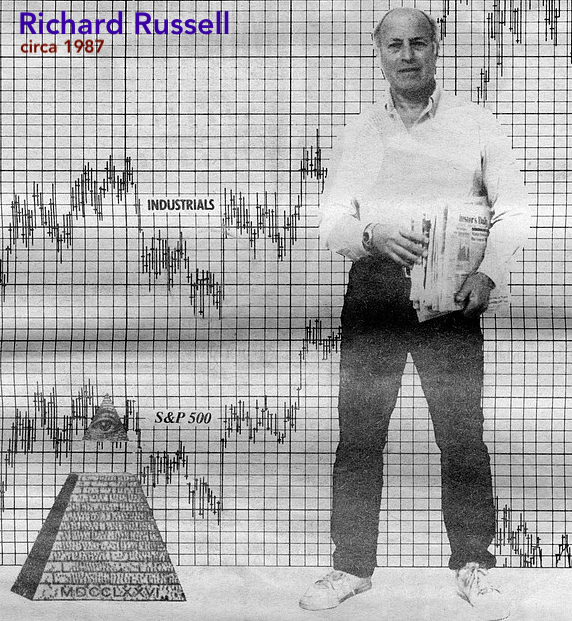
Friday's trading was jittery and had almost a random quality to it, with little conviction on the whole. Thus, the Dow remains the one major index that hasn't made a new high. It continues to trade below the December 4, 2024 close of 45,014.04. Along with that, the Dow Jones Transportation Average confirms the bearish primary trend according to Dow Theory, an art of market understanding that has become nearly extinct since the passing of its last great promoter, Richard Russell (July 22, 1924 – November 21, 2015), publisher of the Dow Theory Letter from 1952 until just before his passing.

One of the greatest and easiest derivations from Dow Theory is its natural ability to capture primary trends in a macro sense. While the components of the Dow Industrials change on irregular intervals, the addition of new components and deletion of others normally can be considered a function of keeping the index a reasonable reflection of American big business with a subtle leaning toward better-performing companies. After all, since the entire structure of Wall Street and stock markets is to sell shares of companies to everybody and anybody with money, it makes perfect sense that the averages and indices would purposely reflect the market as a place to improve and enhance one's wealth.

Given that the Dow Industrials and Transports are - like just about everything else - manipulated by large money managers, banking interests, large funds, and the government to some degree, the fact that both of the averages have NOT escaped from bear market conditions offers an inkling of suspicion as to the overall bullishness of the other indices. It may be nothing at all, or it could be important. At the very least, all-time highs on the more speculative indices - NASDAQ and S&P large caps - while old man Dow Jones hasn't reached in eight months should give one pause and some insight before rushing in to buy stocks. An interesting retrospective on Russell is provided via the San Diego Reader archives.

Adding to the fear factor should be consideration of the Shiller PE, or CAPE, which stands at 38.84, second-highest ever. Whether traders take cues from market indicators or continue with the bubble "greater fool" theory of 21st-century investing is more a matter of media narratives and current sentiment than anything representing discipline and proper risk assessments. The U.S. markets are clearly overheated, but so is the money supply, and it has to go somewhere.

Topping? Probably not, especially if Monday's White House meeting leans towards a positive resolution in Ukraine.

Since April's tariff pause, NASDAQ has had 13 of 19 weeks to the upside; 12 of 19 for the S&P, both indices soaring above their respective 50-day moving averages since the beginning of May.

Stocks reporting this week will feature second quarter earnings mainly of major retail outfits, including:

Monday (before open) Bitdeer (BTDR); (after close) Palo Alto Networks (PANW), Blink (BLNK)

Tuesday (before open) Medtronic (MDT), Viking Cruise Lines (VIK), Home Depot (HD); (after close) Toll Brothers (TOL), Lazyboy (LZB)

Wednesday (before open) Estee Lauder (EL), TJX Holdings (TJX), Analog Devices (ADI), Target (TGT), Baidu (BIDU); (after close) Coty (COTY), Nordson (NDSN)

Thursday (before open) Walmart (WMT), Hovnanian Enterprises (HOV); (after close) Ross Stores (ROST), Inutit (INTU), Workday (WDAY)

Friday (before open) BJ's Wholesale (BJ).

The economic data calendar will be fairly light, starting with Tuesday's Building Permits and Housing Starts for July. Thursday brings forth unemployment claims, weekly energy data from the EIA, and the economic reading of the Philly Fed.

Friday's keynote address by Fed Chairman Jerome Powell at the annual Jackson Hole Economic Conference will be closely watched for indications on the Fed's outlook concerning inflation, employment, and interest rates. The promise of three rate cuts this year are more than likely to come up short, given that there are only three more FOMC meeting scheduled (September, November, December) and inflation continues stubbornly intractable.


Treasury Yield Curve Rates

Date 1 Mo 1.5 mo 2 Mo 3 Mo 4 Mo 6 Mo 1 Yr
07/11/2025 4.37 4.39 4.47 4.41 4.42 4.31 4.09
07/18/2025 4.35 4.39 4.46 4.40 4.42 4.30 4.08
07/25/2025 4.37 4.46 4.46 4.42 4.42 4.31 4.09
08/01/2025 4.49 4.46 4.44 4.35 4.30 4.16 3.87
08/08/2025 4.48 4.43 4.39 4.32 4.27 4.15 3.93
08/15/2025 4.48 4.42 4.35 4.30 4.22 4.12 3.93

Date 2 Yr 3 Yr 5 Yr 7 Yr 10 Yr 20 Yr 30 Yr
07/11/2025 3.90 3.86 3.99 4.19 4.43 4.96 4.96
07/18/2025 3.88 3.84 3.96 4.18 4.44 4.99 5.00
07/25/2025 3.91 3.86 3.95 4.15 4.40 4.92 4.92
08/01/2025 3.69 3.67 3.77 3.97 4.23 4.79 4.81
08/08/2025 3.76 3.70 3.84 4.03 4.27 4.84 4.85
08/15/2025 3.75 3.73 3.85 4.07 4.33 4.91 4.92

Treasury yields didn't move much over the course of the week, and the curve remains inverted from 30-day bills out to 10-year notes with the bottom at the 3-year (3.73%). From the 3-year note out to the 30-year bond, the curve steepens in normal fashion, though it's still rather alarming that it costs more to borrow for one month than it does for 10 years, the result of persistent high inflation. The Fed is reluctant to lower the base federal funds target rate out of fear that it woould lose what little control it exerts against inflationary forces in the first place.

Of course, if the Fed just stopped increasing the money supply, inflation would cease almost immediately, but that might cause a slowdown, otherwise known as a recession, and this Fed just can't have that, so they remain stuck in policy no-man's land. The people suggesting that the Fed will cut interest rates 25 or even 50 basis points at the September FOMC meeting (9/16-17) are apparently oblivious to the inflation data from the past week, with CPI remaining elevated and PPI coming in red hot.

The biggest moves in the treasury market came at the end of the curve, with 10-year notes up five basis points and 20 and 30-year bonds up seven. Demand for the longest maturities is waning, with buyers demanding more for their money. Once the tariff inflation hits - which could manifest anywhere from two months to six months out - expect the 30-year bond to scream past five percent and remain elevated.

Spreads:

2s-10s
9/15/2023: -69
9/22/2023: -66
9/29/2023: -44
10/06/2023: -30
10/13/2023: -41
10/20/2023: -14
10/27/2023: -15
11/03/2023: -26
11/10/2023: -43
11/17/2023: -44
11/24/2023: -45
12/01/2023: -34
12/08/2023: -48
12/15/2023: -53
12/22/2023: -41
12/29/2023: -35
1/5/2024: -35
1/12/2024: -18
1/19/2024: -24
1/26/2024: -19
2/2/2024: -33
2/9: -31
2/16: -34
2/23: -41
3/1: -35
3/8: -39
3/15: -41
3/22: -37
3/28: -39
4/5: -34
4/12: -38
4/19: -35
4/26: -29
5/3: -31
5/10: -37
5/17: -39
5/24: -47
5/31: -38
6/7: -44
6/14: -47
6/21: -45
6/28: -35
7/5: -32
7/12: -27
7/19: -24
7/26: -16
8/2: -08
8/9: -11
8/16: -17
8/23: -09
8/30: 00
9/6: +06
9/13: +09
9/20: +18
9/27: +20
10/4: +5
10/11: +13
10/18: +13
10/25: +14
11/1: +16
11/8: +5
11/15: +12
11/22: +4
11/29: +5
12/6: +5
12/13: +15
12/20: +22
12/27: +31
1/3: +32
1/10: +37
1/17: +34
1/24: +36
1/31: +36
2/7: +20
2/14: +21
2/21: +23
2/28: +25
3/7: +33
3/14: +29
3/21: +31
3/28: +38
4/4: +33
4/11: +52
4/17: +53
4/25: +55
5/2: +50
5/9: +49
5/16: +45
5/23: +51
5/30: +52
6/6: +48
6/13: +45
6/20: +48
6/27: +56
7/3: +47
7/11: +53
7/18: +56
7/25: +49
8/1: +54
8/8: +51
8/15: +58

Full Spectrum (30-days - 30-years)
9/15/2023: -109
9/22/2023: -99
9/29/2023: -82
10/06/2023: -64
10/13/2023: -82
10/20/2023: -47
10/27/2023: -54
11/03/2023: -76
11/10/2023: -80
11/17/2023: -93
11/24/2023: -95
12/01/2023: -105
12/08/2023: -123
12/15/2023: -154
12/22/2023: -149
12/29/2023: -157
1/5/2024: -133
1/12/2024: -135
1/19/2024: -118
1/26/2024: -116
2/2/2024: -127
2/9: -117
2/16: -103
2/23: -112
3/1: -121
3/8: -125
3/15: -109
3/22: -112
3/28: -115
4/5: -93
4/12: -87
4/19: -77
4/26: -70
5/3: -85
5/10: -87
5/17: -94
5/24: -99
5/31: -83
6/7: -92
6/14: -113
6/21: -103
6/28: -96
7/5: -101
7/12: -108
7/19: -103
7/26: -104
8/2: -143
8/9: -131
8/16: -138
8/23: -141
8/30: -121
9/6: -125
9/13: -117
9/20: -80
9/27: -80
10/4: -75
10/11: -58
10/18: -54
10/25: -38
11/1: -18
11/8: -23
11/15: -10
11/22: -12
11/29: -40
12/6: -23
12/13: +18
12/20: +29
12/27: +38
1/3: +38
1/10: +54
1/17: +41
1/24: +40
1/31: +36
2/7: +32
2/14: +32
2/21: +31
2/28: +13
3/7: +24
3/14: +25
3/21: +23
3/28: +26
4/4: +5
4/11: +38
4/17: +44
4/25: +40
5/2: +41
5/9: +46
5/16: +52
5/23: +68
5/30: +59
6/6: +69
6/13: +67
6/20: +69
6/27: +66
7/3: +51
7/11: +59
7/18: +65
7/25: +55
8/1: +32
8/8: +37
8/15: +44


Oil/Gas

WTI crude oil closed out the week near the lows, at $62.29, a drop of $1.06 from last week's close at $63.35 and off $4.97 from the close on June 1 of $67.26. Crude has hovered between correction and bear market since the January 15 peak of $78.71, currently down 20.86%, and seeking lower levels.

Crude's decline was tied primarily to a heavily-publicized meeting between America's President Trump and Russian President Vladimir Putin, which took place on Friday, the 15th, in Anchorage, Alaska, the idea being that if relations between the U.S. and Russia are normalized, the price of oil is going to bottom out around $55-62 per barrel, given fewer sanctions and open trade routes.

Oil's price decline may prove a boon to economies, especially those of Europe, given the outcome of the top-level discussions were positive. How the EU dimwits respond on Monday will play a huge role.

Gas prices have leveled off over the past month and remain near the low end. Gasbuddy.com reports the national average for a gallon of unleaded regular gas at the pump at $3.12, the same as last week.

Since gas prices aren't moving, state-by-state numbers are a waste of time. Suffice it to say that California remains at the top, at $4.48 per gallon, with Washington a close second, $4.39. In the Northeast, New Hampsire is lowest ($2.98), Pennsylvania, highest ($3.21).

Illinois is the standout in the Midwest, at $3.40 a gallon, while Kansas ($2.82) is the lowest.

All of the South, except Florida, from North Carolina to New Mexico, is sub-$3.00, with Mississippi the lowest in the country, at $2.67. The Sunshine State checked in at $3.06 Sunday morning.

Sub-$3.00 gas can be found in 22 states, one more than the prior week.


Bitcoin

This week: $118,309.30
Last week: $118,483.10
2 weeks ago: $113,838.20
6 months ago: $96,096.47
One year ago: $58,708.96
Five years ago: $11,676.19

Crypto is little more than slave money for the 21st century. Repackaged fiat in flashy technology, none of it has any intrinsic value of any kind. It cannot be seen, touched, mined, melted, torn, or altered in any physical manner. Crypto, and bitcoin in particular, is fully a figment of global imagination, hoarded by whales, who own 90% or more of the vacuous creations.


Precious Metals

Gold:Silver Ratio: 88.95; last week: 89.80

Per COMEX continuous contracts:

Gold price 7/18: $3,355.50
Gold price 7/25: $3,338.50
Gold price 8/1: $3,416.00
Gold price 8/8: $3,458.20
Gold price 8/15: $3,381.70

Silver price 7/18: $38.42
Silver price 7/25: $38.33
Silver price 8/1: $37.10
Silver price 8/8: $38.51
Silver price 8/15: $38.02

A serious effort was made this week by the usual suspects at the COMEX and LBMA, with extraordinary assistance from the Trump administration's tariff team of the U.S. Customs and Border Protection, to keep the price of gold from advancing toward the inevitable $3,500 level. Last Friday, June 8, a not-so-subtle announcement was made that 1 kilogram and 1000-ounce gold bars would face tariffs of up to 39%, the country-specific rate for Switzerland, where 30-40% of gold bars worldwide are refined.

After futures rocketed to record levels above $3,500, the administration issued a hasty statement, offering "clarification" in days ahead. On Monday, August 11, President Trump posted on Truth Social, "Gold will not be tariffed." There was not further commentary. It was enough to calm markets, though a social media post doesn't exactly cut it as clarification or official notice. In any case, futures fell, some insiders allegedly made a few million, and the gold price stabilized back into its recent range between $3,300 and $3,400. This week's drop is probably nothing to be concerned about, given everybody knows the price of gold is going to increase as long as the U.S. government continues running huge deficits and inflation remains above the Fed's target of two percent.

Silver took a bit of a hit, though it also wasn't severe. These prices cannot be held down indefinitely. The global economy is being stretched to the point of no return and purchasing power in dollars, euros, yen, and pounds is rapidly declining. Precious metals are one of the few alternatives for wealth preservation during these turbulent times.

Sunday's survey of prices paid on eBay revealed the true nature of separation from the physical and paper markets, especially as it concerns silver. While the COMEX, LBMA, PPT, and any other actors working to suppress silver's price may be perfectly content to keep the contracts for 1000-troy-ounce bars settled in fiat around $38.00 per ounce, it makes perfect sense that smaller denominations for physical delivery, especially down to one-ounce increments, would price consistently higher. Money Daily's benchmark price rose to $46.08 this week, an all-time high.

Records which date back to January, 2021, employing a methodology that has not varied since inception, cannot be false and have consistently provided reliable price points for smaller, incremental, finished silver. While the difference between COMEX futures prices and physical sale prices is great, that variable has been consistent over time in consideration of labor, processing, and material employed in breaking down larger denominations into smaller ones, stamping, polishing, and delivery of finished products. The price also reflects the 13.6% fees charged by eBay on the total purchase. While it can reasonably be assumed that online dealers of size might receive better treatment in terms of fee structure, the exact terms are difficult to discern. The fee discounts probably amount to one to three percent.

Since free shipping is always one of the filters employed in determination of the SOSMPB, final prices paid on eBay sales represents true, delivered prices, without exception.

What this means for buyers and sellers in one of the world's largest open marketplaces for bullion (that being the eBay platform) is that the deviation and so-called "premium" on smaller denominations is reasonable, considering all variables. Anybody, from the collector looking to reduce his or her stack to the larger dealers such as Scottsdale, JM Bullion, Aydin, Liberty, Pinehurst, and many others, should expect sale prices roughly in line with Money Daily's SOSMPB, implying a premium of 20 percent or more, which is wholly in agreement with the processes, labor, and material costs outlined above.

Silver, although widely considered to be undervalued in many contexts and demonetized by central banking operations dating back at least 150 years, is still regarded by advocates as money and a perfectly rational store of value. The consistency of Money Daily's SOSMPB provides the proof and can be considered the North American standard for market pricing of one-troy-ounce finished silver. Gold prices, using the same metrics are also accurate and reliable, with physical prices consistently adding premia to COMEX-derived future paper prices. In the end, it's finished, delivered, physical goods that should project proper pricing. COMEX futures prices and LBMA daily fixes being nothing more than a guideline for bullion banks, central banks, and fiat-centric manipulators.

Here are the most recent prices for common one ounce gold and silver items sold on eBay (numismatics excluded, free shipping):

Item/Price Low High Average Median
1 oz silver coin: 41.94 49.95 45.30 44.99
1 oz silver bar: 39.80 49.99 46.78 47.25
1 oz gold coin: 3,396.20 3,586.80 3,503.58 3,489.00
1 oz gold bar: 3,481.21 3,562.25 3,503.50 3,495.00

The Single Ounce Silver Market Price Benchmark (SOSMPB) rose sharply through week, to $46.08, a gain of $1.35 from the August 10 price of $44.73 per troy ounce.


WEEKEND WRAP

Monday's meeting at the White House should provide some degree of understanding of how politics shapes the world going forward. Either the EU and Ukraine accept facts on the ground that Russia is winning massively or they fall back to their usual chants of "saving democracy" even though none exists in the blown-apart country. Since Putin and Trump appear to be the only sensible leaders concerned with ending the conflict, it's likely that the EU leadership will acquiesce to the Russian and American outlines for peace.

Details can be tricky and may contain some potholes and opportunity for the EU to sabotage the well-meaning of the Alaska summitt, though they realistically cannot prolong the war without substantial U.S. support. If Trump is at all serious, he will inform his European "partners" that the U.S. is out and a joint force of NATO and Russian observers and advisors will provide security guarantees of what remains of the rump country of Ukraine.

Otherwise, the status quo of stupidity and recalcitrance will remain, an outcome nobody outside of the EU-neocon-MIC junta will tolerate for much longer.

To say that the fate of the world hangs in the balance of Monday's White House conference may be putting it lightly. Those who want war will get their just deserts. Those seeking peace, as always, will have to guard their flanks.

At the Close, Friday, August 15, 2025:
Dow: 44,946.12, +34.86 (+0.08%)
NASDAQ: 21,622.98, -87.69 (-0.40%)
S&P 500: 6,449.80, -18.74 (-0.29%)
NYSE Composite: 20,802.68, -5.74 (-0.03%)

For the Week:
Dow: +770.51 (+1.74%)
NASDAQ: +172.96 (+0.81%)
S&P 500: +60.35 (+0.94%)
NYSE Composite: +278.44 (+1.36%)
Dow Transports: +321.71 (+2.10%)


Disclaimer: Information disseminated on this site should not be construed as investment advice. Downtown Magazine Inc., Money Daily and it's owners, affiliates and/or employees are not investment advisors and do not offer specific investment advice. All investments have risk. You should consult a professional investment advisor or stock broker or use your individual judgement when making investment decisions. By viewing this site, you hold harmless Downtown Magazine Inc., Money Daily, its owners, affiliates and employees against any and all liability. Copyright 2025, Downtown Magazine Inc., all rights reserved.